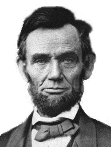
Lincoln's Choice
A Novel
by Roger Seiler
It also inter-weaves the stories of Robert E. Lee, Ulysses S. Grant,
Jefferson Davis, George McClellan, Charles Sumner, Stephen Douglas, Mary Todd Lincoln
and others into a powerful drama leading up to and including the American Civil War.
Copyright © 2001-2002 Roger W. Seiler, Nyack, NY All rights reserved.
WGA Registration # 870672
Contact: (845) 358-0406 (at Leadership Software Corp.) e: info@leadersoft.com
Table of Contents
(Click on the underlined text at left to go to the chapter or other section.)
PRF. Preface
SYN. Synopsis
CHAPTER I. New Orleans (return to top)
Chap. 2-26 PRF. Special Preface To Abridged Chapters 2 - 26
CHAPTER II. The Farm Boy
CHAPTER III. On His Own
CHAPTER IV. Military Men (return to top)
CHAPTER V. Ambitions Joined
CHAPTER VI. War With Mexico
CHAPTER VII. The Auction Of Eliza - "Only 1/64th African!"
CHAPTER VIII. Bleeding Kansas (return to top)
CHAPTER IX. Great Debates
CHAPTER X. Secession
CHAPTER XI. "In your hands...and not in mine..."
CHAPTER XII. April Thunder (return to top)
CHAPTER XIII. Little Napoleon Takes Command
CHAPTER XIV. New Sorrow And The Perfectionist
CHAPTER XV. Whither Slavery
CHAPTER XVI. Antietam And Emancipation (return to top)
CHAPTER XVII. A Place Worse Than Hell
CHAPTER XVIII. Proclamation And Discontent
CHAPTER XIX. Losing The Victory
CHAPTER XX. Gettysburg Under God (return to top)
CHAPTER XXI. Grant Takes Command
CHAPTER XXII. The Guns Of Reelection
CHAPTER XXIII. Preparing For A New Birth Of Freedom
CHAPTER XXIV. "With malice toward none.." (return to top)
CHAPTER XXV. Good Friday
CHAPTER XXVI. Epilog...
SCR. Screenplay
BIB. Bibliography
(return to table of contents)
Preface
From time to time, America faces great challenges. Certainly none was greater than the Civil War and the political and social convulsions of that time. As we face the challenges of our own time, I looked back to how the people of that earlier age dealt with theirs, and found relevant insights to be gained. The most compelling figure of that era, of course, was Abraham Lincoln. He made the critical choices that ultimately set the course of the nation then, and surprisingly, now.
As I studied that time and his role in it, I began to wonder, what was it like to be Abraham Lincoln, and to face the choices that he encountered at the crossroads of history? But which Lincoln - the commander in chief, the compassionate moral philosopher, the clever politician, the self-taught country lawyer, the young frontiersman, the humorous story teller, or the introspective fighter of the demons of personal depression? These different aspects, of course, were all interwoven threads of one persona that came into play in every decision he made - including decisions that still profoundly affect our lives today. Did he make the right choices for us?
Most other writings about Lincoln cover the period after the 1858 Lincoln-Douglas debates had introduced him to the country as a political player of national scope. But by that time, the ethos of the man was already made. Just how he came from such humble beginnings and developed into the man who could be president, and how a few other men and women developed in parallel lives until they joined him on the stage of history and their stories became intertwined, is a fascinating tale.
But why tell the Lincoln story as a novel instead of a strictly documented biography? There are many gaps in the historical record of Lincoln's life, especially regarding conversations between Lincoln and others at key moments in his life. Any attempt to interpolate in order to fill-in the gaps - to draw lines between the dots of documented events and quotations - is necessarily fictional. But it is in these areas of missing information that some of the most revealing episodes and dialog would have occurred. An intriguing example is what did the teenage Lincoln see in slave-trading New Orleans? What did he think about it, and how did it affect his values and later actions? Even during his presidency there are important lapses in the historical record that invite interpolation based on what is known. Lincoln's Choice relies heavily on the documented Lincoln in order to present plausible events and dialog in the gaps, thereby seeking to offer a fuller picture of the man, his perspective and his impact on history.
- Roger Seiler
(return to table of contents)
Synopsis
Nineteen year-old Abe Lincoln takes a flatboat to New Orleans. There, he sees a slave auction where a young family is torn apart. The slave family's father is twenty-two year-old Big Henry, who tries to escape over a fence near Lincoln. Big Henry and Lincoln make eye contact as the slave is recaptured, whipped and sold. Lincoln is horrified by what he sees, which plants a fateful moral seed within his conscience. He heads back to his family's Indiana farm, earning passage home as a crew member on a river steamboat. On the trip, he recalls his growing-up years on his father's farm, especially his stepmother Sally's encouragement of his reading, self-improvement, and religious faith, plus her 3 rules for living that became his compass. He remembers a giant oak tree on a hill that became a symbol in his mind of his naturalistic concept of God. At various times of personal crisis, he would visit the giant oak and talk to it as if it represented what he called, "the great silent one."
At twenty-one, Lincoln leaves home and becomes a store clerk in New Salem, Illinois. One day, while walking along a country road to return a few cents overpayment to a customer, he encounters a farmer's family traveling by wagon from Kentucky through Illinois to Missouri with four slaves tied in a line behind the wagon. Lincoln and one of the slaves - Big Henry - silently recognize each other. Seeing Big Henry again causes Lincoln to ponder anew the fate of slaves.
While serving in the state militia as a captain during the Black Hawk War, Lincoln saves the life of an old Indian, who repays Lincoln by giving him a prophetic Indian name that means, "Right Makes Might" - which much later is a theme of his crucial Cooper Union speech. The militia commanders court-martial Lincoln for incompetence. He is found guilty and sentenced to wear a wooden sword for two days [actually happened!]. He is elected to the Illinois Legislature, marries Mary Todd, starts a family, and endures mysterious bouts of depression. Meanwhile, we see vignettes from the parallel lives of Robert E. Lee, Ulysses S. Grant, and Jefferson Davis. Lincoln is elected to one term in Congress, then his political career is sidelined when he returns to Illinois and focuses on building his law practice. In a border town courthouse, he again sees Big Henry - as an escaped fugitive being returned in chains to his master. This encounter, just as word arrives that the Missouri Compromise has been repealed (which had prevented slavery north of Missouri), provides a catalyst that sparks Lincoln to reactivate his political career in order to fight against the extension of slavery.
The Lincoln-Douglas debates of 1858 cause Lincoln's star to rise as a presidential candidate, while Senator Jefferson Davis visits northern states and becomes an eloquent spokesman for the South. Lincoln is elected president in 1860, and shortly afterward, Southern states start seceding. Davis becomes president of the Confederacy as Lincoln takes office in Washington. Lincoln is besieged by office-seekers and contends with head-strong cabinet members - Seward and Chase - who think they are better qualified to be president than Lincoln. The Fort Sumter crisis quickly faces Lincoln with a fateful choice: hold the fort to assert the Union and risk civil war, or give up the fort and allow disintegration of the world's greatest democracy. He makes his choice, and Davis orders the Confederate attack on Ft. Sumter that starts the Civil War. Lincoln offers command of the Union armies to U.S. Army Colonel Robert E. Lee, who instead resigns and joins the Confederate Army.
A first major battle at Bull Run is a Union disaster, starting Lincoln on a long quest to find the right general to lead the Union forces to victory. Gen. McClellan, an able organizer, trainer and motivator of troops, frustrates Lincoln's desire for a quick march on Richmond and an early end to the war. Meanwhile, Grant starts to build a reputation as a winning general in the western theater of the war, and the Lincolns suffer a devastating personal loss in the death of their young son Willie. Lincoln tells priorities to Horace Greeley: 1) save the Union; 2) free the slaves only if it helps #1.
After a Union victory at Antietam, Lincoln issues the Preliminary Emancipation Proclamation in order to prevent European recognition of the Confederacy. Meanwhile, the President develops a management philosophy with a preference for "smart" and aggressive generals rather than "bright" and cautious generals like McClellan. This "smart" vs. "bright" distinction puzzles Secretary of War Stanton and General In Chief Halleck. Unfortunately, McClellan's replacement, Burnside, proves to be neither "smart" or "bright" with a disastrous defeat at Fredericksburg, which throws Lincoln's state of mind into what he calls, "a place worse than hell." The final Emancipation Proclamation is issued on 1/1/1863; political intrigue by some abolitionist senators and Treasury Secretary Chase is outfoxed and squashed by Lincoln; Big Henry escapes his master and joins the Union Army.
The Union victory at Gettysburg is seen by Lincoln as another victory wasted because Meade fails to follow up with a quick pursuit of Lee's army to destroy it while it is weak. Grant wins the siege of Vicksburg, and the entire Mississippi River is in Union control, splitting the Confederacy. Frederick Douglass persuades Lincoln to abandon his Negro Colonization idea and back equal pay for black soldiers. After Lincoln's Gettysburg Address - in which he inserted the words "under God" as he spoke - he confides to a friend that he thinks God is using the war to punish the country for 250 years of slavery. He says he prays for guidance, but hears nothing in response. He feels abandoned by God amidst the horrors of his responsibilities and hopes that someday God will speak to him.
Grant's western victories earn him promotion to overall command of the Union Armies in March of 1864, and he takes the offensive in Virginia. Lincoln, Grant and Sherman become a strategic team. In the summer of '64, mounting casualties and an apparent stalemate make Lincoln's reelection doubtful. Then Sherman's victory at Atlanta turns public opinion back toward Lincoln, and he defeats the Democrat McClellan in November's presidential election. Sherman's "march to the sea" destroys the breadbasket for Lee's army. Lincoln pushes Congress to pass the 13th Amendment to forbid slavery. The fall of Petersburg, VA precipitates Lee's surrender to Grant on April 9, 1865.
The next evening, at a celebratory White House reception, many African Americans join the receiving line to thank the President for their freedom. Among them is Big Henry, who speaks to Lincoln for the first time. Lincoln interprets Big Henry's words as the divine message he has hungered for, delivered through the former slave. Those words vindicate the direction Lincoln has chosen for the nation. The President speaks in favor of black voting rights, inciting Booth, and a few days later, Lincoln is assassinated. In Illinois, Lincoln's stepbrother visits the giant oak on the hillside, and finds that in the midst of the spring blossoms of surrounding foliage, the great tree is leafless.
Epilog... Washington, D.C., April, 2002. Dr. Henry Edwards, Director of the U.S. Park Service, Capitol District, is a descendant of Big Henry. He has to choose an assistant director to be in charge of all of the monuments at the west end of the Mall, including the Washington Monument, the Reflecting Pool and the Jefferson and Lincoln Memorials - monuments referred to as "the soul of the nation." He is about to interview the third and final candidate, a brilliant young climber in the Park Service management, Dr. Vareena Davis, a descendant of Jefferson Davis. Edwards is intrigued by the irony of the interview. Davis ignores the irony - she just wants the job, based on her qualifications. In the course of the interview, performed like a defense of a doctoral thesis in the midst of the monuments, Davis explains what the monuments represent, and then acknowledges the long shadow Lincoln has cast through history by the choice he made to preserve the Union.
(return to table of contents)
Chapter 1: New Orleans.
March, 1828.
"A man makes his own way," nineteen year-old Abe Lincoln thought, as he stood at the tiller on the flatboat's stern. He couldn't remember where he'd read that - perhaps somewhere in last winter's pile of books. Maybe he hadn't read it at all, but he sure believed it. Far from home for over two weeks now, he was getting used to being his own man. He wished it wasn't temporary. He said to Allen Gentry, working the long oars up front, "Allen, what are ya gonna do when ya turn twenty-one?"
"Ain't got nowhere to go. I'll just stay with Pa on the farm. It'll be mine some day," Allen answered, as he pushed the oars forward in a smooth long stroke.
Abe yelled over the chugging noise of a Mississippi River steamboat heading upriver, "Your pa's got good land, don't he."
"Yup. Prime."
Abe knew that when he himself turned twenty-one, he'd leave his family's Indiana farm. It wasn't prime land, and he and his father didn't get along. They thought about different things. Thomas Lincoln never pondered about anything he couldn't see in front of his nose, and mostly what he saw was land to be cleared, fields to be tilled, seed to sow, weeds to pull, crops to harvest, and mouths to feed. To Abe it was a dreary routine that had given his father a disposition as sour as week old milk. And his father had little patience for Abe's habit of reading whenever he could. Now and then, Father would catch him at it and invent a chore just to make Abe put the book down. The world of ideas was what excited Abe, not the world of the dirt-kicking farmer. But how could he make his way in that other world?
"What're you gonna do, Abe?" asked Allen.
"Not gonna be a farmer."
"Yeah? What else, then?"
Abe wouldn't tell what he'd been mulling over - signing on as a sailor on a European ship after they reached New Orleans. Busting loose from the farm into a new world of far off adventures and greater meaning, was as deep a want in him as that other glowing itch that drives young men. From across the seas, Hercules, Alexander and Plato beckoned. Every day he dreamt of ways to exploit this trip to escape going back. Oh, he would return someday, when he had great deeds of daring - tales of death defied and devils conquered - to lay before his family. But right now, such thoughts were locked inside his secret mind, not to be shared. He answered, "Maybe I'll be a blacksmith in town. Lotsa people need what they do. They can make good money. And if it gets slack, you just pick up your tools and go to the next town."
"Whatta you know 'bout bein' a blacksmith?"
"I watched em. I read about it. They make things, you know."
"Yeah, I seen em. You wanna make brandin' irons?"
Abe's mind had come back to the here and now. "Startin' ta get dark. We better pull in for the night up ahead. We can tie up to them bushes."
They tied on shore, fed their cargo of 8 hungry caged pigs, ate jerky and dried apples, laid out their bed rolls and went to sleep. Darkness settled over the two young men and the hours of night plodded by.
Abe was startled awake by the sound of men clambering aboard. As his eyelids popped open, he saw a moonlit arm lift a long glimmering knife blade above his chest, and in one swift motion he rolled away, grabbed a boat pole, leapt to his feet and swung the pole mightily into the torso of his attacker. The air erupted with the discord of raucous yelling and pig squealing, spiced by the smell of liquor from the hot throats of the attackers. With woodsmen's ax-built muscles, Abe and Allen wielded their poles with such skill that they rapidly knocked the would-be robbers overboard, cut ropes and pushed the boat well out from shore toward the channel.
Suddenly, there was silence, except for the sloshing of the river against the side of the boat and the two boatmen's heavy breathing. Abe had taken a nasty gash to his forehead. He felt surely lucky that he and Allen had been able to so quickly react and prevail with such dispatch.
"There were seven of 'em, Abe!" gasped Allen. "All niggers."
Abe noticed his knees rattling as his mind began to calm. It had been a deadly fright, to be sure. He wondered for a few moments what the attack meant. This was his first physical encounter with blacks. As a child in rural Kentucky, before the Lincolns moved to Indiana, he had occasionally looked across a field to the road and seen slaves there at a distance. They were tied together, walking in tow behind their master who was riding a horse. Until tonight, he hadn't been close enough to blacks to have a first-hand idea of what they were like. Who were these men? Were they fugitives? Were they just drunk? Or, as white fears often spoke, were they wild men answering the savage call of some faraway jungle? Were they even real people, or indeed some sub-species to be feared, mastered and used? As the red hot color of his thoughts quickly began to cool, Abe wondered if these were even the right questions. Considering what would happen to these men if they were caught, it occurred to Abe that his attackers had taken a great risk in trying to rob and kill whites. What had made them so desperate? He couldn't dwell on the mystery for long. Running on the river at night now demanded his full attention. Morning came soon, and they kept on going.
They were doing this job for Allen's father, who had hired Abe because of his flatboating experience on the Ohio. For nearly three weeks now, they had been floating and rowing their flatboat down the Ohio and Mississippi rivers to get Mr. Gentry's 30 barrels of salt pork and 8 live pigs to market. Working the big oars up front, Allen's sturdy round arm muscles rippled as he rowed. As the nose of their boat splashed through the wake of a passing steamer, Abe, at the tiller, stretched his tall lean frame to look ahead and yelled, "Just around that next bend, Allen, we oughta see New Orleans." He had heard that the first sight of the city would be a thrill. Then, beyond a stand of alder branches hanging over a bend of the river bank, there it was: New Orleans, about two miles ahead. Abe had never seen anything of such impressive scope. Its distant shore displayed a long line of gray wharves berthing scores of tall-masted ocean-going sailing ships and river steamboats. A broad skyline of warehouses, church steeples and smokestacks stood behind, proclaiming the city's importance. He was anxious to see it up close.
They poled their boat into the bustling port and tied up to a low pier for flatboats. The dock master came with directions to the livestock pens a few blocks inland. Abe and Allen started herding their pigs along the dock and roadway toward the stockyards. One of the smaller pigs quickly got away and ran toward an alley, with Abe in pursuit. Chasing it through the winding back way, past several merchant buildings and sail rigging shops, he finally ran it down in a small yard. The pig tried to squeeze through the bars of a 10 foot high iron fence along one side of the yard, but Abe dove down on his belly and grabbed it by the hind legs, hauling it back. He pulled a short rope out of his pocket and tied the pig's legs together. As its squealing stopped, Abe lay sprawled on the ground in high grass, holding the pig tight and catching his breath. A commotion drew his attention beyond the fence. He looked through its bars to witness something he'd heard of but never seen, a slave auction.
A large square dirt yard was completely surrounded by the high fence and by sheds used as holding pens for slaves. Abe could see two stage-like platforms in the yard about a hundred feet from where he lay with the pig. A group of Negroes in chains were being led up onto the platforms by a team of slave handlers. The males climbed the steps onto one auction stage, and a female with two young children, a boy and a girl, onto another. The little boy, who seemed about four and the girl who looked six, walked up the steps clinging to the skirt pleats of the young woman. The slave handlers were mostly a burly crew conveying not a sense of malice, but rather a sense of businesslike efficiency and overwhelming muscular power. They followed a routine, with the husky attitude of doing the thing by rote that they'd done a thousand times, like cowhands herding steers at roundup.
Abe saw the look of terror in the eyes of the black adults. The woman kept exchanging glances of desperate dread with one of the two men on the other platform. All the adult slaves appeared to be in their early twenties. Each was chained to a separate iron ring bolted to a sturdy railing along the back of the platform. Standing on the ground in front of the auction stages, but with their backs to Abe, stood a crowd of eight bidders, white men whom Abe assumed were plantation owners or their agents. The auctioneer, a suave and well suited gentlemen who might remind one of a fine whiskey importer, stepped up to a podium between the two auction stages, and started his pitch like a rhyme.
"Give me bids for the lot of 'em now. I'll hear fifteen hundred. Two strong males and a field working female. They'll pull in 20 bushels a day for you. Let me hear fifteen hundred now. No lot takers, then? Do I hear a lot bid now? No bids do I hear."
A bidder yelled, "Let me see this nigger on the left. Turn him round....make him jump."
The auctioneer called out, "We'll do the negress first. Twenty-two and fit to work aplenty. Let me hear 600 now."
Bidder: "Three fifty!"
"No stealing, sir! Let's hear 600!"
Another bidder, "Three seventy-five."
The auctioneer, exasperated: "I hear three seventy-five."
"Three ninety."
"You, sir?"
"Four-oh-five, no brats."
"I hear four-oh-five. So let me hear another, bring it up now. No more? Four-oh-five once, four- oh-five twice, and thrice I call it, four-oh-five. Sold to Mr. Bodine."
Bodine: "No brats."
Auctioneer, "Aye, no brats. Take em away."
A burly handler reached up and grabbed the little girl, swiftly pulling her away from the mother, who screamed in agony as one of the male slaves groaned and looked skyward, as if pleading to heaven. The little girl wailed as the handler carried her quickly to one of the sheds and threw her to another big man in a doorway, who hustled her inside. A smaller handler reached up to grab the little boy, who clutched his mother. The woman, tightly constricted by the chains, screamed again. The terrified child, torn away from his mother, yelled, "Mama! Mama! Papa! Papa!" Just a few feet from the platform, the boy managed to wriggle out of the handler's arms, and scrambled back up the steps toward his mother, yelling all the while, "Mama! Mama!" But just before he reached her, the large handler grabbed him, threw him over his big shoulder like a sack of grain and ran toward the shed as the boy stretched his arms toward his mother, desperately crying out, "Mama! Mama!" In an instant, the boy disappeared into the shed, his yells quickly muffled. Abe, still on the ground in the tall grass behind the iron fence, looked on with wide eyed horror, unnoticed by any of the participants.
The sobbing broken-hearted woman was led off, turning to look back at the man Abe thought must be her husband; who stretched around and looked toward her with wide pained eyes as he cried out her name, "Mayzie! Mayzie!" A handler yanked at the chain connected to her neck collar, and she tripped and fell.
"Get up, nigger," barked the handler, and as she got halfway up, he yanked again and she stumbled headlong out of sight.
"Now for the big nigger, Big Henry," said the auctioneer.
"Let me see his hands! let me see him jump!" yelled a bidder.
The auctioneer nodded to the tall muscular chief handler carrying a bullwhip, who jumped up on the platform with two assistants. They grabbed Big Henry, unchained his wrists and legs, and then thrust him forward. "Let 'em see your hands and jump up and down," said the chief handler.
Abe saw Big Henry take another furtive look over his shoulder in the direction that Mayzie had disappeared. Then Abe saw the black man notice that when the handlers had unclasped his wrists, they had carelessly released the neck chain from the holding ring on the railing. Immediately, Abe understood what must be going through Big Henry's mind as he looked forward and displayed his hands.
Suddenly, Abe saw Big Henry reach behind, grab the neck chain, and before the handlers could react, he leapt from the platform and dashed past the bidders straight for the fence behind which Abe lay. The handlers dove off the platform after him in headlong pursuit. With a flying leap, Big Henry jumped high onto the fence several feet to Abe's left. As he scrambled up, the big handler unleashed his bullwhip, landing it square onto Big Henry's back with a terrific "Thwack!" Lincoln felt a jolt in his gut. For Big Henry, the searing pain was paralyzing, and with a scream, he lost his grip and fell to the ground, where he was immediately set upon by the two assistant handlers. They kicked up a cloud of dust as they wrestled to grab his arms, while the chief handler seized the neck chain and sat on Big Henry's legs. Another handler ran up to join them, and he and the chief handler each grabbed a leg. Together, they lifted the gasping, pacified slave and began carrying him back to the platform.
Abe hadn't been seen by the handlers, but just as they began to carry the slave away, Big Henry saw Lincoln, and their eyes met. The agony and defiance in Big Henry's eyes - as big and luminous as lanterns in the night - were unforgettable. Their eyes stayed locked on each other as the defeated and hopeless man was silently carried away. Lincoln saw in those big pained eyes something unexpected - a glimmer of intelligence and a yearning to be his own man that connected to something inside himself. Big Henry was again chained to the platform, and the auction continued.
Lincoln rose to his knees, and the pig tied on the ground next to him snorted. Lincoln looked down at the trussed pig, looked over at the chained slaves across the way, and then looked down at the pig again, saying softly, "You, Mr. Pig, are an animal. But he is a man." Lincoln picked up the pig and carried it away, back through the alley and off to the stockyard.
He had never thought much about slavery or its consequences, but now having seen a family torn apart and sold like cattle, the experience echoed furiously in his consciousness. His sense of right and wrong was challenged in a way he had not expected, and he felt troubled. On that afternoon, something irreverseable had happened deep within him.
That night, Abe and Allen took beds at a dormitory for boatmen near the docks. It was a stormy night with thunderheads rolling by. They laid out their bedrolls on cots, and as they snuffed the lantern to go to sleep, Abe stared at the dark ceiling, with haunting thoughts. Nearby peals of thunder crashed through the night, and white lightning flashes occasionally surprised the darkness and lit Abe's face.
His eyes closed, and the scene replayed in his mind as the little boy was hauled away, arms outstretched, yelling "Mama! Mama!" He recalled the distant, hollow sobs of another boy crying, "Mama! Mama!" long ago at a small cabin in the backwoods of Indiana. He saw himself at age nine and his sister Sarah, two years older, sitting on a porch step, held by a neighbor comforting them. They were under a porch overhang just outside the front door during a thunderstorm, and through the open door of the cabin, he could see his mother Nancy Hanks Lincoln's still body lying in a rough-hewn wooden casket. Their father, Thomas Lincoln, put the lid on the casket, and began hammering in the nails.
He remembered the feeling. Somewhere inside, he wasn't sure where, he had burned and ached and felt utterly alone all at once. A great sorrow had taken hold of him like a giant blood sucker that seemed to draw the juice out every muscle, making him limp all over. His throat had swelled with a dull pain, and from that deep burning place, heavy cries came up in convulsions he couldn't stop, pushing out tears that matched the rainfall.
The neighbor said to the Lincoln children, "We know not why nor when the Lawd chooses to harvest a soul. But we know that soul be drawn to his bosom, to be foreva' cherished. Your mama has met her time of harvest, and she be with God now."
Harvested, like grains of wheat or ears of corn. Was God a great unseen farmer who made bread from our souls that He alone consumed? Abe remembered how he felt his world had suddenly become very cold and small, like a burned out piece of firewood, having lost all joy that could nourish his future. Again, he heard his younger self cry out, "Mama! Mama!" His father closed the door and continued hammering.
He saw how a few days later, as he knelt alone by his mother's grave on a sunlit afternoon, he had tenderly slid his hand over the mound of freshly shoveled earth, and said softly and sorrowfully, "Mama. Mama," as tears streaked his face. It was a sadness that would often visit him and pierce his inner depths.
A last flash of lightning and a roaring thunderclap jolted the teenage Abe out of his thoughts of mother loss. Then he quickly fell asleep as the storm rumbled off across the river.
They were paid for their cargo and sold the flatboat the next day. But Abe and Allen could be in no hurry to return home - the next steamboat for southern Indiana wouldn't leave for two weeks. Plenty of time to see New Orleans. Abe recalled his father warning him to be wary of the temptations of the city, "It'll try to snare ya, son."
"Allen, you ever been to a city before?" asked Abe, as they walked by the wharves and headed toward the center of the city.
"Nope. This is quite amazin' ain't it. I never knowed ships could be so big. Guess they gotta be, ta cross the ocean."
"Yup," agreed Abe. "There be big storms and big waves out there that can turn one of these ships over quick as a canoe in white rapids."
"Really?"
"Yup. Them sailors gotta be tough fellers to go out there and fight the big ocean," answered Abe. "A lotta of 'em never come back. They end up in Neptune's watery cave."
"What?"
"Neptune? Oh, he was the god of the sea to the ancient Romans."
"How you know that, Abe?"
"Read about it."
As they walked through the city, the country boys found a new amazement on nearly every block. They wanted to see it all, though Abe was inclined to observe rather than participate in the wildness of the city.
"Abe, you ever had yourself a woman?"
Abe glanced at Allen, then stared ahead and said nothing. One good thing he'd learned from his father was how to ignore questions he didn't want to answer.
"Well, I been thinkin' 'bout it," said Allen, "and I done made up my mind. I'm gonna get me one as quick as I can. How 'bout you?"
Abe looked again at Allen, a bit embarrassed, then looked ahead and answered, "Naw."
As they walked the city and saw the action of fancy women, smugglers, hired guns, high rolling gamblers and wealthy plantation owners, Abe concluded that the city's saucy reputation was well earned. He saw that New Orleans had an allure that could easily draw a man into its sticky web. Early that evening in a saloon near the waterfront, Allen found what he was looking for.
The next morning, Abe ate his grits and walked alone to the wharves. There, he saw a ship's mate standing by the gangplank of his sea-going bark, smoking a pipe. The huge hull with its bowsprit lunging into the air overhead was black with yellow trim. The mate was dwarfed by the big boat's towering masts and maze of rigging looming high overhead. A powerful enterprise lay resting there, waiting for its proper moment to take the wind again and ride on to places unseen and barely imagined. Could this be Abe's proper moment? He walked over and looked up at the rope ladders climbing to the sky. As he looked closely, he noticed frayed rungs and long scrapes and gashes near the foot of some masts. A deck house had one wall bent in, no doubt from the battering of heavy storms. Much of the yellow trim-paint was chipped and gone, leaving dark wooden scars. The deck, what he could see of it, was being worked by two gruff sailors coiling ropes, and had the look of a mean place. The weather-beaten mate looked like he had aged early.
"Whadaya want, kid?" asked the mate.
"Where's your boat headed?"
"Liverpool." He looked Abe over from head to foot, and added with a brownish grin missing two teeth, "Wanta come along?"
Abe began to wonder if perhaps the sailors were caught in a different web than the one he knew, but a web trap nonetheless. A seafaring career was quickly losing its romance in a muddy ditch of realities.
"Naw."
Abe decided to walk on and see more of the city's sights. As he began to walk away, he heard the mate chide, "Just as well. You're too damned tall. You'd get your fool head knocked off in a week."
He turned a corner, and there saw a store window displaying books. He stopped to look down at them through the glass, and saw a slogan printed on a cream colored card in front, "Books are knowledge, and knowledge is the true wealth of man. - Benjamin Franklin." Abe read the slogan, and said aloud, "Benjamin Franklin."
One of two middle-aged gentlemen coming out of the store overheard Abe, stopped, and with a kidding smile said, "Yes?"
Abe turned and looked at him with surprise. "You called?" said the finely dressed man in blue velvet and white silk, still smiling. "I am Benjamin Franklin French. You seem to be interested in books, young man."
"Yes, suh," replied Abe. "I read 'em whenever I can."
"I'm no relation to the Benjamin Franklin, just named after him. And what have you read lately?"
Abe noticed that the friendly Mr. French had a book under his arm, and the other business-like man, who smiled indulgently at Abe while peering at him over spectacles, was carrying two books. Abe answered, "Back home I borrowed a book of Shakespeare's plays and just finished 'Hamlet' before we got on the river."
"Ah, 'To be, or not to be, that is the question.' Speaking of which, who be you, son - what's your name, and where are you from?"
Why were these men interested in him, Abe wondered, a bit suspicious. "I'm Abraham Lincoln, suh, from Pigeon Creek, Indiana."
"Pleased to meet you, Mr. Lincoln. This is my friend, Abijah Fisk."
They seemed harmless enough, and there was no sign of any thug accomplices lurking around.
"How do you do sir," said Abe politely as he shook hands with both men.
"What brings you to New Orleans?" asked Fisk.
"My friend and I brought a flatboat down river to bring his father's hogs and salt pork to market. Now we're waitin' two weeks to catch a boat back to Indiana."
"What will you do while you're waiting, Mr. Lincoln?" asked Fisk.
"Well, lookin' in that window, I was thinkin' I sure wish't I could read a good book or two. It's awful hard to find good books where I live."
Fisk looked at French, who nodded, and then he looked back at Abe and said, "I can help you there. I have a fair sized library of books, and I'd be happy to let you come and read some."
Abe grinned and replied, "Suh, that's very kind of you. I'd be most obliged."
"Well then, Mr. Lincoln, come this afternoon to my house at the northwest corner of Customhouse and Bourbon Streets, give your name to my doorman, and he'll let you in and take you to my library."
"Thank you, suh. And thanks to you too, Mr. French." Then as the gentlemen turned to go on their way, Abe added, "And Mr. Fisk, if thar' be any little jobs you need done, I'd be happy to do 'em fer ya, in exchange fer bein' able to come and read your books."
"Thank you, Mr. Lincoln," said Fisk as he and French went on about their business.
That afternoon, Abe went to Fisk's house, a Creole Villa style mansion with enormous white columns, the biggest most elegant house he'd ever seen. The doorman, a tall formally dressed slave with a dignified manner, showed him to the library.
Abe was astonished at the size of the wood paneled room and its collection - maybe a thousand books, he thought at first. A quiet and thoughtful place, it seemed to him. Three old men sat at tables reading. A young brown-haired woman in a long green dress, a clerk, was on a ladder against a far wall putting a volume on a shelf. It slipped out of her hand and dropped to the floor. Abe quickly stepped over, picked up the book and handed it up to her. She glanced down at him pleasantly, said "Thank you," and looked back to her work. As he brought his hand down, he accidently brushed the green pleats of her satin dress, so that he quickly stepped back and turned away with fleeting embarassment.
Books in shelves lined all four walls. Red, green, blue, black and brown they were. And three rows of eight foot high book racks stood in the middle of the room. Abe began walking the aisles between the rows, reading the titles, and feeling like a gold prospector who had just found the mother lode. There were Euripides, Aeschylus and Homer. Shakespeare, of course, and then Marlowe. Yonder sat St. Augustine and Aristotle. Newton and Copernicus called from a high shelf. He reckoned now that the library must have over two thousand volumes.
A clamor and clanking outside caught his attention. Abe looked out a window and saw a dozen slaves in chains being led down the street, reminding him of the slave auction he'd seen. He shuddered deep inside as he remembered the bullwhip striking the back of the slave. He could easily empathize with one inequity slaves must resent - not being paid for the work that brought sweat to their brows. In farming country, sons were obliged to work for their fathers without pay until age 21. And anything earned elsewhere would also be forfeited to one's father. So Abe's pay for this trip would be paid to Thomas Lincoln. But Abe knew that when he turned 21, he would be free, whereas the slave was in bondage for life. He turned back to the book shelves.
Abe believed that books could lead him out of the poor life of subsistence farming. He knew they contained the knowledge and ideas of the greatest minds of all time. Within the leather covers of the right books, he could learn what he needed to make himself valuable. His stepmother had told him so. Right now, being with all these books excited Abe more than anything else New Orleans had to offer.
Which books would be the right ones to help him get ahead? Abe knew the gold was here. He wanted to read his way toward meaning and success in his life. But there were just two weeks to mine this ore for knowledge. Walking along one aisle, his eyes fell on The Theory & Practice of Surveying by Gibson. The title caught his interest - surveying, a job he might learn to do. His big rough hands grasped the volume from the shelf. Abe found a table, sat down, opened the book and began to read.
Suddenly, and for no apparent reason, his mind pictured Allen and his woman. Then he turned for a better look at the girl in the green dress.
(return to table of contents)
Special Preface To Abridged Chapters 2 - 26
The story of this historical novel, told from Lincoln's point of view, takes the reader through his encounters with dramatic events, powerful people and momentous choices throughout his life. The reader sees how he developed mentally, spiritually and emotionally until he arrived at the crucial moment where he alone had to choose for the nation whether or not to go to war to try to save the Union for future generations. We see how his unique state of mind at that moment was shaped by all that had gone before, and how that choice was intertwined with a myriad of other subsequent choices regarding slavery, military strategy, and his selection of generals. We see how his sharply honed political skills and brilliantly analytical mind, disguised by his disarming back-country manner and persistent sense of humor, enabled him to overcome daunting crisis after crisis, and direct his generals and the nation toward a successful conclusion of the war.
But beneath his handling of momentous national events, we see that Lincoln is often a tormented soul, facing bouts with depression brought on by the death of his young son Willie, his wife Mary's emotional instability, and his sense of divine abandonment in the face of the horrors of the war. Yet we see him persevere from the conviction that he is upholding a great cause.
Throughout this journey through Lincoln's life story, counterpoint vignettes are interwoven, showing significant moments in the developing lives of other men and women who will become important players with Lincoln in the powerful drama of the Civil War. This interweaving of contrapuntal themes creates a tapestry of ironies, personality conflicts and harmonies to enrich the reader's experience with the full power and drama of the Lincoln story.
Finally, in the epilog, we see the consequences of Lincoln's great choice, and his many other subsidiary choices - the United States of today with all of its accomplishments and its promise for ages and peoples yet to come. (A screenplay version of Lincoln's Choice can be seen by selecting it from the table of contents. The main story differences between the novel and screenplay are in the treatment of the first and last chapters, which in the film version are more cinematic.)
The following chapters' excerpts from the full text show the novel's treatment of several significant events in the life of Lincoln.
(return to table of contents)
Chapter 2: The Farm Boy
Abe and Allen return to Indiana by steamboat, after selling their cargo and flatboat in New Orleans. On the way back up river, various sights prompt Lincoln to recall important events of his childhood, especially regarding the warm and supportive relationship that developed between him and his stepmother, Sally Lincoln. This flashback starts when Lincoln was 10 and she first arrived with her own three children and met her two new Lincoln stepchildren...
The stepmother reached both arms out to Sarah and gave her a warm hug, and continued to smile, as she said, "We have the same name, Sarah, so I think we'll get along just fine. Young man, did your mother call you 'Abe' or 'Abraham'?"
"Abraham, ma'am," replied young Lincoln.
"Then I think that's what she would want me to call you."
In another reverie, the nineteen year old Lincoln on the steamboat recalls how Sally saw Abe's intelligence, and though she herself was illiterate, encouraged his reading and his intellectual curiosity...
...Then Sally said to Abe, "Abraham, can ya read?"
"I can, some. Been to school a few weeks last year. And I larned some cyphers too. I'd like to larn more."
"And ya shall. As soon as the teachah comes roun' these parts again, I want ya all to go larn. Especially readin' - it'll open the doors to the whole world to ya. When ya can read a book, ya're no longa bound in one place. Yar mind can go to a thousan' places, far off lands, see strange people, and larn new idees. When ya can read books, ya can larn to do anythin' ya want, so ya can become anythin' ya want. But most important, then ya can read the Bible, holiest of books," as she took out her Bible and put it in the center of the table. "Larn the Bible, boy, and ya larn what goodness is. Ya larn what God would have us do. Ya larn the keys to salvation."
"Can you read, ma'am?" asked young Lincoln.
She picked up the Bible and caressed it, then replied, "No, I can't. And I've missed so much because I can't. It pains me. I don't want you chillun to grow up and feel this pain. The pain of not knowin' and not bein' able to help it 'cause you can't read."
After a moment to let her words sink in, Sally Lincoln continued, "Do ya know what ya want to be, Abraham?"
"Hain't thought about it none, ma'am."
"Ya will. I think ya will. You'll wanna amount ta somethin'."...
After dinner, the boys climbed up to the loft and into their bedding. As they lay there, Dennis Hanks said to Abe, "No use wantin' to be anythin' else but a farmer, Abe. We never been nothin' but farmers. Never gonna be nothin' but farmers."
"Ya sure 'bout that, Dennis?" asked Abe.
"Yup. Don't get no idees 'bout amountin' ta somethin'. Yur neva gonna amount to anythin', whateva that means. Yur just gonna be anotha dirt kickin' farmer like the rest of us." Young Abe turned over and stared through a chink in the logs into the night beyond, thinking about what Dennis just said, decided he didn't like it and frowned. Then his face relaxed as he dropped off to sleep.
Sally was very religious, and she treasured her Bible though she couldn't read it. One evening, she gathered the children, as she often did, to teach them her values...
...by candlelight, Sally Lincoln sat with all the children around the table and put the Bible on the tabletop as a signal that it was time to discuss important things.
She then told them, "Children, ta be successful in this life, there are only three things you have ta do," as she counted them on her fingers, "Depend on God, Do the right thing, and Use your head. Rememba these three rules, and ya can accomplish anything."
John asked, "Use my head?"
Sally smiled at him, then reached over, grabbed the rim of John's floppy hat and shook his head affectionately as she said, "Yes dear, use yer head for somethin' else besides a hat rack!" ...
Abe recalls how his reading skills, mostly self-taught, increased quickly from his filling all his spare time with reading whatever books he could borrow. He often read in Sally's Bible, and began to puzzle over religious ideas, especially the concept of God....
A sunny morning followed in Abe's memory, and Sally Lincoln was in the vegetable garden about a hundred yards from the cabin, leaning down and pulling weeds. Twelve year old Abe walked over and sat on his knees next to her and said, "Mother, I've been readin' the Bible and I have a question."
"Yes?" she responded.
"It says God knows what we're all doin'. If that's true, then He must be everywhere. But then, why can't I see him? What is God, really?" he asked.
She stopped weeding and turned to look at him, pausing for a moment, and then said, "Oh, Abraham! The more you grow, the bigger your questions! Well... God is the greatest mystery there is. The preacher says the Bible tells us there is only one God, and describes him by what he's done - like creating the world. And I know it tells how he wants us to be good people and treat each other right and fair."
She paused for a moment and looked at Abe, who was listening intently. Then she looked across the field again and continued, "Some say He's a spirit that is everywhere - that He sees everything and knows everything. I can't imagine that. But I know there is something in the world that brings the seasons, that makes the sun come up every morning, that makes things grow, and that lets there be reasons for most things. I believe that something is God. And I believe we are important to him, that He loves us and watches over us, and that He helps us when it suits his purposes, whatever they may be. That's why He sent his son to show us the right way to live. Our job is to love God and to do his will, insofar as we can see it. That's what I believe."
Abe reached into the garden and started weeding as Sally watched. He glanced back at her, and she seemed to be wondering if there was anything else she should say. She was the only person he felt he could entrust with his inner questions and thoughts, the only one in the world that understood who he really was, and that encouraged him to extend the reach of his mind.
He also recalls one Sunday when the family attended their country church, sang the happy hymn, "All Things Bright And Beautiful," and then after church, he and stepbrother John went running into the woods...
...and as they came out onto a hilly meadow with a giant oak tree standing high against the sky, Abe stopped to look at the big tree and John stopped with him. The oak's branches had a flock of songbirds swinging to and fro in the wind against a bright blue sky with puffs of white clouds. Young Lincoln contemplated the majestic oak tree standing alone on the knoll in the middle of the meadow, surrounded by a forest of much smaller trees.
Young Abe said, "John, I'll bet that oak is the tallest tree in the county."
"Yup."
"I wonder why it's here, all by itself."
"Dunno."
"If it had eyes in its highest branches, it could see everything in the county...everyone in the county."
"Trees don't have eyes, Abe."
"I wonder if it can hear us?"
"Trees don't have ears."
"I wonder if it knows what we're thinking?"
"You think trees can think?"
"I don't know. Maybe not. But we can't be sure, can we? It stands here, so big and strong, with branches reaching out in every direction, like some great being that has seen everything, that knows everything. Everything that has been, and everything that's gonna be."
The giant oak was the biggest and most majestic living thing young Abe had ever seen. Standing as it did on the hill in that clearing in the middle of the woods, there was something grand and mysterious about it, as if a great spiritual presence emanated from it and oversaw all. In his young experience, it was the closest thing to the idea of God that he could imagine. Not that he thought it was God, but that somehow God made his presence known to Lincoln through the concept of a great and silent life in that awesome tree.
____________________________ The steamboat arrived at Lincoln's destination in southern Indiana, vigorously blowing its steam whistle and horn. Amidst the commotion of people debarking from the boat, and cargo being unloaded, Lincoln and Allen debarked across the gangway. Lincoln was met by Dennis Hanks and John Johnston, both grinning broadly, happy to see Abe again after so many weeks away. John spoke up first as he punched Abe playfully in the shoulder.
"How are you doin' Abe?"
"Fine, John, fine. How are you? How is everybody?" he asked, half afraid of the answer.
"Everybody's fine."
Then Dennis asked, "Well Abe, it looks like you took the cure."
The question took Abe a bit by surprise. "Whadaya mean, Dennis?" he asked as they started walking toward Dennis's horse-drawn wagon.
"Well, ya know why your Pa sent you on this trip don't you?"
"Sure, the money - he put me out to hire for 24 dollars."
"That's part of it... Well, you must know the other part. You had to get away."
Abe stopped walking, staring at Dennis for a moment, who also stopped, turned and looked Abe in the eye. Abe set down his satchel and looked at the ground for a long moment, then back at Dennis, and finally said, "Yes, I know," as he turned and looked back at the Ohio River.
____________________________ His mind went back again, to just last January. There were ice foes on the river then, the cold wet air was hard to breathe, and he was bringing a flatboat across to this very spot, pushing by ice cakes as he poled his way to shore. Then as now, he was met at the shore by Dennis and John, but it was very different then. He saw them standing on the bank, and by their glum faces, he knew something must be wrong. Standing on the river bank in dark coats and hats, they had looked like turkey vultures perched there. As he landed the flatboat, the two had climbed aboard, and Dennis had said, "Abraham, I got bad news for ya. Sorry to have to throw it to you this way. Sister Sarah had a rough delivery. Very rough. She died in childbirth last night. The baby died too."
Instantly, the strength went out of Lincoln's muscles. He dropped the pole and sank into shock, as the boat banged against the pier. He stood still staring at Dennis, oblivious of the ice packs pushing against the boat, threatening to force it back into the current. John picked up the pole and took over landing the boat, as Abe found his voice. "Oh, no," he said. He shook his head, "No, no, no!"
He remembered the next day. The chill winter rain had begun to fall on the mourners at the graveside funeral in the village cemetery. About twenty family and friends were dressed in black - so stark among patches of snow - and gathered around as sister Sarah's simple wood coffin was laid to rest and the minister said a burial prayer. Abe, standing next to his stoic father, felt devastated beyond understanding. Sally Lincoln put her hand on Abe's shoulder and said something softly to comfort him, but he was oblivious. He just stared at the grave and tears flowed down his face. The burial party slowly dispersed until only Abe was left standing alone in full blown grief, shaking with sobs, calling his sister's name repeatedly, as the rain came down in a quickening patter and he heard thunder rolling closer. He started to walk away slowly, absorbed in grief, his head hung low. Then his gait suddenly became more purposeful, as he straightened up and a look of grim determination swept over his face.
As he approached the Lincoln home, walking fast long strides, he stripped off his dark jacket, which he threw on a chair on the front porch as he moved quickly around the side of the cabin and grabbed an ax stored in back. Then he walked swiftly toward the woods in back. Sally Lincoln saw him, opened a window and called out, "Abe, where ya goin? Come out of the rain. There's lightnin comin! Winter lightnin!"
"Ya'll hear me, where I'll be," he called back. Into the woods he went, deftly pushing undergrowth branches aside, so that he retained his rapid pace. He came to the clearing with the lone, large and majestic oak tree on a barren knoll in the middle of a clearing. The rain had become steady, turned to sleet, and behind the oak was a dark storm cloud, with occasional lightning flashes striking from cloud to ground in the distance. Winter lightning was a rarity. A dreaded rarity, for a storm that could muster lighting in the dead of winter was usually far more violent than a summer cloud-borne tirade. He stared for a moment at the big oak on the knoll, its bare winter branches spread in broad reaches high overhead, and then he said "Harvest!" as he attacked a tall but smaller tree - a sentinel angel - at the edge of the clearing with his ax.
In his despair, Lincoln imagined for a moment how he must look from the top of the lofty oak, if there were eyes up there - just a tiny insignificant figure hacking away at the edge of the woods. Again and again he raised his ax and slammed it down into the smaller tree he was killing. With power, grace and efficiency, he chopped away at the tree while being pelted with sleet which he ignored. Each sound of the ax struck the sacrificial tree like a gunshot, syncopated with peals of thunder, as in a heated argument between ax and storm. Lincoln quickly felled the tree. Then, without stopping to strip its branches, he attacked the next tree at the edge of the clearing, with undiminished vigor.
His face resumed a look of grim determination, with tears streaming down. "Take my kind, and I'll take your kind," was the angry oath that rang through his brain. After this tree came crashing to ground, Lincoln again spat out the word under his breath, "Harvest," and paused to stare at the big oak for a moment. Defiantly, he looked up through the branches of the mighty tree, as they heaved to and fro in the wind, with a huge dark nimbus cloud looming in the sky behind.
He tackled yet a third tree. After it crashed down, he faced the big oak and cried out with grief-stricken indignation and a broken voice, "Where is the justice? Where is the right? Sarah was good. She never did evil. Why do ya take my family away from me? How can ya be so cruel? Are we nothin' to ya? Am I nothin'? Where is the love ya promised us?" After a moment, he laid down his ax, looked up at the big oak, and muttered, "Oh, great silent one!"
As he stared up at the giant oak, he saw the storm break behind, the wind slackened, and a shaft of sunlight streamed down through the clouds and cascaded to earth. As if in a calm but ineffable response, in a sign language known only to the great tree, he saw its bare branches motion to him slowly in the whispering wind.
____________________________ Once again, Abe was watching branches, these with their new spring burden of fuzzy green bowing to a breeze, swaying over the blue waters of the river. He picked up his satchel, turned to Dennis and said, "Yes. I'm fine now."
(return to table of contents)
Chapter 3:
On His Own
Beginning in this chapter, periodic short vignettes are woven into the Lincoln story that show significant events in the lives of others who will later have major roles in the Civil War. The vignettes show where the values came from that shaped these people and their eventual roles in the War, values that also determined their relationship to Lincoln's story. The first of these vignettes is about young Robert E. Lee, West Point Cadet, as he returned home for a vacation visit....
A side-wheeler river steamboat docked on the Potomac near Alexandria, Virginia. A West Point cadet in his uniform dress grays walked down the gangplank onto the dock and was joyously greeted by his mother and other family members.
"Robert, you're the handsomest Lee of Virginia!" exclaimed his proud mother. They clambered into an open carriage and began the ride home. As young Robert E. Lee and his family rode through the rolling green hills of the beautiful Virginia countryside, Robert sat next to his mother holding her hand, both full of smiles, as she bubbled about how happy she was that Robert was home again, even if just for a visit. He looked into the fields and woods he loved, and as they crossed over a wooden bridge traversing a small stream, he looked down at the rushing water and welcomed a memory of long ago....
He was a boy of nine walking through the trees and high grass toward the stream with his favorite playmate, Jesse, the son of slaves. Both were in country clothes and carrying fishing poles. Robert remembered his having said, "I'll catch the biggest fish!"
Jesse replied, "No you won't Bobby, I will," as they reached the stream bank. "Be real quiet now," said Jesse, "I see a trout in that pool over there."
Both boys sneaked along the stream bank so as not to scare the fish, then threw their baited lines into the water. Almost immediately, fish hit both lines, and the excited boys had battles on their hands pulling the fish in, especially because the fish got the two lines all tangled up together. The boys pulled the snarled lines out of the water, and as they did, both fish got loose.
"Aw shucks," said Jesse, "they got free."
The two boys sat down on the bank and got to work trying to unsnarl their fishing lines. Robert smiled and said, "Jesse, you're my best friend."
Jesse looked up with a big grin and said, "Bobby, you're my best friend."
Robert replied, "We'll always be best friends."
Just then, a deep sonorous male voice called from the woods, "Jesse! Robert! Boys!" Jesse's father appeared on the bank above the boys and said, "Come on boys, its time for dinnah."
The boys got up, and as they started walking back, Jesse's father walked behind them with a hand on each boy's shoulder.
As the carriage approached the Lee farmhouse near Alexandria. Robert asked his mother, "How is Jesse?"
She paused and her expression turned serious as she said, "Jesse's fine. While you were away, times got very hard. Our debts kept mounting."
Just then, the carriage arrived at the Lee house, and Robert helped his mother out of the carriage. Then he turned, looking for Jesse. He saw him standing under a tree to the side of the house, looking at the ground, and not acknowledging Robert's arrival. Happy to see Jesse, Robert walked over to him eagerly, while Jesse looked at Robert seriously, as if wondering how to tell him something. As Robert approached with a big smile, Jesse smiled too, tentatively. "Jesse!" said Robert as he reached out and clasped Jesse's arms.
"Hello, Robert," answered Jesse.
"How's our old fishin' hole?" asked Robert, as he led and the two started walking in that direction.
"You look good, Robert, especially in that uniform," said Jesse.
"How've you been?" asked Robert.
Jesse stopped, and looked down at the ground again, as Robert stopped, puzzled, and turned to face Jesse. Then Jesse looked again into Robert's eyes, but with a look of coldness Robert had never seen in Jesse before. Jesse said quietly, "Your family sold my father."
Jesse turned and walked back toward the farmhouse. Robert stood thunderstruck for a moment, staring after Jesse. Quietly he said to himself, "Oh God, no!" as his eyes welled with tears.
____________________________ Chapter 3 also shows Lincoln at 21, having left home for New Salem, Illinois, where he took a job as a clerk in a general store, and gained a reputation as a wrestling champ and as a young man who could be trusted...
...A few days later, Abe was back in his chair in the store, feet propped up on a barrel, intently reading his book on surveying. He heard a rustling sound moving toward him from the other side of a counter stacked high with rolls of fabric. It was the store's owner, Denton Offutt, carrying a 75-lb. bag of sorghum over his shoulder toward Abe. Offutt came over and stopped in front of Lincoln, dropping the bag on the floor at his feet. Abe stopped reading, looked up at Offutt and closed the book as Offutt said, "Abe, there's a lot of work to be done around here. I'm sure you must know more than any other man in the United States, and some day you're gonna amount to somethin'. But I'd sure be beholden to ya if you'd stop larnin' just a little while to give me a hand around here."
"Yes, suh." Abe got up to help, feeling a little guilty and conflicted about his reading at the store. On the one hand, he knew he had an obligation to work conscientiously for Mr. Offut. There were always things to be done in the store - little inventory and bookkeeping tasks that nagged at him daily. But on the other hand, Abe believed that the knowledge he gained from reading would one day give him the keys to a better future. Besides, he thought, most of those little tasks could be easily left for another day.
A moment later, a lady came in to buy some tea, and as Lincoln and Offutt were still moving things around, Lincoln called out to her, "Just leave the money on the counter, 10 pennies to the pound, Mrs. Landau."
She did so, saying, "Two pounds, Mr. Lincoln," and left.
After the two men had finished moving in the new inventory, Offutt left and Lincoln went over to the counter to collect the money. He counted out 24 cents. Abe realized that Mrs. Landau had overpaid by 4 cents, so he put 20 cents in the cash drawer, picked up the remaining 4 cents in his hand, and stared at them a moment. He could credit them to her account, he thought, but then she always paid cash for everything and didn't come in very often. If he just held it for her, it might get forgotten. But it must not be forgotten, Abe told himself. A transaction is a matter of trust, and he knew he must protect the reputation upon which that trust depends. Socrates had taught him that integrity is absolute - it matters not how small the amount. And Mother Sally had said, "Do the right thing." Best to give the 4 cents back to her now, he decided. He tossed one penny in the air, caught it, and headed for the door, went out and locked up the store. Abe started walking out of town toward the Landau farm six miles away. Socrates would approve, he mused. So would Mother Sally.
Abe passed many houses, and people outside waved or spoke a greeting, returned by Abe with a friendly wave and grin. The same happened as an occasional carriage or wagon drove by spewing dust.
About half way to the Landau's, as Abe walked past a farmhouse near the dirt road, a young man called out to Abe and invited him to come over for a drink. It was Jack Armstrong, and Abe accepted. The two young men sat on the porch drinking tall glasses of lemon water. "Where ya headed, Abe?"
"The Landaus. The missus paid too much for some goods, so I gotta pay 'er back."
As they sat chatting, a large horse-drawn wagon approached on the road, laden with belongings, with the owner sitting on top holding the reins with his wife and a child sitting alongside. Trailing behind the wagon were a cow, and four black slaves all tied together in a line. The rope tying the slaves together was fastened to the back of the wagon, as was the separate rope for the cow. "Where ya headed?" Lincoln called out to the traveler.
"Missouri" he answered, as he stopped his wagon and said, "I'd be much beholden if I could have some water from ya."
"Right sure," answered Jack, motioning for the traveler to drive his rig into the barnyard near a drinking trough for horses.
Jack and Abe walked over to a hand pump and started pumping water into a pail for the people to drink. As Jack filled the first pail, he motioned to another pail nearby and said, "Abe fill that one for the niggers."
Abe filled it, found a ladle and walked over to the exhausted slaves sitting on the ground behind the wagon. He leaned down, and dipped out water for each slave, only one of whom even looked at Abe - the last one in the line of slaves, a muscular young man a few years older than Abe, with expressive eyes big as lanterns in the night. As he drank from the ladle he looked Abe in the eye silently. When he finished drinking, he said nothing, but he and Abe continued staring at each other for a long moment, as it dawned on both of them that they had seen each other before. Abe realized this slave was the young man he had seen auctioned in New Orleans two years earlier. Recalling the horror of that auction, Abe again felt an empathy that suddenly gnawed at him. He knew that there was something very wrong with this situation. He thought the slave could see right through him, and was challenging him with a look that seemed to say, "What are you going to do about it?"
Then Jack said, "Whatsa matter Abe, he puttin a hex on ya?"
Slowly Abe stood up, looked down at the seated slave still staring at him, and noticed the welt on the man's bare back from the New Orleans bullwhip. Abe answered, "Naw."
He set the pail and ladle down, turned back to the porch, and wondered what - if anything - to tell Jack about what he had seen in New Orleans. As the travelers resumed their journey, the slave owner called out, "Get up, Big Henry, let's go."
Back on the porch, the two young men sat and resumed their chat. Abe said, "I'd sure hate to be a nigger, wouldn't you, Jack?"
"Yup," answered Jack.
Abe continued, "I'd hate to be a slave."
Jack asked, "But don't you think they're better off as slaves?"
"Whadaya mean?" replied Abe.
To which Jack responded, "They're not really smart enough to take care of themselves, to be able to make a livin' on their own."
"I've read different," said Abe. "I've read that some are pretty smart, even as smart as white folks. But in any case, I think they have the same feelin's that we do."
"You think so?"
"Yup. Thanks for the drink, Jack. I'll be on my way." Abe got up from the porch and resumed his trek.
(return to table of contents)
Chapter 4:
Military Men
Lincoln leaves Offut's store to join the Illinois Militia in their pursuit of a marauding band of Indians let by Chief Black Hawk. The hundred volunteers from his area elected Lincoln as their unit's captain. Lincoln feels great satisfaction and honor from this election.
Lincoln's career as a militia volunteer only lasted three months, and did not involve any direct combat with the Indians - just a lot of fruitless pursuit. There were some amusing episodes demonstrating Lincoln's lack of training and experience as a soldier. He was even court martialed for incompetence and inattention, found guilty and punished by having to wear a wooden sword for two days.
But there was one serious notable episode, that connected Lincoln to the broad issues of the Indian wars typical of the times. An old Indian had been given a pass to go through the militia lines, but some of the militia, seeing him as their first Indian, wanted to kill him. Lincoln immediately intervened, placing himself between the militiamen and the Indian, saving the Indian's life. After a flare-up of tempers between Lincoln and the militiamen, his authority as captain is recognized and he is obeyed. A subsequent conversation between the old Indian and Lincoln reveals that although Lincoln could empathize with the circumstances of an individual Indian, like the old man, he had no sympathy for the plight of Indians in general. But the old Indian makes a prophetic observation that sticks with Lincoln, and which he uses to great effect years later in his crucial Coopers Union speech: "Right makes might." Lincoln and the Black Hawk War...
The next morning, Lincoln stepped out of his tent dressed in farmer's duds, but with a fabric patch sewn on top of each shoulder with his captain's rank - two silver bars. As he walked hatless towards the headquarters cabin, he saw one of his men with his tent set up off by itself, away from the rest of his company. Lincoln said, "Lewis, you'll have to move your tent over with the rest of us."
Lewis, who was standing outside his tent shaving, replied, "Go to hell."
Lincoln stopped, turned and looked back at Lewis sternly, who then said, "Go to hell, sir!"
Lincoln smirked, and continued on his way to the HQ cabin. Now he was beginning to understand the admonition to Roman conquerors that "Honor is but fleeting." Inside the HQ, Abe stood in front of the militia leader, seated at a table, who handed him a requisition paper.
"Captain Lincoln, here's your company's requisition order: 30 muskets and bayonets, corn, pork, salt, one barrel of flour and five and a half gallons of whiskey."
____________________________ A few days later, an elderly Indian man who had been given a safe-conduct pass by higher authorities, came into camp, and several militiamen from another company, eager to bushwack an Indian, jumped forward to kill him.
"Look! An Injun! Let's kill the bastard!" yelled a militiaman.
"Where's my knife? Let's cut him up!" yelled another.
But Lincoln immediately intervened. He jumped in front of the Indian and said, "Men, this must not be done."
A few in the crowd accused him of cowardice - that he was afraid of provoking the Indians.
"Who the hell are you? You weak-kneed son of a bitch!" challenged a militiaman.
Lincoln replied hotly with the counter-challenge, "Choose your weapons!"
Armstrong immediately intervened, saying, "Hold it men! This is Captain Lincoln. He has the authority to decide."
For a moment, there was some commotion among the militiamen, then agreement. The militiaman who had challenged Lincoln said, "Oh, all right. Choose our weapons? How about cow dung at 30 paces!"
Laughter. Then the old Indian, with Lincoln beside him protectively, ambled away.
After sleeping that night for a couple of hours, Lincoln was awakened by the sounds of distant thunder. As he lay in his tent, he could hear the usual sounds of men snoring, which he had learned to ignore. But he could also hear a chanting song in the background. It was the old Indian. Worried that the Indian's chanting might awaken some of his men and cause another ruckus, Lincoln decided to get up and see what the old man was up to and try to get him to be quiet. Once out of his tent, Abe could see lightning flashes over hills far across the river, and a little over a hundred yards away, he could see a campfire with the old Indian sitting next to it. He put his shoes on, walked over to the chanting old man, and stood across the campfire from him and listened a moment to the Indian's song. He found its tone and cadence almost mesmerizing, conveying a sense of mystery. The Indian was staring into the crackling fire as he sang, sitting cross legged with his elbows on his knees and his hands stretched outward and upward. Lincoln was reluctant to ask the man to stop, but was about to do so when the man stopped chanting on his own and just stared at the fire. After a moment, he said, "Kimo Aka Kalana." Then he looked at Lincoln and said it again, "Kimo Aka Kalana." Lincoln said nothing, having no idea what the man was trying to tell him. Then the Indian said, "You Kimo Aka Kalana. That your Indian name."
"What?" said Lincoln.
"I give you Indian name...Kimo Aka Kalana."
"Kimo Aka Kalana," repeated Lincoln. "What does it mean?"
"Kimo Aka Kalana mean Right Make Might. Your name Right Make Might...Kimo Aka Kalana."
After 90 days service, Lincoln was discharged and returned home. But someone else who would later have a large role in the Civil War, also became involved with the Black Hawk War. Shown in another counterpoint character vignette, Army Lt. Jefferson Davis escorts the captured Chief Black Hawk back to Missouri, displaying military competence, efficiency, and intelligence, but also showing a certain narrowness of mind that will have great repercussions years later.
(return to table of contents)
Chapter 5:
Ambitions Joined
After the Black Hawk War, Lincoln struggles to make a living through his mid-twenties, as a self-taught surveyor and village postmaster. He meets and courts the lovely Ann Rutledge, who soon dies from malaria, plunging Lincoln into depression.
Lincoln wins election to the Illinois State Legislature, and studyies on his own to become a lawyer. He passes the Bar, and then Mary Todd comes into his life. To give the reader an understanding of how this educated and ambitious young woman from a wealthy family could have become interested in the outwardly woodsy Lincoln, in two scenes the story is told from Mary's point of view. In her first encounter with Lincoln in a Springfield Hotel dining room, she overhears him telling his bosom buddy, Josh Speed, his innermost ambition to accomplish something that matters. Lincoln's ambition intrigues her...
Lincoln and Joshua Speed were having dinner together in the dining room of the Springfield Hotel. Speed was the closest of Lincoln's friends, being of similar minds on so many concerns of bachelor life, especially women. Next to their table, to one side of Lincoln were a bank of potted plants separating him and Speed from a neighboring table. While Speed and Lincoln were talking, two young women, the Todd sisters, Elizabeth and Mary, entered and sat at the other table. Lincoln was so intent on his conversation with Speed that he didn't notice the women, but Mary Todd took note of the two men and took an interest in their conversation as she pretended to be reading her menu. She was just a few feet from Lincoln, seated sideways to her on the other side of the plants, and could hear him clearly. She listened intently to what he and Speed were saying.
Speed said, "But Abe, if you run again, most of the Whigs in the legislature would support you for speaker."
Lincoln replied, "I know. But I'm getting restless. Do you ever get a feeling, Josh, that you want to make a mark? A mark that really counts?"
"Make a mark? You sound like Stephen Douglas."
Lincoln continued, "Not his kind of mark. Not just flash and dash. I was just thinking, if I dropped dead tomorrow, in a fortnight I'd be forgotten."
"What?" Speed asked, a little amazed at this turn of conversation.
"I don't just want to be somebody. I want to do something...I want to make a mark that people will remember," said Lincoln.
Speed commented, "You want to be famous?"
Lincoln replied, "No, what I want is more than just fame. Better than just fame."
"Better?" Speed asked, now puzzled.
"I want to make a mark that matters to people. Something worthwhile," Lincoln declared.
"How would you do that? Higher office?"
"Maybe. Maybe," said Lincoln.
Elizabeth said to her sister, "Mary, Mary, where are you? Our waiter wants your order."
Mary, startled, "Oh! Sorry. So many choices."
Joshua Speed noticed Elizabeth Edwards on the other side of the plants, as she and her sister finished placing their orders with the waiter.
"Hello, Mrs. Edwards," said Speed.
"Is that you, Joshua Speed, hiding over there?" asked Elizabeth.
"None other," answered Speed as he stood and reached over to shake her hand. "Do you know my friend, Abraham Lincoln?"
Lincoln stood awkwardly, turned, and looked down over the plants toward the two seated women.
Elizabeth spoke to Lincoln in what Mary noticed was a cool and aloof manner, as she extended her hand perfunctorily towards Lincoln, "We've never met, but I, ah, believe I've heard of Mr. Lincoln." Indeed, as she later told Mary, she'd heard that he was a hick from the back woods who had become a Whig political hack.
Lincoln, as he shook her hand and nodded, "How do you do, Mrs. Edwards. I've met with your husband, Ninian, several times on legislative business. Now I'm glad to have the pleasure of meeting you."
Without acknowledging Lincoln's pleasantry, Elizabeth said, "Gentlemen, this is my sister Mary Todd, who's just come to live with us from Lexington, Kentucky."
Speed stepped around the plants toward Mary and shook her hand, saying, "How do you do, Miss Todd. Welcome to Springfield."
As Lincoln reached down over the plants toward Mary to shake her hand, he said "Pleased to meet you, Miss Todd."
Mary looked up at Lincoln towering over her on the other side of the plants and said, "My word, Mr. Lincoln, what are you standing on?" as she shook his hand.
Lincoln chuckled and said, "I wish I could say I was standing on my laurels, but it's just all me, a bit long in the leg."
Elizabeth looked at Speed, "Mr. Speed, the Cotillion is having a dance on Saturday to celebrate Mary's arrival. Would you be so kind as to join us?"
Speed looked briefly at Lincoln, then back to Elizabeth, "Why thank you, Mrs. Edwards. Mr. Lincoln and I would be delighted."
Elizabeth looked a bit startled, in that - as she later told Mary - she had only intended to invite the bachelor Speed and certainly not Lincoln. Though he was a bachelor also, she thought him to be socially beneath the Todds and Edwardses. And because she thought of him as being of a lower class, it never occured to her that it was rude to invite someone else in front of him. She hadn't counted on Speed's loyalty to his friend. But it was done.
The Cotillion Dance...
Mary Todd could see Lincoln and Speed standing together at the edge of the dance floor as a small string and brass band played and about fifty formally dressed dancing couples gaily twirled around the floor. Lincoln's dark suit looked ill fitting - just sort of hanging on his tall and lanky frame. So he was not like everyone else, not so predictable. He turned and looked toward her across the dance floor, smiled shyly and nodded, then looked back at Speed. Mary was in a billowing pink ball gown with a rose in her hair - the vivacious center of attention of everyone around her. She laughed easily at people's repartee, and spoke engagingly with great charm. Someone tapped her shoulder and she was introduced to Stephen Douglas.
Douglas was short, with a large head topped by a lion's mane of dark hair, with fire in his eyes and a stentorian voice. He exuded energy and self-confidence. On being introduced to Mary, he took her hand with a flourish and kissed it in European fashion.
Mary responded, "Mr. Douglas, I'm so pleased to meet Mr. Flash and Dash!"
Douglas, apparently glad that his reputation had preceded him, said, "May I have the pleasure of this Dance, Miss Todd?"
She stepped out with him, and they wheeled around the floor. She noticed Lincoln watching. As the dance number ended, Mary and Stephen chatted animatedly at the side of the dance floor, and out of the corner of her eye she saw him coming. Lincoln awkwardly made his way over toward them.
As the band struck up a new dance tune, Lincoln said, "Miss Todd, I've been wanting to dance with you in the worst way."
Mary replied, "Well then, Mr. Lincoln, shall we?" She was eager to learn more about this outwardly humble man with great ambitions.
He took her hand and he nearly stumbled as they walked to the dance floor, and then he ungracefully assumed a waltz position with her. As they danced, she looked up - way up - at him, with some amusement.
"I've never danced with a giant before, Mr. Lincoln. Ouch!" she said as he stepped lightly on her foot.
Abe said, "Sorry. I just hope you won't get trampled by a giant. Do you miss your Kentucky home?"
Mary answered, "Sometimes. But I've already made many friends here."
"I was born in Kentucky, you know," Abe said.
"No, I didn't know," she said, now aware of no one else in the room but them. In her perception, the rest of the dancers and the music seemed to have receded and left them almost alone. As she looked into his steady gaze, she saw a deep strength of honest intelligence and a twinkle of humor.
Abe added, "Near the Ohio about 20 miles south of Louisville."
"Oh. Did your family have a plantation there?" Mary asked, as she now saw only his eyes and heard only their words to each other.
Abe chuckled, "Oh no, just a small spread."
"You're in the legislature, I understand."
"Have been a few years," he replied.
"What do you do there?" she asked.
"I'm a badger," said Abe.
"A badger?"
"Yes, I keep badgerin' the other fellows to try and get something useful done."
"Oh? What would you like to get done?" she asked.
"Well, I think the state should improve the navigability of the Illinois River. It would open up commerce way down the state. Help the state to grow."
"And so, what's the problem?"
"People who don't live near the river don't want to spend any money on it. There's one thing our settlers hate more than Indians, and that's taxes."
"And what does Mr. Douglas think of this?"
Abe answered, "Well, if I'm for it, then he's probably against it."
The dance music ended, and as Abe led Mary back to the sideline, she looked up at him, flashed a smile and said teasingly, "Well Mr. Lincoln, you said you wanted to dance with me in the worst way, and you certainly did!"
"Sorry. I hope your feet survived the onslaught. I learned to dance by watching a couple of strutting barnyard turkeys."
"Maybe it's my turn to give you a real lesson. I'd enjoy the challenge, and the conversation."
____________________________ A few days later, Mary and Abe took a walk, with Elizabeth and Ninian Edwards following behind. Mary asked Lincoln, "So, Mr. Lincoln, what do you think your chances are with your Illinois River bill?"
He replied, "Eventually, it'll pass. We'll argue a lot, but eventually it'll pass. Like Saint Paul said, run the good race, just keep on running, and eventually we get our reward."
"You read the Bible a lot?" Mary asked.
"I've read it," answered Abe.
"The whole book?"
"Yes."
"What religion are you?" she inquired.
"I don't belong to any church," he said.
"But you believe in God?"
"Well,...yes...but not the idea of God that a lot of people seem to have," he answered.
"What do you mean, Mr. Lincoln?"
"I don't think of God as a bearded fellow sitting on a throne up in heaven, like some great king, ruling the world and eternity. I think He may be much more than that, something we are probably too small minded to ever really understand. Like the voice from the whirlwind in the Book of Job."
"Do you believe in Jesus?" she probed, as they reached the center of the town square, and they stopped, ostensibly to look at the pink buds on a rose bush in full bloom. Ninian and Elizabeth also stopped, a few paces back, and looked in another direction pretending they were not overhearing Abe's and Mary's conversation, though of course, they were straining to hear every word.
Abe smiled, "Does it matter?"
Mary, quite serious, "Yes. To me, it does," as she looked intently into his eyes.
"Well, let me put it this way: I believe in the lessons Jesus taught us, especially, love the Lord our God with all our hearts, and love our neighbor as ourselves."
"Well said," she responded. His eyes spoke sincerity to her. Again she saw intelligence, strength and a well guarded light of ambition.
"But that last part, that's the hard part," acknowledged Abe.
"I know what you mean! I don't know how I can possibly love some 'neighbors' - let alone some family."
At the end of the walk, back in front of the Edwards house, Lincoln politely said good-bye to Elizabeth, Ninian and Mary, then turned and walked toward the rooming house he called home. As soon as he was out of earshot, the Edwards couple began voicing their disapproval of Lincoln.
Elizabeth said, "Mary, you really shouldn't encourage him. He is way beneath you."
Ninian added, "This man is just an uneducated dirt farmer pretending to be a lawyer."
"You can do much, much better," continued Elizabeth.
Mary looked seriously at them for a moment, looked at Lincoln down the street walking away and said, "You're wrong. Mr. Lincoln will go far. I know it."
Then Mary turned and walked briskly up the steps to the Edwards house. She knew what she wanted.
Lincoln and Mary became engaged, then encountered difficulties...
_____________________ Lincoln was struck by another attack of what he called, "hypo" - hypochondria, which he mentioned in letters to his friend, Joshua Speed. It was a mental and emotional condition that was medically classified much later as severe depression. Lincoln was particularly susceptible to it. Sometimes it was triggered by an unsettling remark - perhaps a criticism that cut deep. At other times, a major disappointment or anxiety would do it. This time, it was two things that had brought it on: the hostility of Ninian and Elizabeth Edwards to his engagement to Mary; and the rekindling of his memories of Ann Rutledge.
Mary was nothing like Ann, and the more he contemplated his approaching marriage to Mary, the more his memories of Ann interfered with his feelings for Mary. Every day his mind was absorbed with comparisons. Mary was vivacious and direct; Ann had been a quiet beauty with depths of spirit he had only begun to fathom. When he had looked into Ann's clear blue eyes, framed by her long soft auburn hair, time stopped, or at least, he wished it would stop. Mary's eyes never stayed still long enough for him to see what was really there. Ann's voice was as soft and smooth as new velvet. Her words had passed into his mind and floated there, where he still kept them in a sacred place. Mary's voice...well, it was Mary's voice. One day, when Mary asked Lincoln about Ann, whom she had heard about from a New Salem friend, he became especially morose.
He felt a "hypo" was like falling through a hole in the ice of a lake, suddenly in a place that was dark, icy cold and without air. Then it was like struggling to find the light from the hole where he fell in, to get back up, to get air. The shock he felt from a bout of "hypo" was every bit as much physical as mental and emotional. His body felt limp and disconnected from his mind.
A memory from childhood edged into Lincoln's tortured mind. He saw himself at age nine walking behind a horse, driving it around a millstone, grinding corn. He kept cracking his whip and commanding the horse, "Git up, you old hussy!" Then he saw himself get too close behind the horse just as the animal got spooked and kicked up one of its hind legs, striking him in the forehead with a hoof just as he said "Git up..." He was knocked out so cold and still, that at first his family thought he had been killed. He was carried home and put to bed. Several hours later, he suddenly regained consciousness, completing the sentence he had started, "...you old hussy!"
He knew that soon after regaining consciousness, he had appeared to his family to be all right. But Lincoln was sure he had actually suffered some kind of inner head damage affecting the muscles of the left side of his face, for which he had to compensate. It made his face look lopsided. He often wondered if the damage was even greater - had the kick of the horse to his forehead shaken something loose that triggered his severe bouts of melancholy? Was it a kick of fate that cursed him?
The pattern of Lincoln's feelings during what he called a "hypo" attack was usually the same. He would be overcome by an overwhelming sense that he was utterly worthless, that life was a sham, that everything he tried to accomplish was for naught, and that no matter what he did, he couldn't surmount his monstrous inadequacy. He was what he was, and there was nothing he could do about it, but accept his fate of being doomed to failure and worthlessness. It pounded into him: he was no use; life was no use. That was what the harvesting of his loved ones meant - his mother Nancy, sister Sarah and beloved Ann - all taken from him to tell him that he didn't matter. He didn't deserve them. He didn't deserve to be loved. That was why he was ugly.
...He found that funny stories could sometimes help pull him out of this abyss. Laughter could break demon chains that reason and logic couldn't. He'd collected jokes, and labored to turn his mind to them. Sometimes, he would force himself to read a book of humor, and eventually it could start to crack the black ice that had frozen him in its grip. When his mind was on the way back from the dark place, toward the hole in the ice, he would try to think of Mother Sally. He would try to think of the footprints on the ceiling and her laughing. He would think of her comforting touch. He knew she loved him. She believed in him. That made him something.
Abraham's and Mary's wedding had been set for New Year's Day, 1841. But sometime during the Christmas of 1840, during one of his dark times, it was canceled and they went their separate bewildered ways.
_____________________ During the summer of 1842, Ninian Edwards took his family and Mary Todd for a country vacation near New Salem. While there, Mary discreetly inquired about Ann Rutledge from a few residents who had known her well, to learn the nature of the woman whose spirit stood in Mary's way. From the legend of the friendly, sensitive and lovely Ann, she gained much food for thought.
_____________________ In September of 1842, Lincoln received an invitation to a small party at the home of his friend Simeon Francis, editor of the Sangamo Journal. As he entered the parlor, amongst just a half dozen people, he saw Mary Todd sitting on the sofa across the room. She was looking at a book she held in her lap, slowly thumbing through its pages. Mrs. Francis stepped over, shook his hand and welcomed him. "Abraham, it is so good to see you again. It's been so long."
"I've been busy down state, ma'am."
"Come with me, my dear sir," as she gently led him across the room toward Mary and motioned to him to have a seat in the armchair next to the sofa. Lincoln sat down, a bit startled by the situation, and looked up at Mrs. Francis with a question in his eye. She said, "Be friends again," as she patted him on the shoulder and then walked away.
He looked at Mary and she slowly looked up at him, smiling softly and saying nothing. Absolutely nothing. Her gaze was steady and gentle. She looked happy to see him. Finally, he spoke, "How are you, Mary?"
______________________ The next week there was another small party at the Francis home, and they both were there. Lincoln was intrigued by how much more grown up Mary seemed than when they were engaged two years before. Now she was almost twenty-four and he was thirty-three. Her manner was different - more mature, yes, but something else, too. There was still that spark of vivaciousness, but it was tempered. She was no longer a race horse. Now when she looked at him, she seemed to be reading him in a caring way. She had interesting and intelligent things to say about a wide range of topics, but now her opinions were not so fierce, and so he enjoyed her company. He asked her, "Read any good books lately?"
"Oh, Mr. Lincoln, I can't read now because it gives me headaches. That's awful, isn't it? I so love to read. I was just starting to read 'Midsummer Night's Dream' a few days ago, when I got a splitting headache."
"Really? Well, maybe I could read it to you."
"Would you? Why, Mr. Lincoln, that would be wonderful. Shakespeare's comedies are so delightful."
"Yes, they are. I'd be happy to read it to you, Mary."
"Well, they have a copy in the study. Shall we?"
They went to the study across the hall, and the voices of the others receded. He found the volume of Shakespeare's plays on a small reading table next to an armchair. He sat down and opened the book. She sat on a low-backed chair in front of him, with her legs covered by the billows of her red dress shaped like the underside of a carnation in bloom, and looked at him smiling expectantly.
"Where were you in the play when you had to stop reading?" he asked.
"Oh, just start from the beginning. It's so good."
______________________ It was late October, and it was the third evening he had stopped by the Edwards house to read to Mary. Both Ninian and Elizabeth were away at their country home to see the last of the fall colors. Now Abraham and Mary were deep into Henry III and His Court by Dumas pere, and as Lincoln sat on the sofa and opened the book, she sat beside him wearing a green satin dress. As he read, she leaned against him and rested her head on his shoulder. After a few moments, for no apparent reason, he turned for a better look at this girl in the green dress.
He put the book down, put his arm around her and said, "Mary, what went wrong before...has gone, it has passed."
"Has it?" she asked, not yet looking directly at him.
He bent over and kissed the side of her forehead, and said, "You've been so kind and patient with me, Mary. I know it must have been hard. I know I hurt you badly."
She sat up and slid away a little on the sofa so she could look up at him, and he continued, "It was very hard to let go, but I have let go. Now I can look forward. And I want to look forward with you, Mary... Because I do know something now...that I didn't really know two years ago. Mary... I love you."
Those were the words - so difficult for him to say - that he thought she wanted. Yet she was still waiting for something more as she stared at him in a way that seemed strangely detached. Perhaps she didn't believe him yet. He reached down and took her small hand and gently clasped it in both his big hands, as he reached inside himself for the words that would make it right. He raised her hand to his lips, and held it there as he closed his eyes. Something was forming in his mind, coming from a deeper place of long-guarded feelings. Softly he spoke, "Yes, I want to be with you. Yes, I need you - I desperately need you. But I know that's not enough. Now I know what you really are, and it is more than I can put into words." He opened his eyes and gently stroked her hand. "You are wonderful, Mary, and I want to make you happy. I want to be happy with you. I want to help you be all that you can be. From now on, I want to begin and end every day with you, making you feel how wonderful you are. Forever."
She moved toward him and placed her other hand on top of his, and quietly asked, "Forever?"
He looked directly into her eyes as he whispered, "Love is eternal."
In one smooth motion, they slipped into each other's arms. Their kiss and embrace was long, and conveyed more tenderness than passion. It had taken them so long to find this moment - their feelings had been so roughly tossed before - that they both wanted to be very careful with each other. As they came slightly apart, he took her face in his hands, and she reached up and took his face in hers, and as they looked deep into each other's eyes, she smiled as she whispered, "Yes, my darling Mr. Lincoln... love is eternal."
_______________________ On November 4, 1842, Abraham and Mary were married at a small service in the Edwards home. He sealed their troth with a simple gold ring he slipped on her finger, engraved, "Love is eternal." On August 1, 1843, their first child, Robert Todd, was born. They had begun a new world together.
(return to table of contents)
Chapter 6:
War With MexicoOn May 1, 1846, Lincoln was nominated to run for Congress by the Whig party of his congressional district. His opponent was Democrat Peter Cartwright, a frontier evangelist. On May 12, 1846, Congress declared war on Mexico over disputed territorial claims in Texas. This war was to last until February 1848, and would be the central issue of political discussion during that time.
An oddity of 19th century congressional elections, apparently due to the difficulty of travel, was that an election held in November of one year was for a term that didn't begin until over a year later in December of the following year. Thus, the time elapsed from Lincoln's party nomination to his eventual seating in Congress was one and a half years - almost the length of time of a two year congressional term. In fact, at the time of his nomination, the incumbent - Lincoln's friend Ned Baker, who had agreed to serve only one term so they could both have the experience of serving in Congress - had just taken office for the first time in December of 1845, just a few months before Lincoln's nomination for the same seat for a term to start in 1847. With that leisurely relationship between the time of campaigning and the time for taking office, there likely were problems of reconciling the relevance between the issues of the campaign and the issues in play when one actually took office.
During the congressional campaign, Lincoln attended a religious gathering led by his opponent, Rev. David Cartwright, to see the fiery evangelist in his own element. Lincoln sat in the back, but still was noticed by Cartwright, who then said loudly, "All who desire to give their hearts to God, and go to heaven, will stand."
Lincoln immediately realized what the preacher was up to, and resolved he would not dance to Cartwright's tune. Several in the audience of about 200 stood. Then Cartwright proclaimed, "All who do not wish to go to hell will stand."
The remainder stood, but not Lincoln. Cartwright then glared at Lincoln, and in a grave voice proclaimed, "I observe that many responded to the first invitation to give their hearts to God and go to heaven. And I further observe that all of you save one indicated that you did not desire to go to hell. The sole exception is Mr. Lincoln, who did not respond to either invitation. May I inquire of you, Mr. Lincoln, where you are going?"
Lincoln got up from his seat in the back and said, "I came here as a respectful listener, and I believe in dealing with religion seriously. I am not a member of any Christian Church, it is true; but I have never denied the truth of the Scriptures. Further, I believe that matters of faith are best handled between a man and his maker, and with no one else. Brother Cartwright asks me directly where I am going. I reply with equal directness: I am going to Congress."
____________________________ The major issue of that time was the Mexican-American War, which offers meaningful glimpses of young men with important futures: R.E. Lee, J. Davis, and U.S. Grant. Some vignettes...
In the chamber of the U.S. House of Representatives, the Speaker announced from the dais, "The representative from Mississippi, Mr. Davis is recognized."
Jefferson Davis stood at his seat and spoke, "Mr. Speaker, I wish to announce that I have tendered my resignation to the Governor of Mississippi in order to accept his appointment as commander of the Mississippi Rifles Battalion, a volunteer unit which will soon embark to reinforce General Taylor in Mexico."
A cry of "Hear! Hear!" was heard from the floor as the house erupted in momentary applause.
____________________________ Davis stood in his office as a couple of slaves carried out suitcases, trunks and boxes of his documents and belongings to be taken to the train station. A white man entered and asked, "Are you Jefferson Davis?"
"Yes."
The man said, "I'm George Bartlet from the War Department. The assistant secretary asked me to bring you this requisition. Your request was approved to equip your 1st Mississippi Volunteers with the new Whitney rifles."
"Wonderful!" replied Davis as he took the requisition, looked it over quickly, and then looked back at Bartlet, saying, "You know, these Whitneys' are accurate up to 500 yards, compared to just 70 yards for the old smoothbore muskets that are still regular issue."
Bartlet commented, "I don't know what strings you were able to pull to get this, but they must be awfully strong because the Whitneys are in very short supply."
"Let me tell you, Bartlet, after the 1st Mississippi turns those Whitneys on the Mexicans, Santa Ana's men are going to be in short supply."
____________________________ Monterey, Mexico, September 21, 1846...
Colonel Davis, wearing a civilian smock and trousers (having lacked the time to get fitted for a uniform), led his regiment on foot in a charge across a field toward a Mexican fort in front of Monterey. Another regiment was advancing in front of them. A furious battle was in progress. Suddenly, Davis saw a gap develop along the left flank of the regiment in front, and ordered his men to charge through the gap to a forward position, which they accomplished immediately. Most of the firing from the fort was then directed over the heads of the 1st Mississippi toward the main body of American troops behind, allowing them the opportunity to take careful aim on enemy troops manning the fort's cannon. Soon, many of the cannon were silenced, and the American charge overwhelmed the fort. Davis climbed up onto a parapet, and as the firing ceased, he waved a captured Mexican sword over his head in jubilation, and beckoned to his men below to come up and join him to enjoy the view: enemy troops who abandoned the fort, fleeing across a valley beyond toward the next fort in a line of forts around the city.
One of the Mississippi volunteers stepped up to Davis and saluted, saying, "You sir, are the bravest, coolest, grandest man I've ever seen!"
Davis responded, "Today, gentlemen, the world has seen here that no army's courage under fire exceeds your own! And today the 1st Mississippi has proved its reputation as the finest marksmen in the world!"
Buena Vista, Mexico, February 23, 1847.
It was the second day of a desperate battle for survival by Maj. Gen. Zachary Taylor's army of 4,800 facing an onslaught of almost 20,000 Mexican troops commanded by Div. Gen. Antonio Lopez de Santa Ana. Just behind the battle lines on a slight rise, General Taylor sat on his horse impassively surveying the carnage in front of him, with cannon balls hitting the ground nearby. If one didn't know what Taylor looked like, one wouldn't know he was the commanding general, because he hated to wear a uniform. On this day he wore his usual comfortable civilian clothes, but with his sword strapped on and his trademark floppy green hat on his head.
(It is said that one day a new lieutenant had arrived in camp, saw Taylor nearby and assumed he was a servant, so asked him to polish his boots. Taylor asked for how much, the lieutenant offered a dollar, and then Taylor promptly polished the boots and pocketed the dollar. One can only imagine the lieutenant's surprise and consternation when he later discovered that the "servant" was his commanding general!)
Brig. Gen. John Wool galloped up on horseback and proclaimed, "General! We are whipped!"
Taylor responded, "I know it, but the volunteers don't know it. Let them alone. We'll see what they do."
The 1st Mississippi Volunteers regiment ran forward past Taylor, following their mounted leader, Col. Jefferson Davis. As they passed Taylor, the general shouted, "Steady boys! Steady for the honor of old Mississippi!"
About a hundred yards in front of Taylor, Davis directed his men to execute an open V formation, with the opening toward the advancing enemy, so as to concentrate their firepower. Davis rode up and down his lines of men, preparing them for battle. An enemy bullet hit his foot, and he momentarily doubled up in the saddle from the pain, then straightened up and looked toward the solid front of an advancing enemy of 1500 mounted lancers.
The Mexican Lancers stopped about 80 yards away to pause before charging - apparently to draw musket fire that they expected would be largely ineffective at that distance. Their assumption was that after drawing an ineffective volley from the Americans, they would charge and slaughter the Americans before they could reload their muskets. What the Mexicans didn't know was that Davis's men were armed with the new long range rifles, which were also faster to reload. Davis yelled to his men, "Boys, fire, and then at them with your knives!"
The thundering volley from 1st Mississippi decimated the lancers, and then the Mississippians charged the remainder, pulling many from their horses and slaughtering them with Bowie knives. Within minutes, the huge Mexican army behind the lancers was beating a panicked retreat, and Taylor's vastly outnumbered army won the field.
The battle over, Davis was helped off his horse and his foot wound was tended to as Taylor rode over and said, "Well done, Jeff! Hurrah for old Mississippi!" Davis acknowledged with a brave but pained smile, and then Taylor galloped off to congratulate another unit.
____________________________ Lincoln won a seat in the U.S. Congress in the election of 1846, for a seat to be taken in December 1847.
In July of 1847, with the Mexican War in full swing, Congressman-elect Lincoln attended the River and Harbor Convention in Chicago, sponsored by the Whigs to promote public works projects and to tweak the Democratic Polk administration. The convention attracted thousands, including political luminaries and journalists from far and wide, such as Horace Greeley of the New York Tribune, and New York lawyer David Dudley Field.
Field spoke out against a project supported by Lincoln - federal improvement of the Illinois River. His objection was that the federal improvement of this river was unconstitutional, because the Illinois river ran through only one state. The logical defect in Field's position was immediately apparent to Lincoln's lawyerly mind, which he would delight in laying out before the jury - the assembled audience. Lincoln gained the floor and said, "I have a question for our distinguished colleague, Mr. Field of New York. Through how many states does the Federally improved Hudson River run?"
Thunderous applause came from the Illinois delegation, to the consternation of Field and the high powered New Yorkers with him. A gleeful friend rushed over and told Lincoln he had just overheard an annoyed Field ask Greeley, "Who is this Lincoln?" to which Greeley had thrown up his hands and replied, "I don't know." Lincoln realized that like ripples from a stone dropped in a pond, radiating outward to far shores, his words were now impacting the consciousness of important people from power centers far beyond Illinois, and that knowledge greatly pleased him.
After the close of the day's meetings, Lincoln and the Illinois delegation stood and were swept up in the tide of delegates heading toward the doors. Horace Greeley made his way through the crowd over to Lincoln and tapped him on the shoulder. "How do you do, Mr. Lincoln, I'm Horace Greeley of the New York Tribune."
"How do you do, Mr. Greeley. I hope you're enjoying your visit to Illinois."
"I am. I understand you'll be in Washington in December."
"Yes, sir."
"What do you think about the Mexican War? I mean, do you think we should even be there?"
Just then, a colleague of Lincoln's broke through the crowd to reach him, and breathlessly announced, "Mr. Lincoln, I have bad news. We just got word that John Hardin, Colonel Hardin, was killed in Mexico at Buena Vista three months ago." Hardin had previously served as a Whig Congressman for Lincoln's district.
Both Lincoln and Greeley stared at the man for a moment, then Greeley looked at Lincoln, whose shocked reaction to his friend's death was, "Hardin...dead?"
____________________________ Between Vera Cruz And Mexico City...
In a mountainous area on the Mexican War battlefield between Vera Cruz and Mexico City, a file of six mounted U.S. Army officers galloped along a winding road leading to the top of a hill. As they neared the top, they came to a halt and tied their horses to brush just below the brow of the hill, and then quickly walked up to where they looked over the hill to a fortress across a valley. They were careful to observe the fort from behind a big rock outcropping so as not to be seen. The group was led by a forty year old captain with a flowing mustache. With him were Lt. George Gordon Meade and Lt. George B. McClellan, both of Pennsylvania. All three were engineers by training, and their job here was to assess the design of the fort for weaknesses that could be exploited in an assault. The Captain said, "Do you see what I see, Meade? That fort's wall was never finished around the left side. We can flank them and breech the wall there."
Meade replied, "I see what you mean, sir."
The captain asked, "McClellan, what is your view?"
"I agree," answered McClellan.
Then the captain said, "Colonel Jeff Davis can lead the attack with his Mississippians right up over this ridge tonight under cover of darkness."
"It looks very feasible indeed," Meade observed.
"Let's get back, then," said the captain.
"Yes sir!" responded Meade, as they got up and rushed to their horses.
(Note: Per Grant's memoir, the following incident actually occurred during the Battle of Monterey in September 1846, which preceded the February, 1847 battle of Buena Vista and the battles between Vera Cruz and Mexico City later that summer. During the August, 1847 advance on Mexico City, Grant was involved in another important - but less visual - act of heroism involving his getting a small cannon to the top of a church bell tower from which he could fire on the enemy at will, forcing them to flee. The earlier event, being more visually dramatic, is used here instead.)
In the crowded inner courtyard of a Mexican villa, a group of 15 U.S. Army officers stood in blue and gray battle dress, all covered with dust. Nearby could be heard the sound of battle: cannons and muskets being fired, incoming cannon shells exploding nearby. A colonel came out of the building and announced, "General Garland has asked for a volunteer to ride through enemy lines over to General Tweed's headquarters to request more ammunition or reinforcements. Who will do it?"
There was a moment of stony silence as the assembled officers just stared at the colonel. Then from the back of the group, a medium height beardless 23 year old lieutenant spoke up, "I'll do it."
The Colonel exclaimed, "Grant? Lieutenant Ulysses Grant, you're a quartermaster."
Grant replied, "I can ride better than anyone else here."
"I've heard that," said the colonel as he looked down at a roster in his hands. He paused to think for a moment, then said, "Allright, then go." But, as the colonel looked up, he saw that Grant had already mounted his horse, wheeled it around in the direction toward Tweed, and spurred the horse into an immediate gallop away.
Grant galloped his mount through the hard scrabble streets of the town, with the loud clattering of hoof beats. Surprised Mexican soldiers on rooftops tried to get a bead on him, but to no avail as he quickly and expertly weaved between the buildings and headed for the road out of town, hugging his mount. A hail of bullets followed him, all aimed badly. Out of town he went, and then raced across a cornfield and an arroyo beyond, then over a ridge. From Tweed's headquarters, sentries saw Grant approaching fast, and quickly recognized him as an American, opening a barricade so he could gallop on in. He jumped off the horse right in front of Tweed's HQ, as the general, having heard the commotion, stepped outside to see what was up. Grant ran up to Tweed, saluted, and delivered his message: "Sir, Lieutenant Ulysses Grant, 3rd Division reporting. General Garland's brigade is nearly out of ammunition. General Garland respectfully requests immediate resupply or reinforcements."
Tweed asked, "Or maybe both?"
Grant replied, "General Garland's request was for more ammunition or reinforcements, sir."
"Tell General Garland the ammunition will be delivered within the hour," said Tweed, and to an aide, he ordered, "Fill the lieutenant's saddlebags with musket ammunition."
"Yes sir!" respond the aide.
To Grant, Tweed said, "You can carry back with you enough ammo so your troops can hold out until we get there."
Almost immediately, Grant's saddlebags were filled, he mounted his horse, and started his return trip at the gallop.
Before Grant came into view of the Mexican soldiers on the rooftops of the town between him and Garland's HQ, he stopped his horse, got off and re-cinched the saddlebags. He looked toward the town with the Mexican soldiers on rooftops, and then mounted the horse in a peculiar way: he hung onto the horse over one side, with one leg reaching over the back of the horse, and the other foot firmly in a stirrup. One arm looped over the horse's neck, and the other hand grasped the reins under the horse's snout. This way, he couldn't be seen from the other side of the horse.
Grant commanded the horse to start, and almost immediately brought it to a gallop toward the town. Again, the Mexicans were caught off guard, and wasted a minute trying to figure out why an apparently riderless horse was galloping into town. By the time they realized Grant's trick, it was too late for them to get a good aim, and their shots went wild. His horse clattered over the hard ground of the streets, and as he passed through the streets, at every intersection, Mexicans came out of the side streets firing after him. Shortly, he was within sight of Garland's HQ, and the Americans' covering fire helped him get back inside the HQ compound safely. Grant jumped off his horse in front of Garland's HQ, and said calmly, "Tweed's men will bring ammo within an hour. My saddlebags have ammo to keep our men going until then."
He pulled the saddlebags off, and laid them on a nearby railing. Then before anyone could say anything, Grant turned on his heel and led his horse off toward a water trough. Just then, the captain leading the reconnaissance mission and his men rode in, and as the captain rode past Grant, the two exchanged brief glances with no meaning. "Who is that captain?" Grant asked another officer standing nearby.
"That captain? He is the smartest and best officer on General Scott's staff, Captain Robert E. Lee," the officer answered.
Lincoln's speeches showed that despite living in a part of the country where slavery was not practiced, he developed a deep personal aversion to slavery that was very likely rooted in personal experiences which he never bothered to mention. A question often asked is what did Lincoln see that could explain the strength of his eventual motivation to end slavery despite great risk to himself? In the first chapter, we saw part of the answer in the auction of Big Henry. But it would have taken more than one event to explain the depth of Lincoln's convictions.
(return to table of contents)
Chapter 7:
The Auction Of Eliza - "Only 1/64th African!"A sensational slave auction that actually occurred is described, with Lincoln as a witness (it is historically unknown whether or not he actually saw it, though he could have - but he almost certainly would have read or heard about it). Through this event, we see him experience another searing encounter with slavery that further deepens his anti-slavery convictions...
A carriage bore the Lincoln family up the driveway of the Todd family's mansion in Lexington, Kentucky. The Lincolns were visiting Mary Todd Lincoln's family on their way to Washington, D.C. where Lincoln would take his seat in Congress. The entire Todd family came out on the porch to welcome the arriving Lincolns - Mary, their young boys Robert and toddler Eddie, and of course, Abraham. With the Todd family on the porch were a few of their slaves, standing by to assist. Abe knew he was looked down upon as a social inferior by the Todds, but after the birth of Robert, he had seen them accept him with dutiful tolerance. He wondered how well he would be able to tolerate them for the next three weeks.
That evening at dinner there was a celebratory mood, with everyone in formal dress. Lincoln was somewhat reserved, but Mary Todd Lincoln was vivacious and talkative, and quite proud of Lincoln's election to Congress. During the dinner, the family was waited on by Negro slaves who were formally dressed, and Lincoln was very observant of the slaves, looking for some sign of their inner feelings, of what they were really thinking. He was not particularly uncomfortable with the situation, having been here before. But to him, it was always a curious situation, and one that he always saw in the context of the slave auction he had witnessed in New Orleans.
After dinner, the men retired to a drawing room where some smoked cigars, and the Todd men chatted with Lincoln and each other about the affairs of their business, the Oldham, Todd and Co. cotton mills - in which most of the labor was performed by slaves. One of Mary Todd Lincoln's half brothers, David, was quite friendly to Abe and they hit it off well. In conversation, Lincoln remarked, "One of your slaves is a very light skinned mulatto. I wonder what percentage of white man's blood it would take for a slave's offspring to be considered white, and thus qualify him to be set free."
David replied, "Oh, no amount will do. The governor of South Carolina has proven that even one drop of African blood would make one a Negro no matter how light the skin... Have you ever been to a slave auction?"
Lincoln answered, "Yes."
"There's going to be a very interesting one tomorrow. I'll take you to see it."
The Auction of Eliza...
The next day, David Todd and Lincoln arrived at a slave auction yard in Lexington, packed with onlookers who had come to see the publicized sale of Eliza, a young slave woman of famous beauty who was so light skinned that she looked like a white woman with a tan. Shortly after they arrived, and had pushed forward to a place in the middle of the crowd, the auctioneer, a seedy and sweaty little man in garish clothes and a voice gone gravelly from too many cigars and too much whisky announced, "And now gentlemen, comes the moment you've been waiting for."
Twenty one year old Eliza was brought out onto the platform by a handler. She was a stunning beauty, and the shock to the audience, which caused a murmur and some gasps, was that her features seemed to have drawn on the most appealing aspects of both Caucasian and Negro characteristics, so that her face had an exotic and elegant perfection. Someone near Lincoln commented in awe, "Only one sixty-fourth African!"
Her wrists were cuffed behind her back, and she was wearing a long flowing skirt and a thin white blouse. Slender but shapely, she had big dark eyes, long straight black hair, delicate sensuous lips, a long graceful neck, and an elegant walk and manner. As she stepped onto the platform, she stared over the heads of the audience off into the distance, as if trying to transport her mind away from this place and blot this horror out of her consciousness. The auctioneer instructed the handler to make her turn around so the audience could see all sides of her. Then he said, "Here is the great beauty Eliza you've heard so much about. Twenty one years old. Raised as a house nigger. They don't come any better than this. Here's your chance to own a slave that's just like the most beautiful white woman you'd ever find. Bidding will start at one thousand."
A murmur spread through the audience. A middle-aged plantation owner in the midst of the crowd raised his hand to bid, "One thousand twenty-five."
Quickly, the bidding ratcheted up, many bidders exuding excitement, a lustful delight in the proceedings and an eager anticipation of winning Eliza.
"Thousand fifty!"
"Thousand seventy-five!"
"Thousand one hundred!"
There was a pause. Eliza stared with outward serenity off into space, a tear rolling down her cheek.
In the crowd, a thick necked Frenchman from New Orleans yelled out, "Thousand one fifty!"
Then a young Methodist minister from Cincinnati, Calvin Fairbank, called out, "One thousand two hundred."
The Auctioneer declared, "I hear a thousand two hundred, let's hear more!"
Eliza, her eyes still fixed on some point way out in space, was still trying to block all of this out of her mind.
Lincoln observed, stone faced. The bidding continued, but at a slower pace, with a distinct pause now between each bid.
Fairbank called out, "One thousand, four hundred and fifty dollars."
The auctioneer wiped his brow. Lincoln read him closely. He saw the auctioneer sense there was more money out there waiting to be coaxed, and then decide to push the bidders. The swarthy little man looked again at the sea of faces in the audience, then reached over and grabbed a corner of Eliza's blouse, and ripped it, yanking it down to her waist, revealing her shoulders and breasts. She gasped and fell to her knees, head down, and was immediately pulled back up by handlers, as she looked skyward, biting her lip to keep from crying, her face contorted by her distress. Then for the first time, she looked down at the audience momentarily, then stared off into space again, obviously trying to regain her composure.
The auctioneer sneered, "Who is going to lose a chance like this?"
The Frenchman bid, "Thousand four sixty-five."
Fairbank countered, "One thousand four hundred and seventy-five dollars."
There was another pause, and then the Frenchman asked Fairbank, "How high are you going?"
"Higher than you, Monsieur," replied Fairbank.
Two handlers were propping Eliza up, one holding each arm. Then the auctioneer reached over and pulled up her skirt to her waist revealing long beautifully shaped legs and called out as he slapped her thigh, "Who is going to be the winner of this prize?"
There was an excited tumult in the crowd as the Frenchman said firmly, slowly and with determination, "One thousand, five hundred and eighty dollars!"
The auctioneer sliced the air with his open hand as he said, "One... two... three..." and then reached for his gavel.
Eliza glanced at Fairbank, with tears and terror in her eyes, and he bid, "One thousand, five hundred and eighty-five."
A breathless silence swept over the audience. The auctioneer looked at the Frenchman, and announced, "I'm going to sell this girl. Are you going to bid?"
The man from New Orleans pursed his lips acknowledging defeat, looked down and just shook his head. The gavel fell with a thud, and the auctioneer proclaimed, "Sold! For one thousand, five hundred and eighty-five dollars. This nigger is yours, Mr. Fairbank."
Eliza dropped her head and began to weep softly. Fairbank jumped up on the platform and immediately paid the auctioneer, then came over to her and curtly told the handlers, "Unbind her," which they quickly did, and then he threw his jacket over her shoulders and she pulled it closed over her chest.
As Fairbank gently took her arm, the auctioneer said, "You've got her damn cheap, sir... What are you going to do with her?" - he added with a leer.
Fairbank stared at the auctioneer for a moment, then looked at the crowd, and announced, "I'm going to set her free!"
The audience gasped with surprise. Lincoln was as astonished as everyone else. Eliza too was taken by surprise. She looked up at Fairbank who smiled down at her as if to say, "Don't worry." He saw the question in her eyes and said, "My wife has found you a place with a nice old lady who needs a housekeeper. You'll be paid and you can leave whenever you want. And you'll never have to pay back the price of the bid. You are free, Eliza. Free!"
Lincoln saw that the surge of feelings that washed over her were more than she could bear, as she apparently felt the yoke of unspeakably humiliating degradation beginning to lift from her. She couldn't stop the tears and the sobs as she dropped her head and Fairbank pulled her toward him with an enfolding comforting arm that acknowledged her humanity. Her head rested on Fairbank's chest for a moment as she struggled to stop the sobs. The audience went silent. Completely silent. And then so did she. Eliza composed herself, and as she stepped back, Lincoln saw Fairbank release her. She straightened up, smiled briefly at Fairbank, wiped the tears from her face with one hand, and then looked out over the heads of the crowd with an expression of dignity returning, glancing back at Fairbank as if to say, "I'm ready now."
Her rescuer led Eliza down the steps toward the crowd, which now began to stir again. There were some boos, some yells of protest, and also many cheers. As Fairbank led Eliza through the crowd, which parted before them, the cheers soon drowned out the boos. As she walked, Eliza seemed to Lincoln to be passing through an invisible iron wall. On one side, slavery. On the other side toward which she was walking, freedom. She scanned the crowd's faces. Lincoln could see them too - some angry, defiant, some happy, most just curious. As she passed through the middle of the mob, her gaze caught Lincoln's. From ten feet apart, they looked into each other's eyes for just a fleeting moment, during which he thought he saw deeply into her very being. In her eyes, he saw alertness, pain and newborn hope - another human being that in some sense he could identify with. For that instant, they touched each other. He felt a sudden pang of compassion for the horror she had endured, a sense of shame that he was in some tenuous way partly responsible for that great evil, and it sent a tear down his cheek. Then quickly she was past him.
David Todd, unaware of Lincoln's reaction, said to him, "You know where the money came from? Don't think for a minute it was Fairbank's money. This smells of Salmon Chase and Nicholas Longworth, those nigger lovers from Cincinnati with deep pockets. They're buying slaves and setting them free wherever they can get away with it. If they keep at it, somebody's gonna get killed."
Lincoln had no comment. He felt like a spy in the midst of the enemy. He wanted out of there.
After taking his seat in Congress, Lincoln spoke against the conquest of Mexico, attacking President Polk's policy with a vehement rhetoric that he soon learned to avoid as being counterproductive. His anti-war position cost him much support back home. Though Lincoln's experience in Congress gave him valuable political lessons and a national perspective, he didn't accomplish anything of note before his single 2-year term expired. While living in Washington, he had more first-hand exposure to the evils of slavery, as the capitol was an active slave area.
(return to table of contents)
Chapter 8
Bleeding KansasDuring the years after Lincoln left Congress, he was politically mostly inactive, building his law practice and supporting a family, while the great national storm between North and South began brewing. Key events of the time....
1852 - Harriet Beecher Stowe's Uncle Tom's Cabin ignites abolitionist passions
Mid 1850's - Grant leaves Army, fails in farming and business. Lee stays in Army.
May 23, 1854 - Passage of the Kansas-Nebraska Bill championed by Stephen Douglas provides the catalyst that arouses Lincoln to reenter politics actively...
Lincoln was traveling on the court circuit, taking legal cases as he found them. In late May, 1854, he arrived in Quincy, Illinois, near the border with Missouri on the Mississippi River. In the boarding house where he stayed with several other traveling attorneys, the buzz over the dinner table was all about the impending vote in the U.S. House of Representatives on the Kansas-Nebraska Bill, which had been sponsored and pushed through the Senate by Senator Stephen Douglas of Illinois. If passed, which seemed likely, especially because President Franklin Pierce backed it, it would repeal the Missouri Compromise of 1820 that forbade the establishment of slavery in U.S. territories north of 36 degrees 30 minutes latitude. It would allow new states anywhere to decide for themselves about slavery, upsetting the delicate political balance between slave and non-slave states.
In the dinner table discussion, ominous predictions were made about the prospects for the Union and the likelihood of eventual war between the states. Lincoln listened, but said little in the lively debate. He mildly interjected, "Little Douglas has made a big mistake."
Ben Harris, a lawyer from Bloomfield, said, "The South claims to stand fast for state's rights. What hypocrisy! In 1850 they pushed through the Fugitive Slave Act that makes the Federal Government reach into free states and grab runaway slaves, ignoring the laws of those states against slavery."
Ned Stevens, another circuit lawyer, added, "Southerners only want states rights for slave states, but not for free states."
Lincoln said, "Pass the potatoes, please."
Stevens continued, "Speaking of fugitive slaves, one was caught here three days ago. Escaped across the river from Missouri. Hell of a swimmer."
Harris added, "Yeah. Comes before the Federal Commissioner tomorrow. I'll bet he'll be back in Missouri and under the whip again by tomorrow night."
Stevens asked, "Hey Lincoln, I remember you spoke out years ago against the extension of slavery into the territories. Are you gonna run for Congress again?"
To which Lincoln replied, "No, I've had my day there. Now I've got a law practice to build, a family to raise."
The next morning, Lincoln appeared in court to present papers to the judge in a routine civil matter. After presenting his papers, he walked out of the courtroom into the hallway, just as the fugitive slave was being led in chains out of a courtroom down the hall. Lincoln turned down the hall, his head drooping, deep in thought about his client's options. He heard the chains, and looked up as the slave was led up the hall toward him. The tall, muscular slave, with eyes like lanterns in the night, was staring at Lincoln as he approached. Their eyes locked into each other, and again Lincoln conveyed a sense of empathy as the slave's eyes seemed to challenge Abe. Though Big Henry said nothing, Lincoln imagined him speaking: "You know this is wrong. You have the power. What are you going to do about it?" As the slave passed, he turned to walk sideways so he could continue staring at Lincoln, until his farmer-master pulled his chain and barked at him, "Come along now, Big Henry."
Just then, one of the other attorneys from the boarding house walked up to Lincoln and said, "The news is just in by telegraph - the Nebraska Bill passed the House and was signed into law by Pierce. What do you think Lincoln? Will it lead to war?"
Lincoln straightened up, and with a sudden sense of resolve said, "The time for right action is fast upon us," and he turned and walked quickly out of the courthouse toward the boarding house. The other attorney stood in the hallway a bit bewildered by Lincoln's reply, not having the foggiest notion what he had meant.
October 2, 1854 - Springfield, IL, evening. After Stephen Douglas gives a speech defending his bill that repealed the Missouri compromise, Lincoln speaks eloquently and forcefully to condemn Douglas's law....
Senator Douglas stood on the porch of Chenery House addressing a crowd holding torches. With great fervor, he said, "I tell you the time has not yet come when a handful of traitors in our camp can turn the great State of Illinois, with all her glorious history and traditions, into a negro-worshipping, negro-equality community."
From the crowd, there were reactions of, "That's so!" "Hit 'em again!"
In the back of the crowd Lincoln stood next to a young woman abolitionist, who said to Lincoln, "Oh, this is dreadful!"
He replied, "Don't worry, young lady. We'll hang the judge's hide on the fence in few minutes."
Douglas finished speaking, to large applause and a few scattered boos.
Then Lincoln stepped up on the porch, took the measure of his audience, and started speaking: "My fellow townspeople, I have seen the face of slavery, and it is a monstrous injustice. When southerners tell us they are no more responsible for the origin of slavery, than we; I agree. But what next? Some would have us free the slaves now. The problem is, the great mass of white people, both north and south, do not yet feel in agreement with this. And a widespread feeling, whether correct or not, can not be successfully disregarded. Freeing the slaves, if it is to happen, will have to come in stages. So what should be done now? For the sake of the Union, the Missouri compromise ought to be restored and Senator Douglas's Kansas-Nebraska Bill must be repealed!"
His speech was followed by solid applause, and some yells of "Here! Here!" "You tell 'em, Abe!"
____________________________ May 22 1856 - Washington, D.C. Douglas's law of repeal, having sparked violence between pro-slavery and anti-slavery settlers in Kansas, earns this territory the title of "bleeding Kansas." It prompts a stinging denunciation of a southern senator in the U.S. Senate by Massachusetts's abolitionist Senator Sumner, demonstrating the inflamed passions of the times that were driving the country toward secession and civil war...
From the gallery of the U.S. Senate chamber looking forward, one could see most of the Senators in attendance, as clerks conferred up front with the President Pro Tem about a procedural matter. Senator Charles Sumner of Massachusetts was meanwhile involved in a sidebar conversation with another senator, who asked Sumner with slight exasperation, "Charles, in dealing with the South, have you ever considered their point of view, have you ever really considered their side of the slavery issue?"
Sumner looked at the other senator sternly and replied, "There is no other side."
The procedural matter was settled up front, and the clerks went back to their seats. Senator Sumner rose and said, "Mr. President, I request the balance of my time, please."
"Granted, Senator Sumner of Massachusetts," replied the chairman.
Senator Sumner, 45 years old, tall and slender with a shock of dark hair, walked to the lectern, and spoke, "This great tragedy in bleeding Kansas, the murder of 200 men, women and children, in the conflict over whether or not Kansas shall be stained by the sin of slavery, is of course a heinous crime. But this crime against Kansas has a champion here in our very midst, none other than the distinguished senator from South Carolina, Mr. Butler."
Shocked friends of Senator Butler reacted with outrage. Butler himself was not actually present, and it added to their anger that he was attacked by Sumner behind his back.
Sumner continued, "And how is this senator distinguished? He is distinguished from most of us because he has chosen a mistress...[an audible stir among the audience of senators]...who though ugly to others, is always lovely to him - I mean the harlot, Slavery."
An uproar ensued among the senators - boos, cheers, outcries, and the hammering of the chairman's gavel. As the uproar subsided somewhat, Sumner continued in a manner of condescending arrogance, "Mr. Butler has, with incoherent phrases, discharged the loose expectoration of his speech so as to incite this crime. He cannot open his mouth, but out there flies a blunder."
The uproar rose again, but much louder, with furious boos and pounding of feet on the floor from Southerners, and wild cheering from Northerners. In vain, the chairman pounded the gavel. Sumner returned to his seat with a self satisfied demeanor. Finally the chairman announced loudly, "The Senate is adjourned until tomorrow morning at nine!" with a final crash of his gavel.
Friends of Sumner gathered around him, congratulating him for attacking Butler, while others outside his circle of admirers admonished or even cursed him. Shortly, the members left the chamber, except for Sumner, who sat at his small desk on the Senate floor, in the middle of a long row of similar senatorial floor desks, to write a letter.
Sumner was alone in the senate chamber. Footsteps could be heard approaching from the marble hallway outside, plus the occasional tap of a cane on the floor. The door opened, and someone came in. Sumner paid no attention, concentrating on his letter, as the intruder approached his desk from the rear and then stopped just behind him, while Sumner wrote quickly with his quill, making a scratchy sound. The intruder held up his left hand, fingers outstretched, as his already gloved right hand slipped a black leather glove onto the left hand, which flexed briefly then grasped the handle of the cane, as the unsuspecting back of the head of the senator bobbed slightly like a ripe melon. After a pause, a soft dry southern voice began to speak in a polite and friendly tone, "Excuse me Senator, I wonder if I might have a little word with you?"
As Sumner stopped writing, and turned around with a slight smile in response to the friendly tone, the intruder swung his cane overhead with both hands and brought it crashing down with great force on the side of Sumner's head. Sumner screamed in pain as he lost his balance and began to fall from his chair, his arms flailing outward. Another blow crashed down on Sumner's shoulder, as the intruder said in the same calm and friendly tone as before, "Here's an idea ...(crash)...with real impact." Sumner screamed again as another blow from the cane smashed into his head, and he fell completely to the floor, trying to curl up to protect himself. The attacker swung another mighty blow from high overhead down onto Sumner's upper back with such force that the cane broke in two, and the intruder calmly asked with mock thoughtfulness, "How does my idea strike you, sir?" Sumner became limp as he lost consciousness, and the intruder struck again and again with the half of the cane left in his hands, which finally shattered.
As blood began to flow from Sumner's mouth, the beating stopped, the intruder threw the cane handle on top of Sumner, and in as smooth and courtly a voice as before, continued, "I knew if we could just have this little chat, and reason together, we'd come to a meeting of the minds. Good night, Senator." The attacker started to walk away, then stopped for a moment, and as he returned, he threw his calling card onto the Senator's prone body. "Oh...how rude of me Senator, I almost forgot to leave my card, you nigger lover." The card, laying on Sumner's back, read, "Haskell Barnes...Member of Congress...South Carolina." Footsteps could then be heard leaving the room, but not by Sumner.
____________________________ In a hospital room lay Senator Sumner, heavily bandaged, in bed and unconscious. A nurse and a doctor were at his side, the doctor with a stethoscope checking Sumner's heartbeat. Then the doctor turned to two visiting senators standing at the foot of the bed and said, "He's lucky to be alive - but he's just barely alive. If he survives and regains consciousness, he'll be in for a very long recovery. Perhaps years."
Senator Seward asked, "Is there brain damage?"
The doctor replied, "No way to know yet, Senator Seward. Can't that man be prosecuted?"
Seward answered, "Unfortunately, he's protected by congressional immunity."
____________________________ An office door bore the nameplate, "Haskell Barnes." From inside the office, one could hear muffled laughing. The door opened, three laughing congressmen left, and inside the office foyer, a male aide to Barnes was opening one of a dozen long narrow packages stacked on a table. Wrapping material was strewn on the floor from packages already opened, and leaning against the table were six gutta-percha canes (gutta-percha is a plastic-like hard rubber resin from a tree). From the inner office, Barnes called out, "How many have we received so far, Ben?"
The aide replied, "Eighteen, sir. The note with this one says, 'Hooray for you, Mr. Barnes. Kindly send me the number of abolitionists in the Senate, and by return post I'll gladly send you a full supply of the best quality canes for your use in reasoning with each of them.'"
Barnes exclaimed, "Best quality!" and laughed heartily.
1856 - Lincoln wins important tax case for the Illinois Central Railroad, saving it from bankruptcy, but Lincoln has to sue the railroad to get paid his fee of $5000.
The 1857 murder trial of Wm. (Duff) Armstrong, successfully defended by Lincoln.
1857 - Robert E. Lee's father-in-law dies, leaving his estate and slaves to Lee's care, and Lee then frees the slaves of the estate, including his childhood friend, Jesse...
Robert E. Lee gathered all the slaves onto the porch of the Custis mansion in Arlington, VA, just across the river from Washington. He stood in front of the doorway and announced, "Father Custis has died and left you to my care. I believe that you will be best cared for if you can care for yourselves, and so today I say to all of you, you are hereby set free."
His announcement was followed by stunned silence, and instead of a celebratory cheer, one of the black women started to cry softly. A black man standing next to her broke into a broad grin, and another man next to him - Jesse, who'd been brought to the Custis estate by Lee - frowned with puzzled concern and then said, "What will we do? Where will we go?"
Lee replied, "Jesse, you don't have to go anywhere. If you want, you can stay right here. But, from now on you will be paid for your work. If you ever want to leave and go somewhere else, that will be your choice. You are a free man. But no one will ever take you away from here, or away from your family, against your will."
The crying stopped, and across the faces of the former slaves, there were no longer any smiles or deep frowns, just silence as all were deep in thought trying to comprehend what was happening.
(return to table of contents)
Chapter 9
Great DebatesLincoln's presidential candidacy emerges, starting with the Lincoln-Douglas debates in the fall of 1858, during Lincoln's run for the U.S. Senate against Stephen Douglas. Lincoln's style of argument - based on heavily researched facts and clearly stated logical analysis - is seen to be highly effective with his audiences. This style contrasted with the vacant flowery oratory of Douglas and others. Because these debates were printed in newspapers across the country, Lincoln emerged as a possible presidential candidate.
Ottowa, Illinois August 28, 1858
On a simple platform in front of the audience of two thousand, were two chairs, a table with a pitcher of water and two glasses, and the two Senatorial candidates, Abraham Lincoln and Stephen Douglas, who stepped forward...
Douglas began, "LADIES AND GENTLEMEN: Mr. Lincoln and I appear before you to-day to discuss the leading political topics which now agitate the public mind." Then he motioned to Lincoln to take the stand.
Lincoln stood, faced the audience, and projected his treble voice into the crowd: "I have no prejudice against the Southern people. They are just what we would be in their situation. If slavery did not now exist among them, they would not introduce it. If it did now exist among us, we would not instantly give it up. This I believe of the people North and South. But all the powers of earth seem rapidly combining against the black man. They have him in his prison of slavery with heavy iron doors; bolted in with a lock of a hundred keys scattered and hidden in a hundred different places; and they ponder still what new ways can be devised to make his escape even more impossible. The Republicans believe that the negro is a man, that his bondage is cruelly wrong, and that the range of his oppression ought not to be enlarged. But the Democrats deny his manhood; dispute the wrong of his bondage; crush all sympathy for him; cultivate hatred and disgust against him; compliment themselves as Union-savers for doing so; and call the indefinite outspreading of his bondage 'a sacred right of self-government.'"
After Lincoln sat down, Senator Douglas stood and replied, "Slavery is not the only question in this controversy. Far more important: what shall be done with the free negro? I ask you all, are you in favor of conferring upon negroes the rights and privileges of citizenship? To vote on an equality with yourselves, and to make them eligible to office, to serve on juries, and to adjudge your rights?"
Freeport, Illinois Debate Platform
In this town, the debate is held on a hotel porch.
Lincoln stood and began, "And now as to the Dred Scott decision of the Supreme Court, which ruled against a slave who sued for his freedom because his master had taken him to a territory where slavery was illegal. Chief Justice Taney, insists not only that negroes' rights were not included in the Declaration of Independence, but also that negroes played no role in adopting the Constitution, and so do not enjoy its guarantees. On the contrary, in five of the thirteen States when the Constitution was made -- New Hampshire, Massachusetts, New York, New Jersey, and North Carolina -- free negroes were voters, and had the same part in ratifying the Constitution that white people had. So, there is no reason in the world why the negro is not entitled to the protections of the Constitution and all the natural rights enumerated in the Declaration of Independence - the right to life, liberty, and the pursuit of happiness. He is as much entitled to these as the white man." Lincoln turns away and sits down.
Sen. Douglas began his response, "No man can vindicate the motives of the signers of the Declaration of Independence, except that they referred to the white race alone, and not to the African. When they declared all men to have been created equal, they were speaking of British subjects on this continent being equal to British subjects born and residing in Great Britain."
Lincoln stood and continued, "My good friends, see what a mangled ruin Judge Douglas makes of our once glorious Declaration. I had thought the Declaration promised us something better than the condition of British subjects; but no, it only meant that we should be just equal to them in their own oppressed and unequal condition. Are you really willing that the Declaration shall thus be left without the germ or even the suggestion of the individual rights of man?"
Charleston, Illinois Debate Platform.
Lincoln began, "'A house divided against itself cannot stand." I believe this government cannot endure permanently half slave and half free. I do not expect the Union to be dissolved -- I do not expect the house to fall -- but I do expect it will cease to be divided. It will become all one thing, or all the other."
The audience responded, "Good! Good! Hurrah!"
Douglas countered, "Uniformity in the local laws and institutions of the different States is neither possible nor desirable. When the Constitution was framed, there were thirteen states. Twelve were slave-holding States and only one was not. If uniformity had been required then, the twelve slave states would have overruled the one free State, and there would have been slavery everywhere -- not what Mr. Lincoln would have wanted. Each and every State of this Union is a sovereign power, with the right to do as it pleases upon this question of slavery, and upon all its domestic institutions. This is the basis of my Nebraska Bill."
Galesburg, Illinois Debate Platform.
Lincoln began, "By his Nebraska Bill, the delicate political balance between North and South of the long standing Missouri Compromise was overturned, and the country was at once set ablaze. When Judge Douglas invites any people who want slavery to establish it, he is blowing out the moral lights around us. When he says he 'cares not whether slavery is voted down or voted up' --that it is a sacred right of self-government -- he is penetrating the human soul and eradicating the light of reason and the love of liberty in this American people."
Douglas responded, "What does Mr. Lincoln propose? He says that the Union cannot exist divided into free and slave States. This doctrine of Mr. Lincoln, of uniformity, will inevitably bring about a dissolution of the Union."
March 2-3, 1859 - The "Weeping Time" - Auction of 429 of Pierce Butler's slaves in Savannah, GA (The largest slave auction in US history - Butler nets $303,850 from sale of slaves to pay his debts)
October 1859 - John Brown taken at Harpers Ferry by Col. Robert E. Lee
Lincoln's pivotal Cooper's Union Address in New York in February of 1860, with its steel-trap logic, became the single speech that made him a real contender for the Republican presidential nomination. Also, Jefferson Davis's rising role as a southern spokesman occurred in parallel, so that one can see the basis of contention developing between the two great antagonists of the looming Civil War.
Faneuil Hall, Boston, Massachusetts - Democratic Party Rally
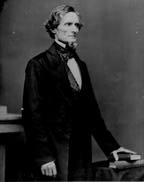
The toastmaster at the podium introduced Jefferson Davis to the audience of over 1000, "Gentlemen, please welcome the Honorable Senator, Jefferson Davis of Mississippi!" [Applause.]
Davis began, "When I heard that a word once spoken here in Faneuil Hall never dies, that it becomes a part of the circumambient air, I felt a reluctance to speak. I think of those voices who first inspired yearnings of liberty in the colony of Massachusetts, proclaiming the spirit of community independence. [Applause.] Lately, It has been my good fortune to stay among New Englanders longer than one who passes through the country at the speed of the railroad tourist. Here I have found a great many true Democrats, their hopes for the future the same as those among my beloved brethren in Mississippi. [Applause.] Instead of finding Boston a place where the records of great words and great deeds teach only federalism, I find here, in bounteous store, that sacred doctrine of state rights."
Cooper Union Meeting Hall, New York - February 27, 1860
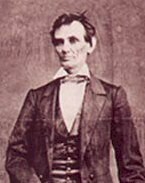
About 7000 were in the audience, as Lincoln stepped up to the podium, a bit awkwardly. He started speaking very slowly, and with an obvious midwest-southern accent that took many in the audience by surprise.
Lincoln started, "Mr. President and fellow citizens of New York..."
In a front row, one newspaper reporter commented to a second reporter, "Oh, no. The famous debater looks and talks like a hick!"
The second reporter responds, "Wait."
Lincoln continued, "The main point of contention between the Democrats and our Republican Party is whether the Federal Government has the power to decide if slavery can or cannot be allowed in the western territories beyond the states. In his speech reported in 'The New-York Times,' the Democratic Senator Douglas asked, 'Does the proper division of local from federal authority, or anything in the Constitution, forbid our Federal Government's control of slavery in our Federal Territories?' He says that the Federal Government is forbidden from regulating slavery in the territories, and claims that this was the intent of the framers of the Constitution - a point with which we disagree. Further, he said, and I quote: 'Our fathers, when they framed the Government under which we live, understood this question just as well, and even better, than we do now.'"
At Faneuil Hall...
Davis continued, "We have heard it argued, along with a petition now circulating in the northern states, that there is an incompatibility between sections of states; that the Union has been tried long enough, and that it has now proved necessary for the North to separate from those parts of the Union where the curse of slavery exists. Ah! those modern saints, so much wiser than our fathers, have discovered an incompatibility in the Union. What incompatibility? Your interest is to remain a manufacturing and ours to remain an agricultural people. Your prosperity is to receive our staple and to manufacture it, and ours to sell it to you and buy the manufactured goods. [Applause.] This is an interweaving of interests, which makes us all the richer and all the happier. What incompatibility? Your Massachusetts man, when he comes to Mississippi, adopts our opinions and our institutions, and frequently becomes the most extreme southern man among us." [Great applause.]
At Cooper Union...
Lincoln went on, "I fully endorse the idea that the nation's fathers who framed the Constitution clearly understood the limits of federal power, and also understood the issue of extending slavery to the territories. This gives us an agreed starting point for analyzing the Republican and Democrat positions. Thus, we begin with the query: 'What was the understanding those fathers had of the question mentioned?' In answer to the Democrats' claim, I will now show that there is no evidence whatever that these framers believed the Federal Government had no authority to control slavery in the territories. On the contrary, they supported prohibitions against extending slavery there."
At Faneuil Hall...
Davis: "With religious pretensions, some claim a moral obligation to agitate against slavery, and I suppose they are going through a sort of vicarious repentance for other men's sins. [Laughter.] But who gave them a right to decide that slavery is a sin? Not the Constitution; that includes it. Not the Bible; that justifies it. What, then, is their standard? Christianity? It cannot be, for servitude is the only agency through which Christianity has reached the slave race, the only means by which they have been civilized and elevated.This agitation has been insidiously working for the destruction of that Union on which our hopes of future greatness depend."
At Cooper Union...
Lincoln: "Who were our fathers that framed the Constitution? I suppose the 'thirty-nine' who signed the original instrument in 1787 may be fairly called our fathers who framed that part of the present Government, and that they fairly represented the opinion of the whole nation at that time.Let us now inquire whether the 'thirty-nine,' or any of them, ever acted upon this question; and if they did, how they acted upon it - how they expressed that better understanding."
At Faneuil Hall...
Davis: "The Constitution recognizes all property. What is behind this agitation regarding other people's negroes? Unless it be a bridge over which to pass into office -- a ready capital in politics for missionaries staying at home -- reformers of things far off of which they know nothing -- war horses who sniff the battle afar off, and cry: 'Aha! aha! I am afar off from the battle. Charge, my righteous legions!' [Great laughter and applause.] There is another question about this negro agitation. It concerns the right to hold slaves in the Territories. What power has Congress to declare what shall be property and where? None, in the territories or elsewhere."
At Cooper Union...
Lincoln: "In 1789, by the first Congress which sat under the Constitution, an act was passed to enforce the Ordinance of '87, including the prohibition of slavery in the Northwestern Territory. It was considered without a word of opposition, and unanimously passed. In this Congress there were sixteen of the thirty-nine fathers who framed the original Constitution. George Washington, another of the 'thirty-nine,' was then President of the United States, and he approved and signed the bill. This shows that, in their understanding, no line dividing local from federal authority, nor anything in the Constitution, forbade Congress from prohibiting slavery in the federal territory."
Reporter 2, who was feverishly writing down Lincoln's speech in shorthand, saw that Reporter 1 was so engrossed in listening to Lincoln, that he had stopped writing and dropped his pencil without noticing it.
At Faneuil Hall...
Davis: "Why is it that the peace of the country is disturbed so that one people may presume a right to judge what another people should do? Is there any political power to authorize such interference? If so, where is it? You did not surrender your sovereignty. You gave to the federal government certain functions. It was your agent, created for specific purposes. It can do nothing save that which you have given it power to perform. Where is the grant in the Constitution conferring on the federal government a right to determine what shall be property? - whether a slave is property? None exists; that question belongs to every community to settle for itself: you judge in your case; every other State must judge in its case."
At Cooper Union...
Lincoln: "The Democrats plant themselves upon the tenth amendment, providing that 'the powers not delegated to the United States by the Constitution are reserved to the States respectively, or to the people.' It so happens that the first ten amendments were framed by the first Congress which sat under the Constitution - the identical Congress which passed the act already mentioned, to enforce the prohibition of slavery in the Northwestern Territory. Not only was it the same Congress, but they were the identical, same individual men who, at the same session, and at the same time within the session, had under consideration these ten Constitutional amendments, plus the act prohibiting slavery in the Northwestern Territory. Having passed both the amendments and the act, we can reasonably conclude that they saw no contradiction between the 10th Amendment and the Act."
At Faneuil Hall...
Davis: "Thus the waves of sectional agitation are dashing themselves against the granite patriotism of the land. The danger lies at your door, it is time to arrest it. It is time that men should go back to the origin of our institutions. Madness must rule the hour when American citizens, shall turn with internecine hand to sacrifice themselves as well as their brethren, upon the altar of sectional fanaticism. I trust we shall never be purified, as it were, by fire." [Applause.]
At Cooper Union...
Lincoln: "On four other occasions, Congress passed laws asserting Federal control over various aspects of slavery in the territories, and during the consideration of which, many of the original 39 framers participated. These were in 1784 regarding the Northwestern Territory (prior to the Constitution), in 1798 regarding the Territory of Mississippi, in 1804 regarding the territory that is now the State of Louisiana, and in 1819-20 regarding the Missouri Territory. In 1784 and 1820, in each case just one of the original framers voted against the proposal - James M'Henry in 1784 and Charles Pinckney in 1820. But for what reasons they so voted is not known. In the course of all of these votes, twenty-three of the original framers participated, and of them twenty-one voted in favor and only two voted against. The remaining sixteen of the 'thirty-nine' have left no record of their understanding of federal control of slavery in the territories."
At Faneuil Hall...
Davis: "I shall gratefully carry with me the recollections of this consecrated hall, where men so early devoted themselves to liberty and community independence. You, men of Boston, go to the street where the massacre occurred in 1770. There learn how your fathers unfaltering, stood for community right."
[Applause and cheers]
At Cooper Union...
Lincoln: "The sum of the whole is that, of our thirty-nine fathers who framed the original Constitution, twenty-one - a clear majority of the whole - understood that no Constitutional division of local from federal authority forbids the Federal Government from controlling slavery in the federal territories. Such was their understanding; and Senator Douglas affirms that they understood the question 'better than we.' Thus, the Democrats cannot base their theory of 'popular sovereignty' or 'community independence' on the intentions of the framers of the Constitution. Further, if those who wrote and adopted the Constitution believed slavery to be a good thing, as the Democrats imply, why did the framers insert a provision prohibiting the slave trade after the year 1808? Wrong as we believe slavery is, we can let it alone in states where it is, to preserve the peace. But we must not allow it to spread into the National Territories, and then to overrun the Free States.
The question is, what will satisfy them? Only this: cease to call slavery wrong, and join them in calling it right. We must arrest and return their fugitive slaves with greedy pleasure. The whole atmosphere must be disinfected from all taint of opposition to slavery. Holding, as they do, that slavery is morally right, and socially elevating, they demand national recognition of it as a legal right and a social blessing. Oh, my friends, let none of these sophistical contrivances divert us into reversing the divine rule, and thereby calling not the sinners, but the righteous, to repentance. Let us have faith that right makes might, and in that faith, let us, to the end, dare to do our duty as we understand it."
[Vigorous and sustained applause]
The first reporter exclaimed, "'Right makes might!' Indeed! Right makes might. And what powerful logic!"
The second reporter adds, "This Mr. Lincoln has a steel-trap mind!"
"Yes. I think Senator Seward's star for the Republican Nomination has just started to fall," remarked the first reporter.
"And Lincoln's to rise," observed the second reporter.
(return to table of contents)
Chapter 10:
SecessionNov. 1860 - Lincoln elected president, sparking Southern moves toward secession, and Lincoln is immediately besieged by office seekers...
It was dusk at Fort Stevens, north of Washington, as three mounted army officers galloped up to the gate and were permitted entry by the guard. Upon dismounting, they hurried into the office of the commanding officer. The leader of the three, Major James Pedigrew stepped forward, saluted the seated Colonel Brent Rodgers, and handed over to Rodgers a set of orders.
In a distinct southern drawl, Pedigrew announced, "Major James Pedigrew reporting, sir. These orders from Secretary of War John B. Floyd hereby relieve you of command of this fort, and immediately place me and my staff in command."
Rodgers looked over the orders, and then looked up at Pedigrew, "I find these orders puzzling. I heard no intimation that such a change was being considered."
Pedigrew responded, "It's the Secretary's order sir, and I must respectfully request that you leave this fort at once."
"At once?" asked an incredulous Rodgers.
"Yes sir," answered Pedigrew.
Rodgers carefully examined the official seal on the orders, decided it was valid, stood and gathered some papers, his coat and sword, and then left.
Pedigrew spoke quickly to his aides, "Get the rest of our men in here. Then make immediate preparations to remove all the cannon and all stores of rifles and ammunition, place them on caissons and wagons, and start moving them south before daybreak."
The aides saluted, and then rushed out to fulfill their orders.
Early dawn the next morning at a bridge over the Potomac River: a column of caissons and wagons carrying cannons, rifles and ammunition proceeded in a long line heading south from Fort Stevens across the river into Virginia. Major Pedigrew rode up on horseback, stopped a moment to survey the column, then rode on ahead. A doctor in a buggy returning to Washington from a late night house call rode by in the opposite direction, and stopped for a moment to observe the scene. He overheard a couple of soldiers with southern accents commenting:
"Our new southern army sure won't lack for cannon!"
"Yeah, Billy, and Fort Stevens won't have any, so we'll be able to take it right quick when the fightin' starts."
The man in the buggy said to himself, "Oh, my God!" Then he whipped his horse and trotted off toward Washington as fast as he could go.
[This type of traitorous activity (without these specifics) by Floyd is reported in Gen. Grant's memoirs, though Grant was not in a position at the time to have first hand knowledge of it. However, it is somewhat contradicted in a U.S. Army military history manual, American Military History 1607-1953, ROTCM 145-20, edition of July 17, 1956, p. 187.]
Dec. 20, 1860 - S. Carolina secedes
Lincoln was pacing the parlor of his Springfield home as Ward Lamon stood and briefed him on the deteriorating national situation. John Hay, one of Lincoln's secretaries, sat at a small desk in the corner ready to take notes for Lincoln, listening to Lamon.
Lamon continued, "The news is all bad, sir. South Carolina seceded from the Union the day before yesterday. The Secretary of War, John B. Floyd of Virginia, was fired yesterday by President Buchanan because he was caught sending cannons, rifles, ammunition, and southern-born soldiers and sailors south - obviously to equip the southern states for war against the north."
Lincoln exclaimed, "Good Lord! How much damage has this traitor Floyd done to our military?"
"A lot," replied Lamon.
There was a knock at the door, the door opened, and Lincoln's other secretary, John Nicolay stuck his head in the door. A hubbub of office seekers could be heard in the hallway as Nicolay spoke, "Are you ready, sir, for the next interview?"
Lincoln asked, "Who is it?"
Nicolay replied, "Professor Hector Sanderson of Rhode Island."
"What does he want?" inquired Lincoln.
"He wants you to appoint him Secretary of State."
Lincoln smiled at Lamon with a mischievous twinkle in his eye, and then told Nicolay, "Why, send the professor right in!"
Sanderson, a short and balding middle aged man with owlish glasses, mutton chops sideburns, a bushy turned-up waxed mustache and a goatee, wore a three-piece suit with a prominent gold watch chain dangling across his ample middle, entered quickly, grinning with his hand outstretched. He seemed to be a bundle of energy.
"Buenos dias, senor Presidente Electado," said Sanderson.
"What's that, sir?" asked Lincoln as they shook hands.
Sanderson translated, "Good morning, Mr. President Elect. Professor Hector Sanderson. I speak four languages: Spanish, French, German and Italian."
"You shortchange yourself, professor. I think you also speak English. Five," said Lincoln.
With a short laugh, Sanderson continued, "Ah, yes. Sir, foreign relations has been my field of expertise for over twenty years. I've traveled extensively in Europe. I've met all the crowned heads of Europe - England, Germany, France, Spain."
"Please be seated, sir," said Lincoln, and they both sat facing each other. "How impressive, professor. And tell me, how is the King of France these days? I understood that he had an illness afflicting the neck."
A bit puzzled, Sanderson asked, "The neck? Oh, I see your joke. I meant Napoleon III."
Lincoln replied, "Ah, I see. I didn't think of him as a real royal. I understand that you'd like to help us out by being the Secretary of State. Is that right?"
Sanderson beamed, "Yes sir. I humbly submit my ample qualifications for your inspection," as he handed Lincoln his resume.
Lincoln briefly scanned the resume and then peered over the top of his reading glasses to look Sanderson over, as he said, "Ample indeed. Tell me professor, are you a Republican?"
"Of course, sir," said Sanderson, smiling broadly.
"And how many votes did you deliver to us at the Republican Convention?"
Sanderson suddenly frowned, "I wasn't at the convention."
"Oh. Well, Seward wasn't either," said Lincoln. "But how many votes did you control at the convention that you sent our way?"
Sanderson, after a pause, admitted, "None, sir."
"Then tell me, professor, about your political influence back in Rhode Island and in the neighboring states of Massachusetts and Connecticut."
"Well, I give many lectures on foreign affairs at colleges throughout the region, and they're very well received," said the professor.
"And who attends those lectures, professor?"
"Students," answered Sanderson.
"I see," said Lincoln. "Well professor, your skills certainly should be put to good use by our government. I think I have just the job for you."
Sanderson, smiling expectantly, "Yes?"
"You said you speak French...fluently?"
"Oh, yes sir."
Lincoln, asked, "How would you like to be the ambassador to Haiti?"
"Haiti?!" exclaimed Sanderson, eyes wide with incredulity and dismay.
They rose from their seats, and Lincoln put his arm over Sanderson's shoulder as he led him to the door, "Well, think it over professor and let us know. We don't want your talents to go to waste."
After Sanderson left and the door closed, Lincoln turned to face Lamon and winked with a chuckle. Lamon smiled back knowingly, and then said, "The newspapers are all clamoring for interviews. They want your comments on the secession movement."
"I'm not going to say anything," Lincoln respond. "I've said it all before. They want me to compromise on the extension of slavery into the territories. I can't do that. We had an election, and the people have spoken. If I compromise now on slavery in the territories, what was the point of the election? We can't give in on that. And it wouldn't stop more states from seceding anyway."
"I see," said Lamon.
Lincoln continued, "Besides, I'm not the President yet. Buchanan still is for several more weeks. If I open my mouth, It will draw attention to me instead of Buchanan, and right now, only he has the power to act."
U.S. Senate Floor, Late January, 1861...
Senator Jefferson Davis, having been recognized by the Chair, rose and began speaking, "I rise, Mr. President, to announce to the Senate I have satisfactory evidence that the State of Mississippi, by a solemn ordinance of her people in convention assembled, has declared her separation from the United States.
"I concur in the action of the people of Mississippi, believing it to be necessary and proper. Secession is justified upon the basis that the States are sovereign. When the Federal Government threatens to be destructive of our rights, we but tread in the path of our fathers when we proclaim our independence, and take the hazard.
"Thus, of course, my functions are terminated here. It only remains for me to bid you a final adieu."
Feb '61 secessionists add 6 more states
Lincoln heads for Washington...
On the way to his inauguration in Washington, Lincoln visited his stepmother Sally. Lincoln and Sally walked in her flower garden next to her home. At age 75, she walked with a cane, wore a long dress, and her characteristic bonnet. The daffodils were already coming up. They stopped, and she looked up at Abe, touched his arm with her hand and said, "Abraham...dear Abraham...first I gave you to God. Then I gave you to yourself. Now I must give you to the nation. God bless you, son."
Choked up, he said, "Mama...Mama," and reached down and hugged and kissed her for the last time.
Lincoln brought into Washington incognito in a secret train
(return to table of contents)
Chapter 11:
"In your hands...and not in mine..."March 4, 1861 - Lincoln inaugurated; and in Montgomery, Alabama - the Jefferson Davis Inaugural...
As Lincoln stepped forward to speak, there was polite applause. Lincoln tipped his head in acknowledgment. Then as the audience became quiet and expectant, and Lincoln surveyed the crowd below, he heard his stepmother's words in his mind, "Depend on God, Do the right thing, and Use your head." He began to speak...
"...Apprehension seems to exist among the people of the Southern States, that...their property, and their peace, ...are to be endangered. ...I declare [again] that 'I have no purpose, directly or indirectly, to interfere with the institution of slavery in the States where it exists. I believe I have no lawful right to do so...'
"...A disruption of the Federal Union heretofore only menaced, is now formidably attempted.
"I hold, that in contemplation of universal law, and of the Constitution, the union of these states is perpetual. Perpetuity is implied, if not expressed, in the fundamental law of all national governments..."
Montgomery, Alabama - the Jefferson Davis Inaugural
Davis began, "Gentlemen of the Congress of the Confederate States of America, Friends and Fellow- Citizens:
"Our present condition, unprecedented in the history of nations, illustrates the American idea that governments rest upon the consent of the governed, and that it is the right of the people to alter or abolish a government that has become destructive of its original purposes.
"In this we have merely asserted a right which the Declaration of Independence of 1776 had defined to be inalienable. The enlightened verdict of mankind will vindicate our conduct, and He who knows the hearts of men will judge the sincerity with which we labored to preserve the Government of our fathers."
In Washington, a row of cannon and regiments of soldiers lined the edges of the Mall as Lincoln continued his inaugural address...
"I trust that this will not be regarded as a menace, but only as the declared purpose of the Union that it will constitutionally defend, and maintain itself.
"In doing this there needs to be no bloodshed or violence; and there shall be none, unless it be forced upon the national authority...."
Those standing or sitting close to Lincoln could sense his self confidence as he presented the logic underlying his policy...
"If a minority, in such case, will secede rather than acquiesce, they make a precedent which, in turn, will divide and ruin them; for a minority of their own will secede from them, whenever a majority refuses to be controlled by such minority. For instance, why may not any portion of a new confederacy, a year or two hence, arbitrarily secede again, precisely as portions of the present Union now claim to secede from it? All who cherish disunion sentiments are now being educated to the exact temper of doing this....
"Plainly, the central idea of secession, is the essence of anarchy...
"One section of our country believes slavery is right, and ought to be extended, while the other believes it is wrong, and ought not to be extended. This is the only substantial dispute.
"Physically speaking, we cannot separate. We cannot remove our respective sections from each other, nor build an impassable wall between them...
"Why should there not be a patient confidence in the ultimate justice of the people? Is there any better, or equal hope, in the world? In our present differences, is either party without faith of being in the right? If the Almighty Ruler of nations, with his eternal truth and justice, be on your side of the North, or on yours of the South, that truth, and that justice, will surely prevail, by the judgment of this great tribunal, the American people...
"My countrymen, one and all, think calmly and well, upon this whole subject. Nothing valuable can be lost by taking time..."
At Montgomery, Davis's inaugural outlined the Confederate policy...
"An agricultural people, our true policy is peace. There can be but little rivalry between us and the manufacturers of the Northeastern States. Mutual interest should invite good will and kind relations.
"If, however, passion or the lust of dominion inflames the ambition of those States, we must prepare to meet the emergency and to be able to maintain, by the sword, the position which we have assumed among the nations of the earth."
As both Davis and Lincoln spoke, army officers at forts in southern states took off Union uniforms and changed into gray Confederate garb - with faces glad and defiant.
In Washington, Lincoln continued...
"In your hands, my dissatisfied fellow countrymen, and not in mine, is the momentous issue of civil war.... You can have no conflict, without being yourselves the aggressors. ...
"We are not enemies, but friends... Though passion may have strained, it must not break our bonds of affection."
As Lincoln spoke, he imagined the length and breadth of the whole Union and its challenges - a Georgia plantation with slaves working in fields, a columned white mansion behind them; a Boston wharf as a cargo ship was unloaded next to an open air market; a Texas cattle ranch; a New Hampshire village with a white church steeple pointing up through the dark green pines.
In Montgomery, Davis concluded...
"It is joyous, in the midst of perilous times, to look upon a people united in heart, honor and right. Reverently let us invoke the God of our fathers to guide and protect us, as we stand for the cause of liberty, and with his blessing, look forward to success, peace, and prosperity."
In Washington, Lincoln also sought to end on an inspirational note...
"The mystic chords of memory, stretching from every battle-field, and patriot grave, to every living heart and hearthstone, all over this broad land, will yet swell the chorus of the Union, when again touched, as surely they will be, by the better angels of our nature."
Lincoln's audience began to applaud. Horace Greeley, scowled as he applauded briefly; General Scott looked on impassively; Hay and Lamon applauded enthusiastically; the general audience offered sustained applause. Then Lincoln took the oath of office, administered by the frail and elderly Chief Justice Roger Taney.
____________________________ Lincoln in the White House besieged by hoards of office seekers.
Lincoln's brief first meeting with Wm. T. Sherman
(Sherman comes away thinking Lincoln is a fool)
____________________________ A quiet evening at the White House soon after inauguration...
A few evenings after the inauguration, Lincoln was in his White House office alone, having just finished seeing a delegation of office seekers, and having just dismissed his two male secretaries for the evening, Hay and Nicolay. He sat with his back to the main office door as he wrote at his desk. Footsteps could be heard in the hallway, plus the occasional tap of a cane on the floor. The door opened, and someone came in quietly, behind the President. Lincoln paid no attention, concentrating on his writing, as the visitor approached his desk from the rear and then stopped just behind him, while Lincoln wrote quickly with his quill, making a scratchy sound. The visitor raised his left hand, fingers outstretched, as his already gloved right hand slipped a black leather glove onto the left hand, which then flexed briefly and grasped the handle of the cane, the unsuspecting back of the head of the president bobbing slightly like a ripe melon. After a pause, a soft dry southern voice began to speak in a polite and friendly tone...
"Excuse me Mr. President, I wonder if I might have a little word with you?"
Just then, a second door to the office burst open with great commotion as the young Lincoln boys, Tad and Willie ran into the office. "Papa! Papa!" yelled Tad, "Willie stole my lariat!"
"I did not! I did not!" yelled Willie.
"Yes you did! Yes you did!" yelled Tad.
The president stood up and stepped toward the boys, kneeling down to their eye level, saying, "Now boys, behave yourselves. Can't you see I'm busy - I have a visitor."
"No you don't! No you don't!" yelled Willie.
Lincoln turned toward the other door and saw that his unknown visitor had left. While he looked toward the open door, slightly puzzled, the boys tackled him and the three of them wrestled on the floor with glee.
The Fort Sumter Crisis
On March 28, 1861, Lincoln met with his Cabinet to discuss the rapidly deteriorating situation regarding Fort Sumter in Charleston Harbor. The Federal garrison there, commanded by Maj. Robert Anderson, would run out of food by April 15th, and was surrounded by rebel artillery batteries commanded by rebel General Pierre G. T. Beauregard - who ironically had been a protégé of Anderson's at West Point years before. The Cabinet was split on its advice to Lincoln. Since March 9th, they had been wrestling with the issue, and submitted written advice to Lincoln on March 16th. Seward advised abandoning Sumter and concentrating effort on holding forts with more strategic military value in Florida and Texas. Chase was of two minds: hold Sumter if it could be done without starting war, or give it up if it would precipitate war. For the March 28th meeting, Gen. Winfield Scott, the top army commander, had sent word that giving up Forts Sumter and Pickens could be justified - which Postmaster General Blair blasted as being political rather than military advice. After much debate, during which it was generally agreed that attempting to hold Sumter would mean war, Lincoln called for a vote from his Cabinet...
"Well, gentlemen, how shall we resolve the dispute over Fort Sumter? How many of you vote to resupply Major Anderson's garrison and hold the fort?"
Three of the six present subtly raised their hands to vote aye: Chase, Welles and Blair.
Lincoln asked, "Against?"
The other three voted nay: Seward, Smith and Bates. Secretary of War Cameron was absent. Lincoln stared at each of them for a moment, and then adjourned the meeting...
"Good day, gentlemen." As the six men left, Lincoln thought they had been of little help in clarifying the issues for him. He felt like a man tied to a powder keg, to which the fuse had been lit.
____________________________ That evening, Lincoln stood by a table in his office and looked on as his secretary, John Hay, rolled out a map of Charleston Harbor showing the location of Fort Sumter and the rebel batteries.
"Let me see Major Anderson's last message again," instructed Lincoln.
Hay handed him the message, and Lincoln again read Anderson's vivid description of his men's deteriorating circumstances, with dwindling supplies of flour and bacon due to run out soon.
Lincoln commented, "He's almost out of food. No food, no fort. No fort...and where is the Union?"
He folded Anderson's wrinkled paper, laid it down on the map, and then opened a desk drawer and pulled out a paper on which he had made notes. Then he said to Hay, "John, I've listed the reasons for resupplying and keeping Fort Sumter, and the reasons for letting it go. First, here are the points for letting the fort go," as he paced the room with the note in hand and read it aloud...
"1. The fort has no military value.
"2. It would avoid a bloody conflict.
"3. It eliminates a sore spot that fans the flames of secessionism.
"4. It would show we're not out to coerce the South, and please the moderates in Congress.
"5. It avoids giving the Rebels the military credibility they'd gain if they successfully attacked the fort.
"The points for keeping the fort are fewer:
"1. It would send a clear message that we intend to uphold the Union.
"2. We would avoid giving the secessionists a victory.
"3. It would avoid offending the Republican Party, whose support I need.
"Have I left anything out?"
Hay responded, "No sir. Those are all the points I've heard. Have you decided what to do?"
Lincoln, put the paper back in his drawer, looked at Hay and answered, "Yes. To wait."
Lincoln walked out of his office, hands clasped behind his back and head drooped in thought about his options, as he ambled toward the family quarters and the wild noises of his two young sons playing army.
"Boys, it's time for bed now," he said.
"No Pappa, we've just gotten started," protested Willie.
"Started with what?" asked Lincoln.
"Whuppin' the rebs!" answered Tad.
"To bed! To bed!" ordered their father.
Lincoln entered Mary's sitting room, found her there alone writing a letter. He closed the door and slouched into a seat near her, staring at the floor.
Mary, looking up from her writing, "Mon cherie! What is it, Mr. Lincoln?"
"Oh, Molly! What shall I do?" he said.
"About what?"
"Fort Sumter," he answered. "If we try to hold it, it means war. If we give it up, it may mean the end of the Union cause."
"Are you sure?"
"Oh, it's hard to be sure of anything in this mess," he replied.
"Isn't it just a little fort?" asked Mary.
"In every crisis I've ever faced," said Lincoln, "I've remembered what Mother taught us at her knee: 'Depend on God, do the right thing, and use your head.' It's advice that has always led me to a solution. But, oh, how hard it is now."
"Trying to find the right thing?"
"Turn the other cheek and give up the Union?" he asked. "Is that what God would have me do? Or throw the money changers out of the temple and try to save the Union? Which is it to be? Which would he have me do?"
Mary replied, "Surely, there's an answer in Scriptures."
"The Scriptures tell us how to treat each other, person to person," he observed. "But what about the life of nations? Nothing in the Gospels tells us how tribes or nations should solve their differences. The Old Testament, of course, does. It seems to say that as long as you are acting on behalf of God's chosen people, then 'might makes right.' But if you're not, then might isn't right. In this case, are we the chosen people? I'm not sure that God considers us as such. So what should I do?"
"God must be for what is right," she said.
"But is God for killing and maiming? If I hold Ft. Sumter and we have war, thousands of young men, the hopes and dreams of families all over this land, will be killed and maimed. Is the Union worth it? Is it right? What would He have me do? ... It seems to me that in some circumstances, like this, that there is no right way out. The alternatives are all bad, and I have to find the one that offers the best chance of taking us through to what's best for the country on the other side of it."
Mary Lincoln said nothing more. She put down her pen, turned, and stared at her husband. At the moment, she could think of nothing useful to say.
"I think of the future," he said. "That is what this is about. What will it be like here a hundred years from now? If we let democracy fail now, if we let a minority dictate to the majority now, what is the future for democratic government? What future will our people have? What future will our boys have?"
"Yes. We have to think of them," she said.
He continued, "It's a fork in the road. One way leads to our national disintegration into bickering states. Like the ancient city of states of Greece, constantly fighting. Over slavery now, then over issues not yet imagined."
"Really?" she questioned.
"The great promise of the Declaration of Independence would be lost forever. The lions of Europe would sweep in, conquer the weak, carve us up and reestablish the empires of tyrants all over America. It's happening already in Mexico. The lives of our people would again be lives of colonial misery."
Mary asked, "The other road?
Lincoln replied, "It means war now rather than later. But if the Union prevails, then a hundred years from now, democracy - and the great purpose of the Declaration of Independence - will be alive and thriving. And slavery will be gone."
"Gone?" she said, almost incredulous.
"Yes," he asserted. "Equality and the right of each person to pursue happiness - this will then have greater meaning. One nation will extend from Atlantic to Pacific. The combined spirit, strength and ingenuity of the people will make this the greatest nation on earth. A beacon of liberty for all."
"I wish we could make my brothers see this," she lamented.
"I wish I could make all our brothers see this!" he said.
"You must do the right as God lets you see it," Mary advised.
"Yes, but is it really his vision that I see?" he wondered.
____________________________ The next day, Lincoln was sitting in his office with his friend and sometimes aide Ward Lamon, recently returned from South Carolina.
"Two things we can try that might defuse Sumter," Lincoln said. "I can send a hand delivered message to governor Pickens of South Carolina, telling him that we will merely seek to resupply our men at Sumter with food only, making it clear that we will not initiate any military action, while negotiations proceed."
Lamon observed, "It has about as much of a chance as a hen in a wolf den, Mr. President. But at least they'd have to fire the first shot."
"But it buys time," claimed Lincoln. "Time to find another way."
"And the second thing?" asked Lamon.
"Virginia has delegates meeting now to consider secession. Voted it down once already. But they're still meeting, watching to see what happens. If we can hold Virginia, we might turn this crisis around and coax the other states back eventually."
"Think so?" Lamon reacted.
"I'd ask the Virginians to send someone here I could talk to. I'd try to work a deal where Virginia stays in if we give up Sumter. What do you think, Ward?"
"Well... I wouldn't bet on its chances," Lamon replied.
Chapter 12:
April ThunderApril 1, 1861 - Seward's proposals rebuffed by Lincoln...
Henry J. Raymond, editor and publisher of the New York Times, was met at Union Station by Secretary of State William H. Seward. As the two walked past the train into the terminal, Raymond told Seward, "Mr. Secretary, the president has been wasting time feeding selfish politicians. Time that should have been used to save the Union."
Seward commented, "I've seen your New York Times urge him to focus on a higher level of activities."
Raymond observed, "The Herald has not been so gentle," as he pulled out a copy from under his arm and read from it, "'...the Lincoln Administration is cowardly, mean, and vicious, [due to] the incompetent, ignorant, and desperate 'Honest Abe.' ' The nation is fast sinking into a terrible crisis, and he is busy appointing postmasters and customs clerks to satisfy his cronies. What can be done?"
Later, Seward entered his office alone, and called his male secretary in to take dictation. But first, Seward asked: "When is that rebel delegation meeting with me today?"
"About two."
Seward cautioned, "We must be discreet about these meetings. The President doesn't know about them. No reason for him to know unless our negotiations show promise. Besides, he's still too distracted by job applicants to play much of a role. Shamefully disorganized."
The young man took a seat with pencil and notepad in hand as Seward strode around his office and began to dictate a memo to Lincoln. The way he walked suggested a man used to being in command, a man who thought that he, rather than Lincoln, should be president. Seward dictated, "To the President. Some thoughts for your consideration. We find ourselves at the end of a month's administration, and yet without a policy, either domestic or foreign. Plainly, the demands of supporters for jobs has obstructed your giving attention to more grave matters. Further delay ...would not only bring scandal on the administration, but danger upon the country. Rewarding supporters with patronage should be delegated. Your attention should be focused on changing the question before the public from...slavery...to Union. I would terminate our holding of Fort Sumter as a safe means for changing the issue...This will raise distinctly the question of union or disunion.
"If Spain and France don't remove their archduke from Mexico, we should demand that Congress declare war against them. That may even bring the South quickly back into the Union, in solidarity. But whatever our policy, someone must see that it is carried out. Either the President must diligently manage it himself, or delegate its management to some member of the Cabinet. In this, I neither seek to avoid nor assume responsibility."
____________________________ Lincoln was standing in his office reading Seward's memo. John Hay, one of his private secretaries was sitting at a table nearby organizing letters from job applicants into piles. The president's demeanor as he read the memo became increasingly exasperated. Then he said, "Tell Seward I want to see him."
Seward entered Lincoln's office, all smiles and began, "Mr. President, have you heard about the farm boy who joined the navy? He tried to bring his cow along so they could have fresh milk every day on the ship." Seward laughed, but uncharacteristically, Lincoln was not amused, as he sat at his desk with one leg propped up on the desk, reading glasses on, and with Seward's memo in his hand. Seward started to sit, then corrected himself, standing back up, because Lincoln had not yet invited him to sit.
Lincoln, in a serious and assertive "in charge" tone, spoke somewhat faster than usual, reflecting his impatience as he peered at Seward over the rims of his glasses:
"I've been reading your memorandum. Your claim that we have no policies puzzles me. Our policies are fully described in my inaugural address. Further, I will decide when new policies need to be made here. Then, I will make them and I will direct their execution. Further, once I have made a policy decision, continuing debate about it serves no useful purpose. War with Spain and France? With the problems we have here at home, that idea is simply astonishing."
Lincoln paused to note and calibrate Seward's degree of discomfort. Feeling that the shock to Seward's ego had been sufficient, he softened his tone as he put his propped up foot down on the floor, sat forward, took off his reading glasses, momentarily rubbed the bridge of his nose, and continued, "Still, as issues arise in implementing policies, I do want the advice of my cabinet."
"Mr. President," replied Seward, quite shaken and chagrined, "if you are not satisfied with my service, or feel my advice is of no value, then..."
Lincoln got up, put his arm around Seward's shoulder, and said, "Come on over here, Bill," as he led him to the open window. "Just look at those roses. A few buds are already opening. Spring is finally here."
Lincoln looked down at the roses with a slight satisfied smile, and Seward looked glum. Lincoln glanced toward Seward, smiled a little broader, being pleased with Seward's chagrin. He patted Seward's shoulder, Seward looked at Lincoln, returned the smile a bit nervously, and looked back at the roses. Lincoln said, "Now it is true, Bill, that sometimes I'm like the innkeeper who's so busy letting out rooms in one end of his house, that he can't stop to put out the fire that is burning in the other."
Montgomery, Alabama, April 10, 1861 - Jefferson Davis confers with his Cabinet
"Gentlemen, you've seen Lincoln's letter to Governor Pickens," said Davis. "Should we attack Fort Sumter?"
John C. Breckenridge, Secy. of War, spoke up, "Mr. President, how can we allow the North to maintain a fort right in our very bosom? We must seize it, of course."
Robert Toombs, Secy. of State, disagreed. "Sir, firing on that fort will inaugurate a civil war greater than any the world has yet seen. Do it and you will wantonly strike a hornets nest which extends from mountains to ocean; legions, now quiet, will swarm out and sting us to death."
Alexander Stephens, Vice President, advised, "You know my opinion, sir. I don't think we should fire the first shot because it will give them the moral advantage. The whole world will think we started the war."
Christopher G. Memminger, Secy. of Treasury, asserted, "You overestimate Yankee resolve, Mr. Toombs. Many northerners would just as soon see us out of the Union. We must not cower. It is time to defend the honor of the South. Take Sumter and it will serve as a clarion call to arms for every Southern gentleman to rally with us and assert our sacred rights."
"And so we shall," decided Davis. "The Confederacy will vindicate its right to exist. We will take Sumter. John, issue the order to General Beauregard to attack. Leave the timing to him."
April 12, 1861 - bloodless bombardment of Ft. Sumter starts the war
Shortly before 3 a.m., a Confederate rowboat docked at Fort Sumter. Four C.S.A. officers walked briskly from the boat to meet three Union Army officers in front of the fort's main gate by torch light. One of the Union officers was the fort's commander, Major Robert Anderson, a former Georgia plantation owner who had sold slaves. Confederate Captain James Chesnut faced Anderson and read him a message....
"Sir, by authority of Brigadier-General, commanding, of the Provisional Forces of the Confederate States, we have the honor to notify you that he will open the fire of his batteries on Fort Sumter in one hour from this time.
"We have the honor to be, very respectfully, your obedient servants, James Chesnut, Jr., Aide-de-Camp; and Stephen D. Lee, Captain, Confederate States Army, Aide-de-Camp."
Anderson stared at the Confederates for an awkward moment, then responded, "If we do not meet again on earth, I hope we may meet in Heaven." He then turned and walked back to the fort followed by his two aides. The Confederates, left standing where they were, after a moment then turned back to their boat.
____________________________ A ramrod was plunged into the barrel of a Confederate cannon as it was made ready for firing. A long line of cannon muzzles aimed over the Charleston Harbor toward Fort Sumter. The artillery commander was holding a wristwatch in one hand and held a sword high overhead with the other. He looked at the watch, and at the stroke of 4 a.m. he gave the order: "Fire!" as he swung his sword down. The cannon all erupted in flame and thunder.
April 18, 1861 - Lee offered command of Union Army and declines...
Francis Blair, Sr., an associate of Lincoln's and a friend of Lee's stepped out of his carriage in front of the Lee-Custis mansion in Arlington, and climbed the steps to the front door, where he was met by Jesse, and then almost immediately by Lee himself, who invited Blair in.
Lee and Blair took seats in Lee's library, facing each other.
Blair began, "As I said, General Scott thinks you're the best man to succeed him, so Mr. Lincoln wants you to head the Army."
There was a long pause as Lee stared off into space. Finally, he said, "I know. Scott sent word earlier. Ever since Mexico, he's been my mentor. I've been up all night thinking about this. You know I'm against secession. It makes no sense. And you know I'm against slavery - I freed our family's slaves years ago. But Frank, I was raised in Virginia, as were generations of Lees before me. Virginia is about to secede. My family, my children, are all Virginians." Then his voice softened to nearly a whisper as he said, "How could I ever raise my sword against Virginia?"
Secretary of War Cameron and Francis Blair, Sr. pushed through the throngs of office seekers in the White House hallway waiting to see the president and entered Lincoln's office as a disappointed office seeker left. Blair told Lincoln, "Mr. President, Lee turned us down. His heart is in the soil of Virginia."
"Who are we left with?" Lincoln asked, and Cameron answered, "We still have Scott."
"Old Fuss and Feathers?" Lincoln said. "Old enough to be my father, and some people think I'm an old coot. He's got one foot in the grave."
The Scott Strategy
Lincoln, Secy. of War Cameron, Secy. of Navy Welles and Secy. of State Seward were in Lincoln's office as 6' 5", 300 lb. Gen. Winfield Scott, General In Chief, 75 years old, hero of the Mexican War, entered, stumbling slightly, in full uniform complete with dangling sword, gold epaulets, and holding a large plumed Napoleonic hat. Awesome to behold, the jowly white haired general was a one-man parade. As he entered, everyone stood but Lincoln, who looked over the top of his reading glasses at the general with a somewhat bemused expression.
"Good afternoon, General Scott," said Lincoln. "Please have a seat."
Near the general was a very small dainty looking chair. He cast a disdainful look at the chair and didn't move. Seward looked at the chair, saw the problem, and quickly pulled over a larger chair from a corner for the general, who plopped into it with a clatter.
Lincoln asked, "General, what plans should we be making? What do you think is the best way to deal with this rebellion? What is your advice?"
"Mr. President," answered the general, "the Confederate strategy is simple - they don't have to do anything to win except keep us out of their territory. We, on the other hand, have to invade them in order to reassert Federal authority over the South. We have to go on the offensive, and do it effectively in order to win. Basically, our strategy must be threefold: Our army is now about 14,000 men. Raise it to 85,000 men and take the time to train them properly before moving against the south. That's the first part. The second part is to enforce a naval blockade of the South to strangle them economically, beginning immediately. And the third part is to take our army, after it's trained, and advance down the Mississippi to divide and conquer the Confederacy. But you have to understand sir, this can't be done quickly. It may take years."
Cameron incredulously exclaimed, "Years?!"
Lincoln probed, "Is all of that really necessary? Can't we just whip 'em in one swift battle that shows they can't possibly prevail?"
Seward added, "Our manpower and resources are far superior. Surely one quick battle will bring them to their senses."
Lincoln continued pushing, "General, don't you think this thing can be over in 90 days?"
"With all due respect, sir," answered the general, "that just isn't realistic. I know their military men, and they won't roll over and give up after one battle. Feeling is too deep for that. This thing has gone too far and for too long for a quick, easy end to this rebellion to be even remotely possible. You had best prepare for a long war, sir."
Silence filled the room.
Scott reiterated, "A big army, a blockade, and then divide and conquer. That's your strategy, sir. And it'll take time."
Unconvinced, Seward declared, "It's the 'Anaconda Plan' - encircle them and squeeze them to death."
Lincoln reacted, "I see."
Cameron spoke up, "I've drafted a call up of militia to be sent to the governors, Mr. President. The call is for 75,000 volunteers to serve for 90 days."
Scott stared at the floor and shook his head.
During the first half of 1862, it became clear that the war would not end in one bold stroke, and Lincoln began to consider a major change in political strategy - changing the war's purpose from restoring the Union to emancipation of the slaves.
Chapter 13:
Little Napoleon Takes CommandThe beginning of war operations in the summer of 1861 are described, when Lincoln and everyone else on both sides - except sick old Gen. Scott - still believed that the war would be short and decided by one decisive battle. The chapter includes...
Grant Gets His First Command
June 15, 1861. Grant, in his old Army captain's uniform, stood on top of a box in front of an assembly of about 1000 volunteers of the 21st Illinois Infantry Regiment in a Springfield, Illinois city park. Only about half of the volunteers had uniforms, and those seem not to be standardized.
Grant banged his heel on the box to get attention, then ordered, "Attention! 21st Illinois Volunteers - attention!"
He paused for a moment, as he waited for the hubbub of the men to quiet down.
"My name is Ulysses Grant. The governor has appointed me to be your regimental commander with the rank of colonel."
He paused again, as he looked over the faces of the volunteers, who were lined up haphazardly in front of him. Then he continued, "I am a graduate of West Point, I fought in the Mexican War, and I served 15 years in the regular army, where I rose to the rank of captain before returning to civilian life a few years ago. I'm from Galena."
Again he paused, to let what he said have a moment to sink in.
"My job now is to train you to be soldiers and lead you into battle when the time comes."
Grant looked them over again. They needed work. "So, let's get started with your training."
Preparations In Washington To Invade Virginia and Attack Richmond
Mid July, 1861 - the 21st Illinois Under Grant On Patrol In Missouri
Early morning near Florida, Missouri. Grant's regiment was strung out in three long lines, advancing on foot up a barren hill with weapons at the ready, expecting to engage an enemy regiment led by Col. Thomas Harris in the next valley. Grant was in the center about three paces ahead of the first line, his sword held forward in his right hand. Two aides and a flag carrier walked beside him. He glanced over his shoulder at the thousand men following him, and his responsibility for his men suddenly hit him. He looked forward again and broke out in a cold sweat, the perspiration beginning to run down his face. His expression turned grim as he almost faltered, but continued forward, determined step by determined step.
His aide, Captain John A. Rawlins: "Colonel, we should see the enemy regiment from the ridge."
"I know," replied Grant as he wiped his brow.
With inner trepidation, Grant stepped up to the crest of the hill and looked over into the next valley. Nobody was there, just a recently vacated campground. He was instantly relieved as he returned his sword to his scabbard, held up his hand signaling a halt, and his men reached the crest and stopped. Grant stared at the vacant valley below, for a long moment, almost trance like.
"Are you all right, sir?" asked Rawlins.
"Yes, John. I'll tell you about it later," Grant said as he looked back at the regiment behind him. "As you can see, men, they're gone. Looks like they headed south." Then to Rawlins, he said, "Assign a detail to inspect the enemy's campsite for any indications of their intentions. Then we'll make camp."
That evening, Grant and Rawlins sat in front of their tents by a campfire, Grant smoking a cigar, alternately sticking it in the corner of his mouth or grasping it and flicking its ash in the fire.
Grant spoke, "During the Mexican War, John, I was a quartermaster, but I fought in every battle I could. And I went into every battle without fear - maybe with some anxiety, but not fear. I was confident that I could do what I had to do, and with a little luck, come out all right. But I never had men under my command there. No responsibility for the lives of others."
"Yes, that's very different," said Rawlins.
Grant continued, "When we were going up that hill today, and I looked back and saw all our men following me, depending on me, I was gripped for a moment with a fear I've never known. But after we reached the crest, and I saw that the enemy was gone, my fear evaporated and I realized something. The enemy commander was as afraid of me as I was of him. As afraid of us as I was of what his men might do to my men. I can use the enemy's fear to eliminate mine."
"What?" asked Rawlins, somewhat puzzled.
"I'm going to scare the hell out of the enemy every chance I get, and that's going to help give my men an advantage so I won't have to be afraid for them again."
"How are you going to scare the enemy?" Rawlins inquired.
"Attack, attack, attack," Grant replied. "Always attack - even when defending, attack with everything we have. Ultimately, you can only win if you attack. And our winning scares the enemy."
Rawlins was not entirely convinced. "You think that will always work?"
Grant shrugged, then changed the subject. "John, I brought you here because you're smart, but mostly because you're tough. And because I know I can depend on you to be tough with me."
"Tough with you, sir? What do you mean?" asked Rawlins, mystified.
"You know what I mean, John."
There was a long pause, then Grant said, "You've got to keep me away from booze. I can't help myself. Keep me off whiskey, John. That may become your most important contribution to our victories." Grant turned and looked Rawlins in the eye with a steely stare, then back at the fire with a steady gaze, as he declared, "And victories, we will have."
[Historically, John Rawlins - a lawyer from Galena - didn't actually join Grant's staff until a few months later, after Grant was promoted to Brigadier General. But this seems to be a better place to introduce Rawlins, to facilitate revealing Grant's inner thoughts at the very beginning of the war - as mentioned in his memoir, via this conversation with one of his closest wartime aides.]
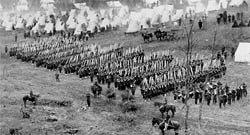
July 21, 1861 - Bull Run, VA. At first, Gen McDowell's Union attack seemed successful, but then confusion caused a demoralizing Union disaster. The green Union troops buckled under fire and gave up the field in a panicked rout. Lincoln was disappointed, but the many disappointments of his earlier life had prepared him to deal with this and the many disappointments to follow with a sense of renewed resolve.
Grant promoted to Brigadier General - about August 1, 1961; reassigned to command a brigade headquartered in Cairo at southern tip of Illinois.
McClellan given command over the eastern Union army
(McClellan had a charismatic mastery of his troops, and demonstrated great skill at organizing, training and preparing a large army for battle)The unmarked enclosed black carriage rolled through Washington toward the Mall carrying Lincoln and his two young sons. "Pull over here, John," he ordered the driver, and they halted and parked behind another carriage near the edge of an expansive parade ground on the Washington Mall. The field was filled with thousands of men in blue of several infantry regiments standing at attention in formation, all facing away from Lincoln and not aware of being observed by their Commander In Chief.

General McClellan, riding a handsome white horse, passed by as he inspected the troops, with his horse strutting past one flank of the assembly and then prancing up to a platform in front. Lincoln, keenly interested in how his new general would take charge of the troops, pulled down the coach window. His boys were fascinated by the military display. Lincoln's face assumed a look of judgment, carefully weighing what he saw and heard, as he watched McClellan dismount onto the platform. The short straight-backed general stepped forward with an air of command, faced the regiments with both hands on his hips, looked them over from side to side, and then spoke in an authoritative but friendly baritone voice...
"Hello, men."
A few voices responded weakly, "Hello, General."
McClellan bellowed, "What's that? I can't hear you!"
In a thundering roar, the men yelled, "Hello, General!"
McClellan replied, "That's more like it. At ease."
A sound of commotion filled the air as the troops changed positions from standing at attention to standing at ease.
McClellan spoke, "Well, you had a rough introduction to war at Bull Run. It's not pretty. It's noisy. It's confusing. It's messy. It's bloody. People get hurt. People get killed."
He paused to let his words sink in, knit his brow with intensity as he scanned the sea of faces before him, crossed his arms, took a few steps to the side and kicked a pebble off the platform, slightly startling his horse. Then he returned to platform center, unfolded his arms and sliced the air with his open hands for emphasis as he continued, "Where's the glory in all this? Where's the glory?"
Again, he paused, then declared, "There can be no glory without victory!"
Pause.
"And there can be no victory in battle unless you know what you're doing and how to do it right! Winning comes from proper training, proper drilling, proper discipline....proper strategy."
Pause.
Then he quickly rattled off, "I'm gonna train you, I'm gonna drill you, I'm gonna discipline you, and I'm gonna teach your officers strategy and tactics until every one of you knows what you're doing and how to do it right without even having to think about it."
Pause.
"And then I'm gonna train you, and drill you and discipline you again....until you are men of steel....that I can lead into hell to whip the devil!"
Pause.
"Then you will know victory and you will know glory! Good day, gentlemen."
He mounted his horse, and as he rode off, a scattered spontaneous "Hurrah!" was heard. A second later, many more voices were heard in a louder second "Hurrah!" Then all voices joined in a thunderous third "Hurrah!"
Two junior officers in the formation near Lincoln's carriage with their backs to Lincoln exchanged glances and one grinned with admiration and said to the other within the President's hearing, "He's our little Napoleon!"
Lincoln pushed the window back up, muttering to himself, "Napoleon, eh?" For a quickly passing moment, like a small cloud casting a brief shadow across an otherwise bright day, he wondered what unknown challenges may lay ahead in dealing with this popular Democrat general.
Then Tad asked, "Papa, are they gonna march across the river now and shoot some Rebs?"
Willie chimed, "If they do, can we watch?"
"No, boys. First the General's gotta teach 'em how to go into battle without turnin' yellow. Driver, move on."
____________________________ Grant - the Battle of Belmont - Nov. 7, 1861
Brig. Gen. Grant and his aide, Capt. Rawlins, and a subordinate commander, Brig. Gen. John A. McClernand, were on horseback, standing to the side of a road as a column of Grant's infantry marched past. Grant was chewing on a cigar in the corner of his mouth, then took it out to speak. "Fremont has had us running to and fro, chasing ghosts. It's bad for the men."
"Yes, morale is slipping," observed Rawlins.
Grant continued, "I must get them into battle soon to turn them into real soldiers."
"Got to lose their military virginity," commented McClernand.
Grant turned to look at McClernand, momentarily nonplused by his metaphor, then grinned and replied, "Right!" He put the cigar back in his mouth, and they rode off, following the column of soldiers.
A few days later, with two aides mounted behind him, Grant was on horseback - no cigar, in front of his assembled 3000 troops. They were just part of his total command at the time of about 20,000 men, and he was about to lead them in an attack on the Confederate encampment at Belmont, MO.
In a firm, loud voice, Grant ordered, "Commanders, brief your men," as he motioned to his regimental commanders - also mounted - to begin briefing their infantry, as he observed and listened.
C.F. Smith announced to his men, "In a few minutes, we will board ships that will take us a few miles down river toward the enemy and set us ashore. Then we will launch our attack. This time, the enemy is there...the enemy is real. This is not going to be a cakewalk like when we took Paducah and nobody was there."
McClernand, also mounted, told his men, "Most of you have never faced a real enemy in battle before. Well men, ... you are about to lose your cherry!"
Scattered laughter. Grant rode over to the first row of infantry, got off his horse, and began walking in front of them, looking each man in the eye as he spoke to them - not attempting to speak loud enough to be heard by everyone.
Firmly, clearly, and matter of factly, Grant said, "Remember what we've taught you. Attack! attack! attack! An army wins only by moving forward, not by just holding ground, and never by retreating. The name of the game is kill or be killed. Kill and destroy. And kill and destroy without mercy... unless... until... the enemy surrenders... unconditionally."
Grant's words turned the men's attitude from an excited giddy anticipation of their first battle to sober determination. He continued to pass in front of a line of men for a moment, silently and intently looking each man in the eye with a look of steely determination. Then he stepped forward toward his horse, turned and faced the men once more, and commanded, "Let's go!"
He swung up onto his horse, and began leading the way toward the steamboats that would quickly transport them down river to the vicinity of Belmont, Missouri - right across the Mississippi River from Columbus, Kentucky. As soon as all troops were loaded, a steam whistle blew on a gunboat and the flotilla was underway. It took a day and a half for the flotilla to reach the debarkation point Grant had selected about three miles upriver from Belmont.
The troops debarked noisily on the west bank of the Mississippi. Then Grant led his staff on horseback, which in turn led a column of infantry through the high cornfields and brush leading to the Confederate encampment. Suddenly, firing from Confederate pickets started the battle. Grant and his staff rode off to the side, as Grant motioned to his infantry commanders to lead their regiments in a charge. Grant's horse was shot from under him, and he took an aide's horse. Confusion and mayhem of a fast peaking firefight ensued as Union troops scrambled over the piled log barriers surrounding the Confederate encampment.
Rebels, seeing the Union troops swarming into their camp with guns blazing, suddenly panicked and retreated toward the river over an embankment out of sight. The Union troops didn't pursue but instead began rummaging through the rebels' tents looking for souvenirs as they yelped and hollered like kids winning a high school tug-of-war. Grant rode into the encampment, saw the looting, dismounted and tried to order his men to stop looting and pursue the rebels - to no avail. Finally, Grant ordered his officers to set the tents on fire in order to stop the looting frenzy and get control of the men. Then the big guns of the Confederate fort across the river in Columbus, KY started firing at the Union troops in the encampment.
Confederate Gen. Leonides Polk led a force on two steamboats departing from Columbus loaded with rebel troops, heading for a point up river from Belmont in order to cut off Grant's avenue of escape. Both rebel and Union soldiers' bodies were strewn around the campsite as cannon balls hit randomly. Loud confusion surrounded Grant as he stood in the midst of the campground calmly assessing the situation. Two men ran up to Grant, calling his attention to the two rebel steamboats nearby heading up river. One of the panicked men yelled to Grant, "They're surrounding us! We'll have to surrender!"
Grant, watching the steamboat smokestacks passing by above the tops of the trees, answered, "No we won't."
The soldier who just spoke to Grant was shot in the head with a spattering of blood, and fell dead.
Grant, not yet noticing that the person he was speaking to had fallen, said, "We'll cut our way out."
Grant then saw that the man was dead at his feet, coolly stepped over the body and motioned to his suddenly desperate men to follow him as he remounted his horse and started leading the way back through the high brush. Through firefights during the retreat, stressed Union troops hurried back onboard their steamboat transports beached upriver. Grant, alone on horseback behind his men, kept an eye out for pursuing rebels and pushed his foot soldiers to run toward their boats.
Grant decided to ride back toward the rebels through a high cornfield to determine how far back they were. Visibility through the cornstalks was very limited, even down the rows. As Grant advanced slowly, he suddenly saw a whole column of rebels passing by about 50 yards away along a dirt track through the cornfield. He backed his horse a few steps, wheeled it around carefully - trying not to draw attention - and then galloped off toward his boats as a couple of wild shots were fired in his direction.
As Grant approached the anchorage at the gallop, he saw that all the boats had shoved off toward the river channel, except one still on shore with a number of troops still climbing aboard. Grant yelled, "Hurry up, they're coming!" as he spun around to take one more look behind and then expertly rode his horse down the embankment toward a gangplank connecting the shore to the boat's deck. He coaxed the balky horse across the gangplank just as a hail of bullets started falling from over the high embankment. The plank was pulled up and the boat backed out into the river under rifle fire.
Grant dismounted and climbed the stairway to the pilothouse where he said a few words to the Captain and then quickly stepped back out to look toward the rebel soldiers now firing on the boat from the embankment. He ducked into the Captain's cabin and lay down for a moment on a sofa to catch his breath. Hearing commotion on the decks below, Grant got up off the sofa, and immediately afterward a bullet crashed through the wall, through the head of the sofa and lodged in the sofa's foot - exactly where Grant had been seconds before. Grant noticed this, reacted with just a surprised raised eyebrow, and then jumped out on deck to see what was happening. The boat quickly got out of range of the rebel soldiers and relative calm was restored.
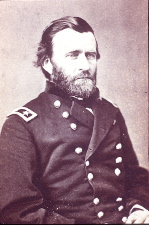
Grant sat at a desk in his office - on the 2nd floor of a bank in Cairo, IL - as Rawlins came in and handed him a paper with casualty figures, saying, "We lost about a hundred killed, sir. Plus missing and wounded. They probably lost more."
Grant looked over the figures and grunted, "Umhmm."
"The newspapers are giving you a real drubbing," said Rawlins. "They claim our men died for nothing - that it was a useless adventure with nothing gained."
"Well, they don't know much, do they?" said Grant.
"Plus, they say you contradicted your own convictions against retreating," continued Rawlins.
Grant leaned forward and asserted, "These men won't ever be forced into a retreat so easily again, now that they know what it feels like."
Grant took a long draw on his cigar as he stared coolly at Rawlins for emphasis.
"Yes, sir," Rawlins responded.
"We did accomplish our mission," Grant pointed out, "which was to keep Polk bottled up in Columbus instead of his chasing after Fremont. And now our men know what battle is really like."
"For sure!" agreed Rawlins.
"That's worth a lot," emphasized Grant. "Nothing like battle to toughen a soldier, so next time he'll follow orders under fire."
Grant pointed to the map of Kentucky and Tennessee on his desk, then said, "Look at this, John. Three rivers leading right into the heart of the Confederacy - the Cumberland, the Tennessee and the Mississippi. Whoever controls these rivers wins the war."
McClellan supervises the seemingly endless training and drilling of his troops near Washington.
Lincoln, Seward and Hay go to McClellan's house in Washington to meet with him about his plans...
The President was feeling increasingly frustrated by McClellan's lack of movement. The general had been training the Army of the Potomac for five months, and still there was no sign of an advance against Richmond. Some gentle nudging was needed, thought Lincoln. He would drop in on the good general at his house and ask about his plans. Seward and Hay went with him that evening. When they arrived, McClellan wasn't home yet, so the butler asked the President's and his men to wait in the parlor. Half an hour later, the general arrived. Lincoln could hear the butler tell him at the front door that the President was waiting to see him, and then McClellan went directly upstairs.
Another half hour passed, and McClellan hadn't come down. "What's keeping the man?" thought Lincoln, as Seward rapped his knuckles on a table. "John, ask the butler when the general will see us," Lincoln told Hay. A few minutes later, the butler announced that the general had gone to bed. So Lincoln and company got up and left. In the street outside, Seward was indignant and insisted that Lincoln should fire McClellan on the spot. But Lincoln wasn't yet ready to give up on their "Little Napoleon", especially because he didn't have a credible choice for a replacement. He patiently told Seward, "Bill, if would help win the war, I'd hold McClellan's horse for him. But if he doesn't use the army soon, I might want to borrow it for a little while."
(return to table of contents)
Chapter 14:
New Sorrow And The PerfectionistFeb. '62 - Julia Ward Howe's Battle Hymn of the Republic published.
Gen. McClellan stepped onto a reviewing stand with dignitaries seated behind. An Army band played a marching tune with lots of drum rolls and bugles, and the massive Army of the Potomac marched by in review, looking sharp. McClellan had a satisfied smile. He turned to the dignitaries, including Sen. Sumner, and pointed out a flying artillery unit coming by of which he was particularly proud, and Sumner nodded approval. ("Flying artillery," pioneered during the Mexican-American War, was light horse drawn artillery that could be moved quickly from one part of a battlefield to another for maximum effect).
Fort Henry (West) - Feb. 6, 1862
The lone figure of Lincoln walked from the White House across the street to the War Department - dressed in his usual black suit with a stovepipe hat, head drooping and hands clasped behind his back. He entered the War Department and headed straight for the telegraphy room and as he approached he heard cheers, took off his hat and looked at the telegraph operator as he entered, inquiring, "What's the news?"
Stanton chimed, "Good news, Mr. President! Fort Henry has been taken from the Rebs in Tennessee!"
"Who did it?" asked Lincoln.
"General Grant under General Halleck, Mr. President," answered Stanton, "with strong help from Foote's naval forces." [Navy Flag Officer Andrew H. Foote, commander of steam powered gunboats and troop transports on the Tennessee and Cumberland rivers]
"Grant?" questioned Lincoln. "Is he the fellow Halleck and McClellan have complained is reckless?"
"I guess that's right," replied Stanton.
"I better keep an eye on him then," said Lincoln. He grins to himself, knowing how intolerant Halleck and McClellan would be of anyone with more ability or aggressiveness than they.
Another parade passed in review before McClellan, again with lots of rousing marching music.
Fort Donelson (W) - Feb. 14, 1862
Grant, in the cramped kitchen of the widow Crisp's country cabin - commandeered as his temporary field headquarters near the Confederate's Fort Donelson on the Cumberland River - finished conferring with three aides, grabbed his toothbrush (his entire traveling kit) - stuck it in his shirt pocket, and hearing distant cannon, put on his hat and headed for the door, throwing a command over his shoulder almost as an afterthought: "Let's go!" Without waiting for anyone else, Grant jumped onto his horse and immediately galloped off toward the battle. His aides were left to catch up in his dust. [At the time, Grant was generally considered the most capable equestrian in the U.S. Army, perhaps in the entire country. Since boyhood, he had loved and worked with horses. He had a widely admired knack for controlling any horse in any situation - even wild stallions - and getting the horse to do exactly what he wanted.]
Lines of skirmishers battled between Grant and Fort Donelson, with the river and Andrew Foote's gunboats in the background. The gunboats fired at the fort, and cannon from the fort returned the gunboats' fire, while other cannon fired in the opposite direction on the attacking Union troops led by Grant. He galloped onto the battlefield, and seeing a Union line in the center starting to fall back, he pulled up to them, quickly rallied the troops, and turned them back into attack mode. Then he continued to the next regiment in his infantry line and with sword in hand pointing toward the fort, ordered them to charge. A group of infantry charged across a field toward the fort as a white flag popped up across the field.
A mounted Confederate lieutenant carrying a white flag handed a note to Rawlins, also mounted next to Grant. Rawlins read the note and said, "They want an armistice to negotiate terms for surrendering the fort."
"Give me your notepad and a pencil," Grant instructed Rawlins.
Rawlins handed them over, and Grant quickly scribbled his reply to the Confederate General Buckner - a prewar friend of Grant's. Then he brusquely handed the pad back to Rawlins, who read the reply aloud to the Confederate officer:
"No terms except unconditional and immediate surrender can be accepted. I propose to move immediately upon your works. Your obedient servant, U.S. Grant, Brigadier General."
Rawlins tore off the written page from the pad and handed it to the Confederate, who glanced at it a bit flustered, looked up briefly at the impassive Grant, stuck the note in his pocket, then turned and galloped back to the fort, his white flag waving briskly.
The President was in the yard behind the White House with his son Tad, who was sitting on a pony. Lincoln was trying to teach Tad some nuance of horsemanship as Stanton walked up quickly and handed a telegraphed military field report to Lincoln. As Lincoln began to look at it, Stanton summarized it, "Grant took Fort Donelson yesterday on the Cumberland River of west Tennessee."
Lincoln exclaimed, "Just 8 days ago he took Fort Henry on the Tennessee River. That man sure likes to fight, doesn't he?"
"I guess so," replied Stanton, "but Halleck remains nervous about him - still thinks he's reckless and hard to control."
Lincoln observed, "Now I know what his initials, 'U.S.' stand for. He's 'Unconditional Surrender' Grant! 'I propose to move immediately upon your works.' Indeed! I've never met the man, but I like him already."
Again, McClellan drilled his troops on a parade ground.
____________________________ Feb. '62 The Death of Willie Lincoln
The watch over the dying boy Willie, the Lincoln's third son, had lasted many days since he took ill in mid February of 1862. Often, the president took time to be with his desperately ill bedridden son, holding his hand and trying to cheer him up with stories. The end for Willie came while Lincoln was occupied elsewhere. Mrs. Lincoln immediately went into grief stricken hysterics and had to be taken to her room and attended to there. Then Lincoln came into the room alone to say good-bye to the body of his son. He lifted the sheet from the boy's face, and with deep sadness he said softly, "Oh, it is hard, hard, hard to have him die!"
Abe sat next to the bed where Willie's body lay. His face, with moistened eyes, was etched with unspeakable grief. Through his mind flowed the image of cut timber crashing down in the woods during a rainstorm. "Harvest again," he thought. After a long moment of silence, Lincoln took the boy's lifeless hand in his and spoke, as if to the child's spirit, "You were a wonderful boy, Willie. I know you would've become a wonderful man. You had such intelligence and sensitivity and goodness of heart. Now, all that you could ever be...is gone from us forever. Oh Willie, we loved you so...I love you so." He clasped the boy's hand in both of his, kissed it, and then dropped his head in abject sorrow.
Lincoln's great grief at the loss of Willie became sidelined by his absorption in military affairs, especially trying to get McClellan moving. Willie's death added to his long list of sorrows that he bore fatalistically. Mrs. Lincoln descended into depths of depression that approached insanity. But he could be of little help to her because of the all-consuming pressures and responsibilities of his office.
____________________________ March 9, 1862 - Monitor vs. Merrimac (East)
Shiloh (W) - Apr. 6-7, 1862
Dawn broke in the woods south of Shiloh Church near Pittsburg Landing on the Tennessee River, as three lines of rebel troops (one line behind the other) with rifles and bayonets at the ready, advanced slowly through the trees until they reached a clearing. The command, "Charge!" was heard, and then the rebels broke into a run across the field screaming the Rebel Yell, firing their rifles at Yankees just waking up in a tented campground at the north end of the field. Supporting cannon fired on the Union position.
Grant, just arisen, was seated in his headquarters house a few miles north at the riverside town of Savannah, TN. The evening before, he had been riding in the rain and his horse had tripped and fallen on him, giving him a badly sprained ankle, which was still annoyingly painful. He picked up a cup of coffee just as he heard the rebel cannon. He set down the coffee, stood, grabbed his toothbrush, hat and crutches and hobbled quickly outside, his staff trailing behind as he rushed over to a waiting Navy steamboat and yelled to the captain, "Let's go!" As the boat pulled away, his staff was still scrambling aboard.
At the battlefield, next to the small rough hewn log church, Gen. William T. Sherman with a smoking pistol in his hand, ran into his tent briefly, grabbed his sword, ran out strapping it on and then jumped onto his horse and galloped toward the action, yelling commands to his men amongst the confusion of the surprise rebel attack.
At Pittsburg landing, Grant's steamboat pulled in and docked. Grant immediately hobbled off and with assistance, mounted his waiting horse, throwing the crutches on the ground, and galloped up a road climbing a ravine from the river's shore to a plateau about 150 feet above. On top, he saw part of the field of battle, with cannon shot exploding nearby and terrified Union soldiers streaming toward the river in retreat. He pulled out his sword, and as he galloped back and forth on his horse, he turned some of the men back toward the battle, directing them to a line of trees where they could find cover and fire back at the rebels. Then he galloped on, shortly meeting Sherman. They stopped for a five second conference, during which Sherman's horse was shot out from under him. As Grant's staff caught up, Sherman took one of their horses, and then the two generals galloped off toward the action, the staff trailing far behind.
The generals stopped for a moment by the edge of a field to observe the action. A newspaper reporter standing about 6 feet from Grant was taking notes and asked Grant a question. As Grant turned to respond, the reporter was decapitated by a cannonball. Grant was completely unfazed, and turned to Sherman, saying, "Hold your position here. Wallace will reinforce you shortly." Just then, there was a loud "clang" as a bullet struck Grant's scabbard, suddenly pushing him back in his saddle. He pulled himself erect again, and continued talking to Sherman. "Prentiss has a very important position. Make him hold it at all costs."
A bullet ripped through Sherman's hat as he replied, "Yes, sir." Then the generals galloped off in opposite directions, Sherman to command his men, and Grant to assess another area of the battle.
That evening at Pittsburg Landing, Grant got off his horse and was handed his crutches by Rawlins.
Rawlins asked anxiously, "What's the situation, sir?"
A rebel cannon shell exploded about 30 yards away, giving Rawlins a start.
Grant took the cigar out of his mouth, looked at it a moment, then calmly replied, "Time is everything. We just have to hold on. Then Buell reinforces us tonight, and tomorrow, of course, we attack."
____________________________ Mr. & Mrs. Lincoln - still in mourning clothes for Willie - entered the New York Avenue Presbyterian Church near the White House for Sunday morning service, to give prayerful thanks for Grant's victory at Shiloh [barely a victory - he managed to hold his ground and repulse the rebel attack]. They walked down the church aisle to their usual seats in the eighth pew from the front; the minister preached in support of the Union cause, and asked for prayers of thanks for Shiloh; Lincoln bowed his head in prayer. After the service, the Lincolns left the church, shook hands with the minister, and then were joined on their walk back to the White House by a Republican operative and friend of Lincoln's, A.K. McClure and his wife. McClure said, "Mr. President, I've seen a number disturbing reports about Shiloh."
"Oh?" replied Lincoln.
"There are reports that there was gross negligence in Grant's planning for Shiloh," said McClure, "that complete disaster was only narrowly averted, and that Grant was drunk on the field. Many now demand his removal from command for being a drunkard and incompetent."
Lincoln looked at McClure a bit skeptically and asked, "Do you know what brand of whiskey Grant drinks?" Surprised by the question, McClure responded incredulously, "What brand of Whisky? No, I don't."
"That's too bad," said Lincoln, "If I knew what brand of whiskey he drinks I would send a barrel to some other generals who have never won a victory!" McClure was astounded by this remark, and then Lincoln turned deadly serious and continued, "I can't spare this man - he fights."
An Impatient Lincoln Meets With McClellan
McClellan met with Lincoln, Stanton and Welles in Lincoln's office, entering with a large map rolled under his arm.
"Thank you for coming over, General, said Lincoln. 'I'm anxious to hear why you want to approach Richmond from the peninsula between the York and James Rivers instead of by the more direct overland route."
McClellan spread his map of eastern Virginia over a table in the center of the office, and the four men stood around it as McClellan began to explain, speaking rapidly and authoritatively, occasionally pointing things out on the map.
"Mr. President, the direct overland route may seem obvious, but militarily it is a strategy fraught with danger, as the disaster at Bull Run illustrated. The biggest danger that an army advancing in the field faces is the danger of being flanked. That is, the enemy finds a way to maneuver around either the right or left end of your army, where it is weakest. At either end, most of an army's guns are beyond the range of an enemy attacking the end, and also, if the bulk of your army tries to fire toward its flank at the enemy, it'll shoot its own men in between. So an attack on a flank forces an army to turn, to wheel around toward the attacker, thereby abandoning its forward motion, and also exposing its other flank to attack. When that happens, the situation deteriorates fast. That's exactly what happened at Bull Run, where there was plenty of room on all sides for the enemy to maneuver against our flanks."
"I see," said Lincoln.
"But on a narrow peninsula," continued McClellan, "this is much less of a problem. My idea is to use geography to our strategic advantage, as cleverly as we can. First, we can move men a greater distance faster by water than over land. This way, we can get into position to attack Richmond before Johnston can move his men overland and concentrate his army to oppose us. The wide rivers on both sides of this peninsula protect our flanks, especially with our navy controlling the York. The rivers prevent the enemy from attacking our flanks, so we can keep marching straight ahead toward Richmond, with all of our guns pointed straight ahead, sweeping the enemy before us. We will take Richmond within a week of starting our campaign. Also, this strategy enables us to control our rear area, so we will have a secure avenue of retreat if need be."
Stanton asked, "How are you going to move such a huge army down the Potomac to the starting point? Does the navy have enough ships for this?"
"We can do it," assured Navy Secretary Gideon Welles.
"If this strategy is so strong, as it seems to be," asked Lincoln, "why would you need an avenue of retreat?"
"Because in this situation, we can't flank them either," answered McClellan, "except perhaps with some naval bombardment. The two armies will be butting head to head. Success will be simply decided by who has the most troops and guns. If they are able to bring in larger numbers than we, then they could push us back, and so we must have a place to go to get out if we have to. To prevent being forced to retreat, it is absolutely essential that we go in with 100,000 more men than we now have, as I've requested."
"Your army is already double the size of theirs," Stanton pointed out.
McClellan countered, "I don't know where you're getting your information, Mr. Secretary, but my Pinkerton spies have given me reliable counts of the rebel army that show we are outnumbered by 50,000."
Lincoln interjected, "Pinkerton? Oh yes, I know Mr. Pinkerton. I met him on my way to Washington. I got the impression he was somewhat of an alarmist."
"His people can count," said McClellan.
"All right, General," agreed Lincoln. "We'll work on the numbers. You have your plan. I'm not going to ask you when you're going to implement it, because I know you are well aware of the urgency. But one more thing: you must be sure to leave enough troops behind to protect Washington from attack."
"I will," promised McClellan. "Good day, gentlemen."
McClellan rolled up his map, tucked it under his arm and briskly and confidently marched out. Lincoln felt greatly relieved. McClellan was finally on the move.
____________________________ Early April, 1862 - Yorktown, VA
In the Yorktown headquarters of C.S.A. Maj. Gen. John B. Magruder, a lieutenant quickly entered with urgency, saluted and reported, "General, close to 100,000 Yankees have now been landed at Ft. Monroe. Looks like they'll start marching west toward Richmond very soon."
Magruder responded, "We have to stall them to give General Johnston time to move his army between here and Richmond. How many men do we have?"
A staff lieutenant answered, "Just 14,300, sir."
"We'll have to make them look like 75,000" said Magruder. "I always loved the theater. Now we'll get a chance to do some acting that would astonish Shakespeare himself! Here's my plan..."
____________________________ A leading scout unit of McClellan's cavalry, a double column of about 20 men on horseback, approached Yorktown and stopped to observe. At some distance before them they could see the ramparts of the Confederate earthworks. A cavalry officer looked through binoculars at the Confederate position. He saw heads and rifles bobbing up and down all along the entire line of trenches.
Inside the Confederate trenches, however, men were scattered about ten feet apart, doing a sort of dance. Each man stepped a few paces to one side, then stuck his head up to look over the top of the trench. Then he ducked down, quickly moved a few paces in the other direction, then popped up momentarily again, and so on - giving the overall impression that there were several times more men in the trenches than there really were. Also, sticks were in place all along the top of the trenches to simulate rifles. At some distance back, what appeared to be cannon emplacements, were actually fake cannon made of logs. Further in the distance, a column of Rebel cavalry appeared to be riding into the town between buildings from a road leading out of the woods. It appeared to be a very large cavalry unit, because just after disappearing into the town, the horsemen doubled back out of sight to join the end of the line in the woods, and then came into view riding into town again. A similar sight trick was being played with an infantry unit along the same road.
The Union cavalry captain exclaimed, "Sam, look at this!" as he passed his binoculars to a lieutenant.
"Whoops!" reacted the Union lieutenant. "We've stumbled onto a major Reb army here. Did we know about this?"
"No," said the captain. "How many men do you think they have?"
The young lieutenant estimated, "Infantry and cavalry both? I'd estimate over 50,000."
"Maybe even more," added the captain. "We better head back and report to the General."
____________________________ In McClellan's headquarters, the cavalry captain and lieutenant rushed in and reported to the general, seated at a desk. They saluted and handed him a paper with their report.
McClellan arched his eyebrows and probed, "And you estimate 60,000? I'll bet they have another 30,000 in reserve out of sight."
"Yes, sir. I think you're right," affirmed the captain.
"Well, this complicates our plan," concluded McClellan. "We only have 95,000 men with us now, which isn't enough to make an assault on 90,000 enemy that's well dug in. We'll have to prepare for a siege - ship in siege guns and put them in place - and then hammer Yorktown into submission before we can move on up the peninsula."
"Right, sir," said the captain.
"Damn! This is going to cost us a couple of weeks!" groused McClellan. "If only Lincoln had given me more men, I could separate a detachment to bottle up Yorktown while the rest of us marched on by to Richmond. Well, we'll have to do the best we can with what we've got."
Fair Oaks (E) - May 29, 1862 - J.E. Johnston vs. G. McClellan
During the battle of Fair Oaks, among the rebels taken prisoner were three who were put under guard near McClellan's headquarters. A Union lieutenant walked over with a pad where he was writing the names of prisoners...
"Reb, what's your name," demanded the lieutenant.
"Jimmy Bob Taylor."
"Private?"
"Hell, I'm not just a private, I'm an army actor!" said Jimmy Bob with a big grin.
"An actor? What do you mean?"
"Well, were you at the siege of Yorktown?" asked Jimmy Bob.
"There was no siege," corrected the lieutenant. "After we got our siege guns in place, we found your whole Reb army had skedadled during the night - all 90,000 of you."
Jimmy Bob began laughing, "You sure got yourself a damn fool for a general."
"Watch it, Reb," warned the lieutenant. "What are you gettin' at?"
"How long'd it take ya to get your siege guns in place?"
"About 3 weeks," said the lieutenant.
Jimmy Bob laughed again, "There weren't no 90,000 of us in Yorktown all that time. For three weeks, until Johnston arrived, we only had 14,000 men and fooled your general into thinking we had a whole damn corps!" All 3 Rebs erupted into uproarious laughter.
"What?!" exclaimed the lieutenant.
Jimmy Bob, still laughing, "We had him fooled for three weeks!"
McClellan's spring 1862 attempt to take Richmond - Lee takes command of Army of N. Va.
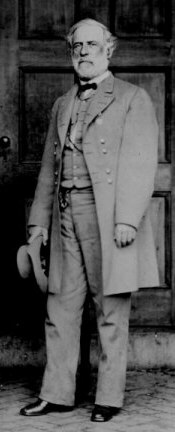
June 26, 1862, the battle at Mechanicsville was poorly executed by the Confederates, but it nonetheless forced McClellan to retreat to Gaines Mill. That evening, Gen. Robert E. Lee, who had replaced Gen. Joseph Johnston after Johnston's severe wounding at Fair Oaks, presided over a war conference with his subordinate division generals James Longstreet and Thomas "Stonewall" Jackson. The three generals stood around a table covered by a large map of eastern Virginia.
Lee chided, "Our attack on McClellan today was not executed according to plan. Thomas, you were uncharacteristically slow to start your attack."
"Sorry, sir," Jackson apologized. "We had coordination problems that I should have anticipated. Won't happen again."
"No matter," Lee said as he looked at the map. "Though we actually lost the battle, McClellan has retreated."
"I wonder why?" asked Longstreet.
Lee replied, "I knew him in Mexico. He's an excellent engineer, a perfectionist. He has us outnumbered. He really won today's battle, but he retreated. His problem is that he still thinks like an engineer instead of like a soldier."
"I know exactly what you mean, sir," commented Jackson.
Lee continued, "If he doesn't win a perfect victory, with almost no losses, and exactly according to plan, he thinks he lost. But war defies such perfection. We don't have to win battles. We just have to deny him perfect victories, bloody his nose, deny his expectations, and he will keep retreating."
"We can do that!" exclaimed Jackson heartily.
"Our job over the next few days, gentlemen," said Lee, "is to exploit his Achilles heel. If we do this, even though we are greatly outnumbered, even if we technically lose every battle, we can convince McClellan to defeat himself."
(return to table of contents)
Chapter 15:
Whither SlaveryGaines Mill (E) - June 27, 1862
A small group of runaway slaves made it to the Union lines, where they were taken into custody by Union soldiers and brought to a farmhouse headquarters for the Commanding Officer to decide their disposition. The runaways were brought up on the porch, and the commander, a colonel, came out smoking a cigar and looked them over. Then he ordered a lieutenant, "Our job is to win a war, crush the rebellion and save the union. That has nothing to do with freeing slaves. They are fugitives and must be returned to their owners. Send the niggers back."
______________________________ A mass meeting to recruit new soldiers met at a town hall in Terre Haute, Indiana, as a Union Army officer - a Republican - shouted to the crowd. He said, "For the Union to gain victory and survive, we need more men. Now, I've heard some complain that this war is about freeing niggers. That ain't so. I hate a nigger worse than I hate the devil. This war is about licking the damn Rebs!" The crowd erupted in cheers.
______________________________ Wendell Phillips (actually on 8/1/62) addressed an anti-slavery crowd near Boston: "That man in the White House has no mind whatever. He has not uttered a word that gives even a twilight glimpse of any anti-slavery purpose. He may be honest - nobody cares whether the tortoise is honest or not; he has neither insight...nor decision. The policy that prevails at Washington is to do nothing and wait for events."
______________________________ Blind mother-in-law of MO Rep. Frank P. Blair: "Of all things in the world I hate slavery the most - except abolitionism."
______________________________ June 1862....
Stanton and Chase were seated with Lincoln around the Cabinet table discussing Maj. Gen. Hunter's order freeing slaves. Lincoln holds in his hand a countermanding order.
Chase counseled, "I know, Mr. President, that General Hunter should have consulted you before issuing his order freeing slaves in the Rebel areas his army occupies. But now that he's done it, it would send the wrong signal around the world if you countermanded it."
Lincoln firmly asserted, "No commanding general shall do such a thing, upon my responsibility, without consulting me. Beside which, letting it stand would upset the delicate balance of what I'm trying to do with Congress to enact gradual compensated emancipation, which would give the Rebels a big carrot for coming back. I will not allow generals to run around fooling with politics. Politics is my responsibility not theirs."
Lincoln signed his order countermanding Hunter's freeing of slaves, with a look of firm determination.
______________________________ At this time, Lincoln was still attempting to persuade Congress to support gradual compensated emancipation of slaves, though in March, a bill to this effect failed to pass. Again in July, '62, Lincoln asked members of Congress to reconsider this concept as a way to enable ending the war and restoring the Union on terms the South might accept: "...in my opinion, if you had all voted for the resolution...of last March, the war would now be substantially ended. How much better to [spend] the money [otherwise sunk in the war on buying freedom for the slaves]. How much better to do it while we can, [before] the war [makes us financially] unable to do it..."
______________________________ July 4, 1862...
Senator Sumner stood next to Lincoln at a Capitol commemoration of July Fourth on the morning of that day. As a band played in the background, and troops marched by in review, Sumner said, "Mr. President, you could make Independence Day more historic and sacred than ever."
"How is that, Senator?" Lincoln inquired.
"Put forth an edict of emancipation this very day," Sumner urged.
Lincoln turned and looked straight at Sumner. He was incredulous at the naive stupidity of this man. "I would do it if I were not afraid that half the officers of the army and navy would fling down their arms and three more states would rebel against us," Lincoln replied.
Sumner shook his head and remarked, "Oh, Mr. Lincoln, some times I fear there is a great gulf between us."
"Not so, Charles," objected Lincoln. His mind boiled with the knowledge that had it not been for Sumner and just a few other extreme abolitionist zealots like him, it might have been possible to have negotiated the troubled waters between North and South without secession and war. But now Sumner was a powerful senator and Lincoln needed to cultivate his support. So he continued in a thoughtful tone, "From where I sit, timing is everything. You and I are separated by only a month - perhaps six weeks at most. We want the same end. But the means to an end depends on what is possible at the moment. And what is made impossible today by the inclinations of men, becomes possible tomorrow as circumstances change, causing men's inclinations to change. I must wait for the right moment and then seize it."
______________________________ Congressmen Owen Lovejoy of Illinois had been in Stanton's office for half an hour arguing with the Secretary of War about a new policy of reassigning soldiers between eastern and western theaters of the war. Finally, in exasperation, Lovejoy said, "But we have the President's order sir."
"Did Lincoln issue an order of that kind?" asked Stanton.
"He did, sir."
"Then he is a damned fool," sputtered Stanton.
"Do you mean to say the President is a damned fool?"
"Yes, sir, if he gave you such an order as that," affirmed Stanton as straightened his back, cocked his head up to one side, pushed his bottom lip up in a frown for emphasis and glared angrily through his spectacles at the hapless Congressman.
Amazed and indignant, Lovejoy quickly left and went directly to the White House, where he promptly reported to the President what Stanton had said.
Lincoln's placid reaction was, "Did Stanton say I was a damned fool?"
"He did, sir; and he repeated it!"
Lincoln stared thoughtfully at Lovejoy for a moment, mindful that he didn't want anyone to think there was high level discord in his administration, even if he had to appear to eat crow. Then he said, "If Stanton said I was a damned fool, then I must be one, for he is nearly always right. I will go over and see him."
He saw that Lovejoy was nonplused by his comment. No matter. Lincoln had long ago learned the value in being able to analyze and discuss an issue without seeing one's own standing as depending on it. His ability to do this had given him an advantage that always took his adversaries unawares. Besides, he wanted to know Stanton's logic, lawyer to lawyer.
Lincoln walked into Stanton's office, catching the Secretary at his desk engrossed in reading a lengthy military requisition. Stanton looked up surprised, and then stood. Lincoln said matter of factly, "Good afternoon Mr. Secretary. I've come to learn why I'm a fool," as he sat down on the big sofa against the wall.
"Now Mr. President, here are the facts," said Stanton as he stepped across the room and handed Lincoln a paper. As he stood over Lincoln, he said, "You must see from these facts that your order cannot be executed."
The President quickly scanned the document, put it down and then as he looked up at the hulking Stanton, he politely insisted: "Mr. Secretary, I reckon you'll have to execute the order." He wasn't going to explain to Stanton why that was so. Keeping the big political picture in balance was Lincoln's business, not Stanton's. His Secretary of War would have to learn to obey on faith, but for that to happen, he would have to play Stanton just right.
"Mr. President, I cannot do it. The order is an improper one, and I cannot execute it."
Softly, Lincoln persisted: "It must be done."
"It cannot be," repeated Stanton.
The President slowly and elegantly stood up, handed the document back, looked down at Stanton and without raising his voice or betraying the slightest impatience, said with finality, "Mr. Secretary, it will have to be done." Then with a faint smile, he just stood there and stared unflinchingly at Stanton.
After a long moment, the Secretary of War's demeanor softened, he gazed out the window, and said, "I see," as he crumpled the paper in his hand.
Lincoln quietly left, the fool no longer.
______________________________ Mid July, 1862...
A social reception was held at the White House attended by many congressmen and top ranking military officers. Rep. John W. Crisfield, member of a House committee studying the idea of gradual compensated emancipation, was noticed by Lincoln standing by himself at one side of the East Room. Lincoln walked over to the congressman and said, announcing a topic of importance to him, "Gradual compensated emancipated. Well, Crisfield, how are you getting along with your report? Have you written it yet?"
Crisfield, answered, "No, sir."
Lincoln looked Crisfield over, saw him as a stubborn mule, and then chided, "You had better come to an agreement. It's obviously much better to pay the South for the freeing of their slaves and thereby possibly end the war, than continuing to spend our money on a war that goes on and on. But if we don't do it soon, we won't have the money to buy the slaves' freedom because it will have all been spent on guns and bullets instead. So, I urge you fellows to get moving on this." Then in a provocative tone of irony, tweaking the congressman's supposed abolitionist principles, he added, "Niggers will never be cheaper, you know."
A butler stepped up to Lincoln and announced, "Sir, I present General Cassius Clay of Kentucky and your Ambassador to Austria, Mr. John Motley."
"Good evening, gentlemen," said Lincoln as he shook hands with each of them. "Come with me for a moment," he continued, as he motioned toward the central hallway, and the three walked to a more private corner. "Now tell me, Ambassador Motley, what is our situation in Europe?"
"Mr. President," Motley began, "our situation in Europe is most precarious. I've been to London, Paris and Berlin, and have found that all over Europe, governments are ready to recognize the Confederacy. Many are anxious to intervene and break our blockade of the South because of their commercial interests in the supply of cotton. I believe it has come down to just three things, any one of which could halt their march toward recognition. Here they are... One: a crushing defeat of rebel forces on the battlefield; Two: our getting control of major cotton ports, confiscating thousands of bales of cotton, and then releasing it for export to European factories; or Three: our unequivocal declaration of emancipation for the slaves."
"Any one of these three events would save us in Europe?" asked Lincoln. "Yes sir," replied Motley.
"Well, I've found that the first two are not very easily within my control - military victories and seizing Southern ports do not come at the waving of the presidential wand. And the third event, an emancipation proclamation is very dangerous. It could ignite a powder keg, triggering border states to leave us." Turning to Clay, Lincoln said, "Kentucky would go against us, and we are now fighting as many states as we can possibly hold off."
"You are mistaken, Mr. President," said Gen. Clay, "Kentucky will stay with us. The antislavery forces there now have the upper hand."
Lincoln stared at Clay for a moment, then said, "General, the Kentucky legislature is now in session. Go down and see how they stand and report to me."
"Yes sir," answered Clay. Lincoln turned and walked back to the East Room.
Two clergymen, Reverend Conway and Reverend Channing, were standing together across the room and Lincoln walked over to them. "Reverend Channing," said Lincoln, "as you know, I have long agreed with your idea of getting rid of slavery by having the government buy all the slaves and then free them."
"And how is that plan progressing in the government, Mr. President?" asked Channing.
"Not well. I wish you would talk to Congressman Crisfield, over there."
Conway said, "Sir, however it is done, free the slaves and you free America of its greatest evil. And if America ends slavery, won't that be an enormous boon to all mankind?"
"Perhaps," answered Lincoln, "but we may be better able to do something in that direction after a while than we are now. Right now, support for emancipation isn't broad enough."
"Are you sure, Mr. President?" asked Conway.
"Reverend Conway, no doubt you spend a lot of time meeting with people in the anti-slavery movement - probably much more time than you spend with people outside the movement. This being the case, don't you think that you possibly may over-estimate the number of people in the country who support emancipation? You see, the position in which I am placed brings me into contact with opinions from all parts of the country and from many different kinds of people. And so it appears to me that the great masses of this country care very little about the Negro, and are anxious only for military victory."
"Is that so?" commented Conway thoughtfully, who then said, "Well, thank you sir for inviting us and for listening to us."
Lincoln responded, "We shall need all the anti-slavery feeling in the country that can be mustered, and more. Go home and work hard to bring more people to your views - say whatever it takes to win them over, say anything you like about me, if that will help." Then he added with a short laugh, "Don't spare me!" as he started to walk away. Then suddenly a serious and thoughtful demeanor swept over Lincoln, and he turned back to say, "When the hour comes for dealing with slavery, I trust I will be willing to do my duty though it cost my life. And gentlemen, lives will be lost." He looked at them for a moment while that sunk in, and then turned and walked across the room.
Lincoln walked up to a delegation of four free Negroes and shook hands with each of them. Then he said, "Gentlemen, come with me please," as he led them to the place in the hallway where he could have a private conversation away from the party. "Gentlemen, I need your advice. Your race is suffering, in my judgment, the greatest wrong inflicted on any people. But even when you cease to be slaves, you are yet far removed from being placed on an equality with the white race... Some in the anti-slavery movement believe that the best solution is for freed blacks to become colonists... to whom we would give passage back to Africa or to someplace like New Granada in the Caribbean, where they would build new lives for themselves in freedom. I imagine that Negroes who are now enslaved may be happy to gain freedom conditioned on their becoming colonists to be sent away from America. But how do you who are already free think of such a plan? What do you think?"
After a pause, one of the African Americans spoke up, "Mr. President, we see no advantage in it. We know America. It is our home. Why should we be sent away? Because it would be more convenient for the white man if we disappeared? This country was built with our sweat as much, if not more so, as with the white man's sweat. It is our country too. We have a right to its bounty as well. Don't send us away."
Lincoln looked into the man's eyes for a long moment, then bowed his head and said, "I see."
______________________________ As Lincoln walked along the factory floor of a munitions plant in Washington with Stanton, he said, "Since Shiloh, we've learned two things. First, this war is not going to be won in a single great battle, because no single battle involves the majority of the enemy's troops and resources. Second, this war is not about real estate. It's not about taking and holding positions. It's about destroying armies. These two facts mean this war could go on for a long time - years and years."
"I know," Stanton agreed. "Do you think the people can stand it?"
"They've got to see progress. Real progress," Lincoln replied. "What ever happened to Grant? After his victories last spring, I thought he had promise. But he seems to have disappeared."
"Halleck sidelined him for a while when he took personal command in the field," Stanton answered. "Then when you made Halleck General In Chief, Grant was put back in the field out west, and now he's headed toward Vicksburg."
Lincoln remarked, "Ah, Vicksburg - the last rebel position on the Mississippi. If Grant gets that, then the entire Mississippi River is in our control and the Confederacy is cut in half. But it's going to be very tough to take. I was there many years ago. I know the area. The geography greatly favors the rebels."
Stanton reflected, "Grant should be the right man for the job, especially with Sherman at his side."
"Hopefully," agreed Lincoln. "Remember Scott's 'Anaconda Plan'?"
"Yes," acknowledged Stanton.
"We laughed at it a year ago," observed Lincoln, "but now I see the old warrior was right."
(return to table of contents)
Chapter 16:
Antietam And EmancipationJuly 22, 1862 - Lincoln's first proposal of Emancipation to cabinet

Lincoln was seated by a conference table in his office as Hay brought in a dispatch from McClellan, whose Army had been retreating after reaching the very gates of Richmond. Lincoln read the dispatch as the Cabinet assembled in his office, then said, "General McClellan, our 'Little Napoleon,' has stubbed his toe near Richmond, so now he and our one hundred thousand troops are in a general retreat." Seeking to lighten the air of the meeting, after the discouraging news from McClellan, Lincoln read aloud a short funny story sent to him by a friend. Lincoln laughed often, as did a few others. Chase had a look of some amusement, apparently to assuage Lincoln, and Stanton looked grim, and even indignant throughout.
When Lincoln finished reading the amusing story, Stanton commented, "Mr. President, I don't understand how you make light of things at a time like this."
Lincoln replied, "Mr. Stanton, with the load I'm carrying, if I couldn't laugh at a time like this, I would go mad."
After a moment of silent tension, Lincoln said, "The war is grinding on, and a successful outcome for the union is not in sight. European powers are getting close to recognizing the rebels, which would be a disaster for us. We must change our tactics, or lose the game. So I think now may be the time to adopt an emancipation policy to change the context of the war, and make it much more difficult for Europe to recognize or help the rebels. I have written a draft of an emancipation proclamation. Read it, and then you can offer your suggestions."
As they read the copies Lincoln's secretaries had put in front of each cabinet member, Lincoln studied their faces for some sign of reaction. After they each finished reading it, some stared at Lincoln in silence, others just stared at the wall. Then Seward said, "Mr. President, I approve of the proclamation, but I question the wisdom of issuing it at this time. It may be viewed overseas as the last measure of an exhausted government, a desperate move for European support while we're on the retreat. While I approve the measure, I suggest, sir, that you postpone its issue until you can give it to the country supported by military success."
Lincoln looked long at Seward, then at the other cabinet members, and then nodded and slowly folded the papers of the proclamation, got up, walked to his desk, and put the papers a drawer. As he slid the drawer shut, he looked back at his cabinet, and announced, "I'm replacing McClellan as chief of the Eastern Department with General Pope. He's a man of action from the west. Beat the Rebs at Island Number 10. Aggressive. That's what we need now, someone who isn't afraid to attack the Rebs. McClellan seems to think this war is some kind of a chess game - a game of strategy. Strategy is fine, but to win a war, you have to fight. Pope will fight."
8/62 Lincoln vs. Greeley (The following exchange between Lincoln and New York Tribune Editor Horace Greeley, actually took place in the form of an editorial in the Tribune on 8/19/62 and a public letter in response by Lincoln on 8/22/62. But to give a more lively picture of the relationship between these men and their conflicting perspectives, it is handled within the context of a meeting between the two men on the grounds of The Soldiers Home - Lincoln's summer residence in Washington.)
As Lincoln and Greeley strolled together along a pathway with a broad lawn on one side, and a forest nearby on the other...
Greeley began, "Sir, there are many among us who wonder whether you are not remiss. Remiss in doing your duty to quickly win this war and end slavery. You seem to be too afraid of the reactions of politicians from the border states." Lincoln continued walking with Greeley, but did not respond. Greeley continued, "We also must complain that a large proportion of our army officers actually seem more interested in upholding slavery than in putting down the rebellion."
Lincoln stopped walking, faced Greeley, and said, "Don't you see, the real nature of that problem? You think that as Commander In Chief, all I have to do is issue an order and everyone will carry it out. It's really not that easy. Ultimately, any order has to be carried out by men in the field. And if enough of them don't believe in an order, they can always find ways to get around it, to ignore it, to defeat it. Do you have any idea what the desertion rate is now?"
"It would be much lower if you would shoot deserters," contended Greeley.
"Easy for you to say, Mr. Greeley," Lincoln responded. "Easy for you to say. You don't have to face a mother who's already lost three sons to this war."
Lincoln turned and started walking again, his hands clasped behind his back and his head bowed in thought. He wondered if it was even possible to get through to a man like Greeley. Well, he would try. Then he said, "The primary issue for you, Mr. Greeley, is slavery. I abhor slavery. I've seen men and women in chains sold at auction, families torn apart. I've seen it with my own eyes. It's horrible. My personal wish is freedom for all. But my official duty may lead in a different direction. You see, the primary issue here cannot be slavery, it must be union, because without union the Constitution is nothing, and then the nation has no power, no future. I would save the Union... The sooner the national authority can be restored; the better for all. My paramount object in this struggle is to save the Union, and is not either to save or destroy slavery. If I could save the Union without freeing any slave, I would do it, and if I could save it by freeing all the slaves I would do it; and if I could save it by freeing some and leaving others alone I would also do that... Save the Union, and then all things become possible; without it, nothing is possible."
A gust of wind struck the two strollers, Greeley's hat was blown off, and he chased after it across the lawn. Oblivious to this and deep in thought, Lincoln kept walking on, and resumed talking, now to himself, as Greeley chased his hat. "This nation is balanced on the head of a pin. So every action, no matter how small, has to be carefully calibrated. If I make one false move, we will topple over."
Greeley, having recovered his hat, rejoined Lincoln. Just then, a young military aide ran up and handed Lincoln a telegram. He stopped and read it. Then he said to Greeley, "It's from General Pope. He signed it, 'Headquarters in the Saddle, Pope.' This general worries me. I'm afraid his headquarters are where his hindquarters ought to be."
2nd Bull Run (E) - Aug. 29, 1862
August 29, 1862. In the early evening, Lincoln walked across the street from the White House to the War Department to get telegraphed reports from Gen. John Pope, at Manassas, VA battling a Confederate army led by Gen. Thomas "Stonewall" Jackson. Lincoln took a seat near Stanton, who was seated next to the telegraph clerk, as word came in over the wire. The telegrapher handed Stanton a sheet with the transcription, which said that Pope had suffered a disastrous defeat and had been forced back across Bull Run. Stanton frowned and handed the sheet to Lincoln.
"Licked again." said Lincoln as he crumpled up the paper, put it on the telegraph table, got up and as he started for the door, turned to Stanton and said, "Put McClellan back. He's the only one who can train these new men and shape them up properly." He then walked out stoically.
[It's not exactly clear whether McClellan was every really replaced by Pope for a time as overall commander in the east. Some historical accounts, including Sandburg's, say yes. But the Army's own history in ROTCM 145- 20 implies that for a short time in the summer of 1862, Pope was brought east (after his victory at Island #10 on the Mississippi) and put in command of a new Army of Virginia, which did not include the Army of the Potomac, of which McClellan was still the commander in July-August of 1862. In any case, it is clear that Pope lost the battle of Second Manassas, was reassigned by Lincoln to Minnesota to fight Indians, and then the Army of Virginia was incorporated into McClellan's army.]
______________________________ Antietam (E) - Sept. 17, 1862
After Antietam: Preliminary Emancipation Proclamation
10:00 am, Saturday, September 22, 1862. The cabinet assembled in Lincoln's office, and took seats, waiting for Lincoln to arrive. A door flew open, and the cabinet members, expecting the President, all stood. But instead, Tad in his "little colonel" uniform came running through, whirling his lariat, and hooping and hollering, heading straight through the group for the second door, which he flew through and slammed shut. The cabinet members displayed various forms of surprise, annoyance and amusement as they began to retake their seats just as Lincoln walked in with his spectacles on, holding his second draft of the Emancipation Proclamation. One of his secretaries followed Lincoln into the room, distributing copies to the cabinet members. Once again, the cabinet was caught by surprise and they all rose again, then sat again when Lincoln did.
Lincoln looked over his spectacles from face to face of his Cabinet as they read the Proclamation again, and as before, searched for signs of their reactions. As was often the case with these high powered men, they seemed to be looking for reasons to object. Many a lower lip was jammed up in the frown of judgmental analysis. Good. He wanted to hear every objection anyone could raise to be sure he could knock them all down.
"Gentlemen," said Lincoln, "I had put the draft of the proclamation aside waiting for a military success. Well, finally we have one. Last Wednesday, our valiant troops delivered a great defeat to the rebels at Antietam, and have hurled back their attempt to invade Pennsylvania. Now we have the credibility of power we need in order to issue the Emancipation Proclamation and have the Europeans take it seriously. Freeing the slaves has the sympathy of the broad masses of the European people, and so with this proclamation, their governments will not dare recognize the rebels."
"But Mr. President," said Postmaster General Montgomery Blair, "issue this proclamation and the border states will all revolt."
"Monty, that is a risk that has troubled me greatly," replied Lincoln. "That is why I have exempted the loyal border states. They can see to emancipation themselves in their own way."
"Sir," said Treasury Secretary Salmon P. Chase, "This proclamation is very curious indeed, because it actually doesn't free a single slave, in that it only applies to rebel areas we don't control."
Lincoln replied, "But as those rebel areas are overrun by our advancing armies, then their slaves will be freed. This is a very carefully weighed move. It is to be announced as a 'Preliminary Emancipation Proclamation.' The most important things about it are the words 'Emancipation Proclamation' in its title and its statement of principles. This statement has political power that will weigh heavily both here and abroad. The technicalities of its application, for the moment, are purposely very weak, so as not to offend states or parts of states that are loyal to us. But as a statement of principles, it will give people time to get used to the idea before we move to total emancipation.
"The final proclamation will be scheduled for three months from now on January first. This will give us time to gauge the reaction to the idea, and if it undercuts the resolve of our troops to fight to restore the Union, then we can postpone issuing the final proclamation. But in the meantime, it will have stopped recognition of the rebels by Europe."
Secretary of State William Seward said, "Mr. President, I suggest that you add the words, 'and maintain,' so that it will read '...the government shall recognize and maintain the freedom of such persons.'"
Lincoln immediately made the change on his copy and said, "Done."
______________________________ A celebratory crowd had gathered with a brass band beneath the White House balcony on Monday, September 24th, on the day the Preliminary Emancipation Proclamation was published. Lincoln stood on the balcony and addressed the crowd:
"...I can only trust in God I have made no mistake...It is now for the country and the world to pass judgment on it. Its implementation is surrounded by enormous difficulties. Yet they are scarcely so great as the difficulties of those who, upon the battle field, are endeavoring to purchase with their blood and their lives the future happiness and prosperity of the country."
As Lincoln finished speaking, the brass band on the lawn started to play a happy rendition of The Battle Hymn of the Republic. Lincoln turned, left the balcony and came inside where he was met by War Secretary Stanton. Lincoln asked, "Has McClellan taken up the pursuit of Lee yet?"
"No sir," answered Stanton.
Lincoln shook his head and said, "I fear McClellan has the slows again."
______________________________ September 27th, near Antietam, General McClellan was in his tent with his visiting wife seated next to him as he finished reading the Preliminary Emancipation Proclamation in the Baltimore Sun.
"My dear wife!" exclaimed the general, full of indignation. "Look at that outrage! Emancipation Proclamation, indeed! I shall resign tomorrow! What does he think we've been fighting for? We're fighting to save the Union, not to free the slaves, dammit! The good of the country requires me to submit to men whom I know to be vastly my inferiors, socially, intellectually and morally. There never was a truer epithet applied to a certain individual than that of 'Gorilla.'"
(return to table of contents)
Chapter 17:
A Place Worse Than HellLincoln faces McClellan and his "slows" for the final time....
10-3-62 Lincoln & McClellan meet at Antietam, and Lincoln tries to persuade the general to move quickly after Lee to crush his army before it can be reinforced and refreshed. McClellan resists. An excerpt...
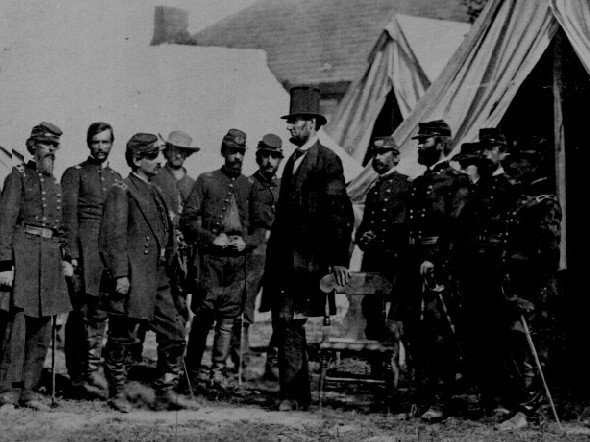
...Lincoln posed with McClellan and his staff for the photographer, Alexander Gardner, in front of tents at McClellan's Grove Farm headquarters. As he paused for Gardner to get his picture, Lincoln's mind anticipated the objections he knew McClellan would likely raise to getting his army moving quickly after Lee. He also knew it would be as futile to simply order McClellan to march south as it would be to order the tides to go out an hour earlier. Yet this was a ripe opportunity, Lincoln thought, to wipe out Lee's army and force an end to the rebellion. Somehow, he had to persuade McClellan. The picture taken, president and general conferred in the general's tent, where they sat on camp chairs across a map table from each other.
"May I offer you a cup of coffee, Mr. President?" asked the general.
"No, thanks," replied Lincoln. "Like I said, you did a fine job of stopping Lee's drive north and forcing him back. But, don't you agree that in his weakened condition, now is the time to pursue and finish him off?"
"Lee still has a big and formidable army," answered the general, "every bit as many men as we have, probably more. It was all we could do just to stop him. He can't repair his condition any time soon, and we need time to rest, take care of our wounded, and bring up supplies for pursuit. To pursue now without proper preparations, and without enough men would be foolhardy. We need at least another 20 thousand men to have a chance of defeating Lee."
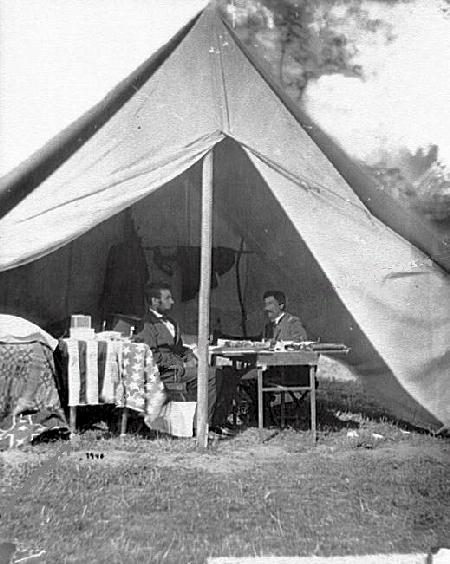
"You had 30 thousand held in reserve while you beat Lee to a halt here. Surely you have enough men."
"I don't think so, sir. In any case, they need more rest to rebuild their strength for a hard march south. Otherwise, we'd just be going off half cocked again, like both battles of Bull Run. I don't want to just throw men away and gain nothing - that's what happened both times when our army was forced to move at Bull Run before it was ready."
"General, how ready is ready? If we wait too long, another opportunity to strike the blow that will win this awful war will be lost."
"Mr. President, we consumed half our ammunition in this battle. It isn't all replaced yet. We lost 12,000 men. They're not all replaced yet, and when they are, we still may not have enough to beat Lee in a chase. But I think we should be in shape to go after him before long."
"The battle was on September 17th. It is now October 3rd. How long is long?" asked Lincoln with a tinge of impatience.
"This month," said McClellan.
Lincoln got up to leave. As he turned toward the tent opening, McClellan was slow to rise from his seat. According to protocol, when the President stands, anyone else should immediately stand as a show of respect. McClellan, gathering some papers from the table then said with a slight tone of condescension, as if he were an instructor in military tactics addressing an inexperienced student about a key element of strategy, "Besides, Mr. President, if we attacked now, we wouldn't have the element of surprise."
Lincoln stopped, half turned his head toward McClellan and said, "You'd surprise me!" And then he picked up his black stovepipe hat, stepped outside, put on his hat and walked alone toward his own tent, hands clasped behind his back and head drooped as he contemplated his military frustrations.
Early the next dawn, Lincoln got up at the sound of a rooster crow and awakened one of his aides, Ozias Hatch. Lincoln said, "Come, Hatch, I want you to walk with me." Wordlessly, they dressed and then the two of them walked through the lanes of the army's tent city as it began to stir.Curiously, as the army awakened, one heard a rolling roar of coughing - a phenomenon that occurs when thousands of men in tents wake up at the same time. Lincoln's serious, somewhat grim mood, infected Hatch as well as they climbed a nearby hill without speaking a word. Then Lincoln stopped, and they looked over the city of tents below as soldiers arose and went about their morning chores. Lincoln turned to Hatch and said with irritation, "Hatch..., what is this," as he waved his hand over the scene below, conveying his growing sense of dismay.
"Why, Mr. Lincoln, this is the Army of the Potomac," answered Hatch, bewildered by the question.
Lincoln silently surveyed the scene below for a moment, then turned to Hatch and with a look of mixed anger and frustration said, "No, Hatch, no. This is General McClellan's bodyguard." He stared at Hatch for a moment letting this sink in, and then brusquely turned and headed back down the hill toward the encampment.
__________________________ McClellan continued to delay pursuing Lee, so an exasperated Lincoln finally decided to fire him...
Lincoln met with Secretary of War Edwin M. Stanton and General Henry W. Halleck in Stanton's office at the War Department to discuss replacing McClellan. Stanton was seated at his large papers strewn desk, and Lincoln and Halleck - the bureaucratic chief general - sat across from him. Lincoln stood, stretching his arms almost to the ceiling as if to relieve a sudden tension, then walked around behind his chair, grasped its back and leaned on it as he started to speak. "I said I'd remove McClellan if he let Lee get away from him, which he has. Again, he's got the slows."
"And there's his letter trying to tell you how to run the government," suggested Stanton.
A brief knowing smile swept across Lincoln's face and he said, "Well, that reminds me of the man whose horse kicked up and stuck his foot through the stirrup. He said to the horse, 'If you're going to get on, I might as well get off.' But much worse...I found he lied to me about how many troops he left to protect Washington during the peninsula campaign. He disobeyed me and left the Capitol unprotected. McClellan's problem is that he's very very bright, but not very smart."
Puzzled, Halleck asked, "Bright but not Smart? Aren't they the same?"
"No. Big difference!" answered Lincoln. "Both 'Bright' and 'Smart' people can be very knowledgeable, which makes them hard to tell apart. But analytical depth and judgment make the difference - smart people have them, but people who are only bright don't." He sat down.
"Interesting observation, sir," Stanton remarked.
"Since I took this job," Lincoln explained, "I've often seen that very bright people, like McClellan, are quick thinkers with lots of clever ideas. But he taught me that people who are very, very bright can make decisions that are very, very stupid. It's because bright people tend to be shallow, and make judgments and decisions without really using their heads."
"In what ways, Mr. President?" Halleck inquired diffidently.
"Remember Yorktown?" Lincoln reminded them. "When McClellan was fooled for a month into believing that 14,000 Rebs were an army of 90,000? Why? Because his mind just skated on the surface and didn't try to really penetrate the situation. He didn't ask the right questions."
"Ah, the right questions!" said Stanton, as if Lincoln had whistled a favorite tune.
"Yes, like you and I had to ask in courtroom cross-examinations," Lincoln pointed out, looking at Stanton.
"True." said Stanton.
Thinking of McClellan's failures caused another wave of exasperation to wash over Lincoln, and he said, "Oh, God save us from bright people! So shallow - like McClellan, our 'Little Napoleon'."
"Some Napoleon!" exclaimed Halleck sardonically.
In an instant, Lincoln read Halleck. He saw how the general quietly relished the opportunity to take a whack at McClellan, especially if the opportunity was free, created by his superior, so that Halleck was covered and could not be accused of initiating the whack. Halleck had his uses, Lincoln thought, but he would have to be wary of the general's objectivity. The President now instructed his subordinates with a tone of righteous conviction, "Give me a general who's smart, not just bright. Give me a general who fights!"
"How about Burnside?" suggested Halleck. "He's no intellectual, and he proved at Antietam that he's not afraid to fight."
"Much other battle experience?" asked Lincoln.
"Some. A West Point man," said Stanton. "His Rhode Island regiment was one of the first to protect Washington. Last spring, led a joint Army and Navy attack that took Roanoke Island. Captured over 2500 prisoners and over 30 cannon."
"What do his men think of him?" Lincoln asked. "How well will they follow him on the offensive?"
"He seems to be well regarded," said Halleck.
"Strategy and tactics?" Lincoln inquired.
"Should know them as well as anybody by now," replied Halleck cautiously.
Lincoln stared at the carefully impassive Halleck and replayed the general's words in his mind, "SEEMS to be well regarded." "SHOULD know them as well as anybody..." Halleck was hedging. Why? But Stanton spoke straight. Stanton is conscientious and thorough. He knows the man's resume and recommended him. Yes, Burnside did attack fearlessly at Antietam. But is he smart, really smart? Impossible to know from the information he had, Lincoln thought. He'd never met the man, and there was no time now. What were his choices? Bring in someone from the west? The situation was too delicate out there to pull anyone back now. Better leave the west alone. There is Hooker, but he's as big a risk as Burnside. They think Burnside can do it. On balance, Lincoln had no reason to believe that he couldn't.
"Well then, maybe he's our man," declared the President. "Write it up. Remove McClellan." Then with a note of irony he said, "Send our 'little Napoleon' to the Trenton army post, where he'll be out of our way. But he'll need a big map and a big box of tin soldiers."
Halleck chuckled.
Again serious and determined, Lincoln continued, "Yes, give the Army of the Potomac to Burnside. And tell Burnside to get moving after Lee!"
Lincoln got up to leave, and the others stood. He took a few steps toward the door, then turned and said, "No more bright ideas. I want victories. Real victories! I want Lee's complete and total surrender."
Then he turned back toward the door, stovepipe hat in hand, and walked out with a purposeful gait.
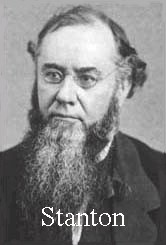
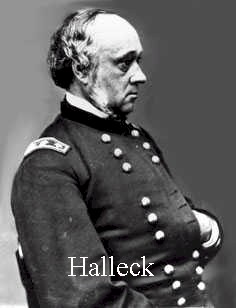
"Box of tin soldiers?" asked Halleck.
Stanton replied, "Oh, he didn't really mean it. He's too kind for that, even with McClellan." Then with a sly gleam in his eye, Stanton asked, "So what are you, Henry? Are you a bright general or a smart general?"
"Good day, Mr. Secretary," responded Halleck coolly, as he stood and walked out.
____________________________ Army post, Trenton, N.J....
Gen. McClellan was unpacking in his new office when an aide entered carrying two items - a large map rolled up, and a large elaborately decorated oak box.
"General Halleck sent these to you, sir," explained the aide. "He said in a note that they're for you from the President."
"Really?" remarked McClellan with surprise.
McClellan unrolled the map - the map of eastern Virginia he had shown to Lincoln before the Peninsula Campaign. He looked a bit puzzled as he laid it on a table and motioned to the aide to set the box on top of it. McClellan opened the box, and when he saw the tin soldiers inside, he erupted in a rage and smashed the side of the box with his fist, sending it flying across the room, spilling the tin soldiers all over the floor. The helter-skelter pile of tin soldiers on the floor looked particularly forlorn.
____________________________ December 13,1862 - Battle of Fredericksburg, a Burnside disaster...
Lincoln was personally mortified by the disastrous result of his choice of Burnside, who turned out to not be very smart after all, even though he was more aggressive than McClellan and temperamentally the opposite of McClellan. Lincoln had confused a difference in temperament with the smart-bright difference he'd been looking for. An excerpt...
____________________________ Gen. Burnside's disastrous frontal attack on the well fortified Rebel position at Fredericksburg inflicted the Union attackers with horrific losses. Lincoln, seated in the War Department's telegraph office, got news of the Army of the Potomac's battle disaster. His head dropped to his hands, tears began to well up in his eyes, and he said to Eckert, the telegrapher, "If there is a worse place than hell, then I am in it."
Slowly he got up and left alone for the White House. Outside, he put on his stovepipe hat, and with sunken shoulders, head tilted down and hands clasped behind his back, he trudged back to the White House under a stormy sky, deep in sorrow, frustration and misery. As he crossed Pennsylvania Avenue with thunderslaps sounding nearby, a cloudburst pelted him with heavy raindrops that he ignored. As he entered his second floor office, he took off his soaked hat, and with a barely audible trembling voice he asked his secretaries Hay and Nicolay to leave him alone. They looked at him and each other in dismay, and as they left, he closed the door and locked it. Then he turned and stared into the eyes of the Gilbert Stuart portrait of George Washington, who seemed to be passing judgment on him.
Lincoln felt himself falling through the ice again into the dark and frigid lake of unknown depth. He sank into a chair at the Cabinet table, pushed aside a pile of letters pleading for presidential favors, put his elbows on the table, clasped his head in his hands and wept. Lincoln imagined awful scenes of the aftermath of the battle - the suffering on both sides, the bodies of the wounded writhing in pain on the battlefield amidst a multitude of grotesquely disfigured corpses. He cried to himself, "I chose that damn fool general. I chose him. Where was my head? I wasn't smart enough. I didn't ask the right questions! I sent thousands of men to their deaths. And for what? And for what? Nothing accomplished."
His mouth opened wide, and after a moment of stillness as he gasped inward, a scream of hideous agony burst out from the depths of his tortured soul, shattering the air like the blast from an exploding cannon ball.
He could hear the door being shaken, and the muffled voices of Hay and Nicolay calling, "Mr. President! Mr. President!" At first, he ignored them. Then hearing more commotion outside the door, and afraid they were about to break in, he called out sternly, "Leave me alone!"
The commotion outside the door stopped. Slowly, he opened his eyes and focused them again on the portrait of Washington. Through the window, he saw fast moving clouds closing out the twilight of the western sky and forming a massive thunderhead. The dusk light on Washington's portrait dimmed as the clouds darkened. Then lightning roared outside, and Lincoln saw its flashes play across the serene face of Washington. Would he have understood? Would he have known what to do?
(return to table of contents)
Chapter 18:
Proclamation And DiscontentDecember 15, 1862 - Chase & Senators try to get Seward dumped
Political intrigue between the ambitious Secy. of Treasury Chase and Senator Sumner - two extreme abolitionists - against the more moderate Secy. of State Seward forces a Cabinet crisis on Lincoln, which he deftly handles, outmaneuvering his antagonists...
It was early evening on Pennsylvania Avenue as snow flurries swirled in the air, blown by boisterous and chaotic gusts. By the gas-lit streetlights, horse drawn carriages with lanterns lit ran back and forth on the roadway, and bundled up people scurried to and fro on the sidewalks and across the street, like rats looking for their holes. One could hear snatches of conversations as people rushed around, and the words were gossipy whispers with conspiratorial accents...
"Seward has Abe in his grip."
"Mary Lincoln's brothers are in the Reb army. You know she's a spy!"
"That incompetent old gorilla must be impeached."
Through a frosted townhouse window, one could see Treasury Secretary Salmon P. Chase standing in his parlor talking heatedly to Senator Sumner, waving his arms while holding a letter in one hand. One might hear the anger in Chase's muffled voice, but the words were a blur. Sumner was nodding his head in agreement. Chase gave Sumner the letter, and Sumner rushed outside into the blustery night.
Just outside a corner door of the capitol building, several senators arrived from different directions and rushed through the door - anxious to get out of the weather and into the caldron of their cabal.
Inside a Senate caucus room, senators entered and took off their overcoats, while mumbling to each other about something that had most of them quite agitated and worried. Sumner entered and handed the letter to Senator Jacob Collamer of Vermont, who looked at it and then exclaimed, "Here it is. Seward wrote to Ambassador Adams: '...the extreme advocates of African slavery and its most vehement opponents acted together to precipitate this Civil War - the former by making the most desperate attempts to overthrow the Federal Union, and the latter by demanding an edict of universal emancipation...'"
Collamer passed the letter to Senator Morton Wilkinson of Minnesota, who glanced at it briefly, shaking his head, and then said, "This is perfidy. Our cause is lost. The nation is ruined. Seward has a controlling influence on the mind of the president. Seward doesn't believe in the war, and as long as he remains in the Cabinet, nothing but defeat and disaster can be expected."
Senator Benjamin Wade of Ohio stood, frowned heavily, with eyes scanning the room, and then announced gravely, "We must meet with the president and demand that he dismiss Seward immediately. We must also demand that he put Republican generals in command of the army. His Democrat generals don't believe in the war and they don't fight worth a damn."
Senator Preston King of New York abruptly left the meeting, and headed directly for Seward's house to warn him.
Down the capitol building hallway, and through a locked door into another conference room, dimly lit by the gas lighting, sat half a dozen other senators at another meeting. Their faces could barely be seen as they hunched forward over the table toward each other, speaking in hushed tones.
"This president is a disaster."
"Battles are being lost, thousands of our young men killed, because this idiot jokester keeps appointing Democrat generals to lead the army."
"That bitch of a wife of his is feeding secrets to the Rebs. Her family are all Rebs. Mary Todd Lincoln should be tried for treason and then hanged."
"We must start a secret investigation immediately."
__________________________ Interior, Seward's house as Senator King rushed in. "Bill, I've just come from a caucus of Republican senators, and they're after your head based on your letter to Adams."
As Seward chewed on a cigar, he asked, "My letter to Adams?"
"Yes, where you blame the war on extremists of both sides."
Seward responds, "The truth is hard to bear...so kill the messenger. I smell Chase in all of this. They seem to forget I was one of the leading founders of the Republican party."
King added, "They think you don't support the war and so they want you out. Chase must be behind it. They'll see Lincoln tomorrow to demand your dismissal. They were each pledging to keep this secret, but I said I wouldn't be bound. I left before they voted on a statement to the President. Slipped out to tell you, 'cause I thought you oughta know."
Seward frowned, thought for a moment, then turned rapidly, sat at his desk, and quickly wrote a short note, which he handed to King, saying, "They may do as they please about me, but I won't let them try to bully the President. That's my resignation, Preston. Will you take it to Mr. Lincoln for me right away?"
__________________________ Lincoln's friend, Senator Orville Browning of Illinois met with the President in his office. Both men were seated next to the Cabinet conference table. Lincoln was hunched over the table, leaning on his elbows, doodling with a pencil on a piece of paper that he stared at with a frown of displeasure. He was in a foul, frustrated mood. If he had known this job would be ninety percent frustration, he would never have taken it. But now he was stuck; stuck with having to kowtow to idiots; powerful idiots. He asked Browning, "Were you at the caucus yesterday?"
"Yes, sir."
"This uproar has already pushed Seward to submit his resignation, which I haven't accepted yet. What do these men really want?" asked Lincoln.
"I hardly know Mr. President, but they are increasingly hostile toward your administration..."
Lincoln commented, "They wish to get rid of me, and I am sometimes half disposed to gratify them... We are now at the brink of destruction. It appears to me the Almighty is against us, and I can hardly see a ray of hope."
Browning, surprised by the darkness of Lincoln's words, replied, "Be firm, Mr. President, and we will yet save the Country. Do not be driven from your post, sir."
With great exasperation, Lincoln jumped up and paced the room as he said, "Why will men believe a lie, an absurd lie, that even a child wouldn't believe, and then cling to it and repeat it in defiance of all evidence to the contrary?"
John Hay entered momentarily to announce, "Mr. President, the senators are arriving now at the front portico."
Browning got up and said, "I'll go wait outside and come in with them."
"Yes. Probably better if they don't know we've spoken. These events make me more distressed than anything else that's happened here," said Lincoln, almost reduced to tears as they both stood and Browning stepped outside to the waiting room and closed the door.
Lincoln stood by the cabinet conference table frowning down at a map showing army positions. With his dark beard and the heavy lines of his face, when he frowned he looked fearsomely ghoulish. Behind him, the door opened, Hay announced the visitors, and the committee of Republican senators filed in. Lincoln's demeanor immediately changed. His face lit up with cordiality and friendliness, he turned toward them, and the master politician went to work. "Good morning, gentlemen," he said. "How is this weather treating your back, Charles?" Lincoln asked Sumner cheerily.
"A pang now and then," Sumner answered, and then continued, "Sir, we have some serious concerns..." Everyone took seats, Lincoln faced the senators across the table, then Senator Collamer stood and began reading a statement:
"Mr. President, we must persevere in this war to save the Union. But this effort can only succeed if the President can rely on the wisdom of the Cabinet and its solidarity for winning this war. Unfortunately, we have found that Mr. Seward and others in high places of command do not support continuing this war to its rightful conclusion. We believe that the responsibilities for prosecuting this war must not be placed in the hands of anyone who is not a steadfast champion of the Union cause and of winning the war. In short, sir, we have lost all confidence in Mr. Seward and urge that he be dismissed."
Lincoln just stared grimly at Collamer as he sat down. After a long pregnant pause, Senator William P. Fessenden of Maine stood and said, "Mr. President, let me assure you that we have the utmost faith in your patriotism and integrity, and have no desire to dictate to you regarding the Cabinet. But we don't believe Mr. Seward agrees with the majority of the Cabinet. Further, in the Army, every general with a reputation for being antislavery has been demoted, disgraced or sidelined. And McClellan is being used for advantage by the Democrats." He sat, and Lincoln stared at Fessenden, saying nothing. Lincoln would let them stew in their own juices.
After another uncomfortable pause, Sumner rose and said, "Sir, we have seen official correspondence that Seward has sent out, which shows a most offensive disrespect for Congress. I know these were sent without your knowledge or approval, so I don't criticize you, sir." Sumner handed Lincoln a copy of the Seward letter and sat.
Lincoln scanned the letter briefly and then stood, walked over to a window and looked out at the city pensively for a moment, glanced down at the letter, then turned and walked back toward the senators. He set the letter down on the table, and in a calm and reasonable tone, said, "Seward is a good man. You're really picking at straws here. Out of a huge body of Seward's work, which has been absolutely crucial in keeping Europe out of this war, you have chosen a few bits of chaff, minor examples of his occasional moments of frustration. The generals? There are very few Republican generals, and most haven't done well. Just one of the many ironies of this war. When it comes to the military, I've found political affiliation is irrelevant in finding good generals. Bullets don't care what party a general belongs to. The Rebs just aren't any more inclined to get whipped by Republicans than by Democrats. However, I will look into your concerns, I'll discuss them with the Cabinet, and then we can meet again and thrash out our mutual frustrations together." He smiled and picked up a document in a way indicating the end of the meeting.
A few of the senators smiled back, and one said, "Thank you, Mr. President." Sumner was not smiling - he and Chase had been outfoxed again.
__________________________ The shadowy senate conference room, with half a dozen senators gathered around the table, some seated, some standing. One senator spoke up, "We must hire a detective to keep an eye on Mrs. Lincoln for a couple of weeks. All we have to do is catch her sending a letter to her southern brethren, and then we've got her. All in favor, say aye."
"Aye." "Aye." "Aye." "Aye." "Aye." "Aye!"
"Unanimous. Once we have the proof on her, we can impeach the gorilla."
"Yes, and maybe hang the imperious bitch too."
"That would bring her supreme royal majesty down a notch or so."
__________________________ A cabinet meeting had just started in Lincoln's office, everyone seated. Seward was not present. The door opened and Secretary Chase joined them, closing the door behind him, and he took a seat directly across the table from Lincoln, who said, "Gentlemen, a number of Republican senators are raising Cain about Seward, and so he has tendered me his resignation, which I have not yet accepted. The senators claim to be upset about a dispatch Seward sent to Adams in London, where he blames the war on extremists. Of course, this is really just a smoke screen. What they're really upset about is the influence they think he has on me." In a grave voice and an ominous expression, Lincoln continued, "They think Seward controls me." He stopped talking, and then looked from face to silent face around him, holding his ominous expression. There was a very awkward silence in the room, and then suddenly, Lincoln threw back his head and laughed as he spit out, "They think he controls me!"
No one else laughed. Lincoln got serious again and then said, "I guess someone is envious of Mr. Seward, for some reason I can't imagine," as he looked sternly at Chase.
Then Chase said, "I've thought about this sir, and I decided to compose a letter of resignation to you this morning."
Lincoln suddenly brightened with a slight smile, leaned toward Chase across the table, and quickly asked, "Do you have it with you?"
"Yes."
Lincoln thrust his hand toward Chase and said, "Give it to me now," as his smile broadened.
Chase was taken aback by Lincoln's attitude and hesitated.
Lincoln shook his hand in the air and said, "Come on, come on!"
Awkwardly, Chase took the letter from his pocket and handed it to Lincoln, who quickly opened it, read it, and then looked up with an expression of triumph, saying, "Wonderful!" as he took Seward's letter of resignation out of his pocket and put the two letters down on the table in front of him side by side. "I can ride on now. I've got a pumpkin in each side of my saddlebags now - a perfect balance."
Chase was all the more confused, chagrined and deflated. He knew he had been outmaneuvered, but he didn't quite see how. Then Lincoln said, as he stood up, "That'll be all this morning, gentlemen."
The Cabinet members all left, except Chase, who waited until the others had left to ask, "So, Mr. President, are you accepting my resignation?"
Lincoln spun around to face Chase, put his hand on Chase's shoulder and said, "Of course not, Salmon. You're much too valuable to me and the nation. Go back to your office and continue the excellent work you are doing managing our finances. You are making miracles, Salmon. Keep making them. And don't worry yourself about Seward. I really do have him well in hand."
__________________________ In the White House family quarters, Mrs. Lincoln was in her study writing as her secretary entered and said, "Mrs. Lincoln, Mr. Jones is here now. He's the new tutor for Tad."
Mrs. Lincoln turned in her chair and looked up as Jones entered and shook hands with her. "Ah, Mr. Jones, " she said, "I hope you have more patience than the last tutor had for Tad."
Jones said, "Pleased to meet you ma'am. I'm sure I'll be able to get the boy back into his studies." Jones was a tall thin man in his early thirties with a blonde goatee, piercing blue eyes and a look of earnestness. He glanced over Mrs. Lincoln's shoulder at the letter she was writing and saw that it began, "My dear brother," and then he smiled, realizing that his job was going to be easier than he had thought.
_____________________________ Murfeesboro (W) Dec. 31, 1862 - Jan. 3, 1863The Emancipation Proclamation - January 1, 1863
December 30, 1862. In a hallway of the Capitol, Senator Sumner was standing talking with Sen. Wm. Fessenden of Maine. Sumner said, "New Years day is fast upon us, which is to be the day of the final Emancipation Proclamation, but there has been no definite word from Lincoln about it. I'm worried. He's being pulled in so many directions. I'm afraid he's dropped it."
Senator Orville Browning of IL, walking by, overheard the conversation, joined the other two and said: "Charles, if he drops it, that is good news. I'm afraid that proclamation is fraught with evil, and evil only. It will incite uprisings of Negro slaves and mass murders of whites. There'll be race war. This is the wrong way and the wrong time to go about emancipation."
Sumner countered, "Orville, there won't be an uprising. But if there was, it would be to our advantage."
__________________________ 10:00 am December 31, 1862. A cabinet meeting was in progress. Lincoln said, "I gave you copies of the final proclamation yesterday for your review. Any comments?"
Secretary Chase said, "Mr. President, I thought the language needed improvement, so I took the liberty of redrafting it. I thought this, or something like it, would be appropriate," as he handed a complete new draft to Lincoln, who looked over his spectacles at Chase with some annoyance.
Postmaster General Blair asked, "Sir, I am still puzzled by the exception made for certain Louisiana parishes and Virginia counties that are under Union control. They are in the very heart of slaving, and unless there is good reason of which I am unaware, why should they be exempted?"
Lincoln replied, "Well, upon first view your objections are clearly good. However, after issuing the preliminary proclamation in September, we've had discussions with loyalists in those areas who felt we could more easily maintain our control there and get elections in our favor if we exempted them. So I agreed. Would you have me go back on my word?"
"Oh, no sir," agreed Blair.
Lincoln quickly scanned Chase's draft and continued, "Now Chase, I like your last sentence. With a slight change, I'll use it thus: 'And upon this act, sincerely believed to be an act of justice, warranted by the Constitution, upon military necessity, I invoke the considerate judgment of mankind, and the gracious favor of Almighty God.'"
"As you wish, Mr. President," replied Chase.
"I'll sign it tomorrow," said Lincoln. He held the document out to where he could admire the look of the whole proclamation, and then thought that in this at least, he would surely be doing God's will.
__________________________ 9:00 am January 1, 1863. The White House East Room: the traditional New Year's reception was being held by President and Mrs. Lincoln. Thousands of people were streaming through the receiving line to shake hands with the president....handshake after handshake after handshake.
2:00 p.m. January 1, 1863. The president's office, the White House. Lincoln entered with Secretary Seward and his son Fred Seward, who carried the official version of the proclamation, ready for the president's signature. Lincoln sat at his desk and Fred slid the document in front of him. After dipping his pen in ink, Lincoln held it in the air and paused to say, "I never, in my life, felt more certain that I was doing right, than I do in signing this paper. I've been shaking hands since nine this morning, till my arm is stiff and numb. Now this signature is one that will be closely examined, and if it looks like my hand trembled they will say, 'he had some reservations.' But anyway, it is going to be done."
The President put his pen to the paper and signed, "Abraham Lincoln," clearly and firmly.
5:00 p.m. January 1, 1863 Boston, MA. In the front window of the Boston Herald, the day's front page was pasted up by a clerk, to be seen by passerby who quickly gathered to read it. The entire page was taken up by the final Emancipation Proclamation, issued earlier that day.
At a meeting of the members of the Union Progressive Association in Boston's Tremont Temple, including several African American members, Frederick Douglass stood in front and read from the proclamation: "...on the first day of January, in the year of our Lord one thousand eight hundred and sixty-three, all persons held as slaves within any State or designated part of a State, the people whereof shall then be in rebellion against the United States, shall be then, thenceforward, and forever free..."
Wild cheers came up from the audience.
A lineup of several cannon on the Commons in the center of Boston were fired in commemoration of the Emancipation Proclamation.
That day, cannon were also fired on battlefields.
____________________ The Senate investigation of Mrs. Lincoln
Lincoln walked alone hat in hand down the long corridor of the Capitol's Senate wing, windows on his left and a wall with doors spaced every twenty feet on his right. He focused on a door ahead labeled, "Caucus Room B - Private." A clerk opened the door and came out, was about to close the door and then saw Lincoln heading toward it and stopped stunned in his tracks. As Lincoln kept coming, the clerk backed away, leaving the door open, and stood to the side clutching his papers with his mouth hanging open. Lincoln stopped just outside the door and listened. Inside the shadowy Senate conference room, the secret investigation committee was in session. The chairman was speaking, and he said, "Here we have evidence. A letter written by Mrs. Lincoln to one of her brothers."
"Which brother?" asked a senator.
"David Todd."
"What does the letter say?"
"Well nothing obvious. It purports to just talk about family nonsense, but it is surely in code."
Lincoln stepped through the door. Backlit from the brightly lit outside hallway, the senators saw a very tall slender figure of a man standing there momentarily, not recognizing him at first. All conversation stopped, and all eyes in the room went to Lincoln's dark figure, his face still not visible in the shadows. He walked slowly into the room and stood at the end of the table, seeing members seated around two sides of it with the chairman at the other end. Seated next to the chairman was the young man who had posed as a tutor for Tad. Then Lincoln began to speak : "I, Abraham Lincoln, President of the United States, appear of my own volition before this Committee of the Senate to say that I, of my own knowledge, know that it is untrue that any of my family hold treasonable communication with the enemy."
He stood a moment longer, then turned around and walked back out the door into the hall. As he walked away, through the open door of the caucus room he could hear an excited murmur and then the chairman struck his gavel and declared, "This matter is closed."
Down the corridor in front of him, Lincoln saw the clerk he had surprised in the hall whispering excitedly to two other clerks, one of whom saw Lincoln approaching, and then they stopped chattering and just stared at him. He pretended not to notice them as he put on his hat, walked past, and then without looking back or breaking step, asked with words that resonated throughout the hollow corridors of the Capitol Building, "Don't you fellas have something useful to do?"
(return to table of contents)
Chapter 19:
Losing The VictoryLincoln appoints Hooker to lead the Army Of The Potomac (AP)
Disaster At Chancellorsville - May 2-3, 1863
Summer 1863 - Lincoln nearly assassinated while horseback riding at night toward Soldier's Home
(the first 2 almost identical assassination attempts about a year apart)It was twilight outside the White House barn side gate. From across the street and half a block away, a horse and rider waited in the shadows. Through the bars of the White House fence, the dark form of a horse and mounted rider could be seen moving toward the gate. That lone rider was Lincoln, wearing his trademark black stovepipe hat and dark suit, leaving the White House at about 9:30 p.m. to ride three miles northwest to the Soldiers Home, where the Lincolns stayed during the hot summer months. As Lincoln passed through the gate and started to ride away, the unseen rider waiting in the shadows made a smacking noise with his mouth, cueing his horse to start walking. He followed Lincoln almost a block behind, as Lincoln was illuminated by a gas streetlight momentarily and then passed through a pool of darkness.
After two blocks, Lincoln turned left, traveled a short block, and then turned right, confirming his route to the follower, who then detoured down a parallel alley and coaxed his horse to a trot. Soon, the follower could look to the left and between buildings to intermittently see Lincoln and his horse walking along the main roadway, occasionally illuminated by street lamps. Then the spying rider spurred his horse to a gallop, and looked forward over the horse's head, thrusting to and fro in front as he galloped out of the alley onto a roadway. The horse huffed and puffed as he galloped a short way, then was turned off the road onto a trail through a wooded area parallel to the main road where Lincoln would be riding. Suddenly, the horse was brought to a stop, the rider got off, and by the light of the full moon, he found his rifle in a sheath on the back of the horse and pulled it out. Then he stepped lightly through brush toward the main road until he had a clear view of it about 100 feet away and then stopped and listened. The clop, clop, clop of Lincoln's government issue horse, coincidentally named "Old Abe," approached.
As Lincoln rode alone, he was deep in thought and stared down at the ground right in front of the horse, seeing not the roadway, but visions of far off battles he could not stop.
The assassin saw Lincoln approaching and raised the rifle into position and began to aim. Intervening brush got in the way momentarily, but Lincoln and Old Abe kept coming closer.
Lincoln remained deep in thought, riding along completely unaware of his danger.
The profile of the rifle barrel followed Lincoln, preparing to deliver death.
Lincoln reached up languidly with one hand to scratch an itch on his cheek.
The assassin looked over the rifle barrel through the sights aimed at Lincoln's head, and listened to the clop, clop, clop of Old Abe, and then squeezed. Suddenly the rifle fired with a flash and an earsplitting thunderclap.
Old Abe instantly leapt forward into a gallop, Lincoln's hat flew off and he almost fell backward off the horse, but his rough-country reflexes grabbed hold and he stayed on as the horse lurched forward. Lincoln galloped off rapidly in a clatter of hooves toward the Soldiers Home at the end of the lane. In a few seconds, the mounted assassin galloped in hot pursuit.
Lincoln's horse raced toward the moonlit open iron gate in the high brick wall surrounding the Soldiers Home.
The pursuing assassin raised the rifle over his horse's head and took aim on Lincoln, just as Old Abe made it through the gate and turned right, disappearing behind the wall. The rifle went down, and the assassin pulled his horse to a stop. Silhouetted against the moon, the rifle toting would-be assassin with a floppy broad brimmed hat yanked on his horse's reins, and it reared up onto its hind legs, then wheeled around and galloped away on a cross country trail toward the Potomac.
In the Soldiers Home stable yard, Lincoln slowed his horse down and brought Old Abe to a stop just as a stable boy ran up to take the reins. Lincoln dismounted, and remarked to the boy, "Bout half a mile back, a deer hunter must have discharged his weapon on his way home. The rifle shot spooked Old Abe. He jumped so fast my hat fell off. See if you can find it in the mornin', son."
Then Lincoln turned and walked toward the house, brushed dust off his jacket and acted as if nothing unusual had happened, because oddly in his fatalistic bent of mind, nothing had. Despite a file full of death threats, the years of being easily accessible to all comers in the midst of a war without having been attacked, had inoculated him with an irrational lack of fear.
Early the next morning, the stable boy rode out and found Lincoln's hat by the roadside, dismounted, picked it up and examined it. He stuck a finger through a bullet hole in the hat and his jaw dropped in a surprised realization of what really happened the night before. A couple of papers fell out of the hat, he picked them up, then jumped on his horse, gripped the hat, and galloped back to the Soldiers Home.
________________________ The White House gate, as seen before from outside as Lincoln rode out on Old Abe again in early evening for the Soldiers Home, but now accompanied fore and aft by a mounted Ohio Cavalry platoon with sabers drawn, specially dispatched by the governor of Ohio to guard the President henceforth.
Summer 1863 - Lincoln meets with Frederick Douglas to discuss issues regarding black troops
Frederick Douglass sat in the waiting room outside the president's office in the White House. He had a serious demeanor as Hay opened the president's door and invited Douglass to come in. As soon as he was in the door, Hay said, "Mr. President, I present Mr. Frederick Douglass of Boston."
Lincoln immediately got up, smiled broadly, and walked over to greet Douglass, arm outstretched to shake hands. "Mr. Douglass, I am glad to meet you at last. I've heard much of the fine work you've done recruiting colored soldiers in Massachusetts. And I've read some of your very persuasive writings."
"Thank you, Mr. President."
"Please have a seat Mr. Douglass, and tell me what's on your mind." The two sat in arm chairs close to each other.
Douglass got right to the point: "Mr. President, our colored soldiers are facing the same bullets as white soldiers but they're being paid half as much. That's not right. They should be paid the same. They're doing the same work, taking the same risks. They should be paid the same. And they're not getting promoted when they should. That's wrong too. These errors must be corrected."
"I understand," replied Lincoln. "But we're tilling new ground here. There are powerful objections to allowing Negroes to serve in the army at all. The thought of black men shooting white men is abhorrent to these people. So we're planting up a steep hill here. Others feel the colored man has much more at stake in this fight than white soldiers and that he should be willing to serve without pay. That's wrong, of course - it would just be extending slavery to the army. And there are enormous financial pressures at work here. But be patient, and eventually we will have equal pay. Promotions? Except for length of experience, I don't understand why there should be any difference. I'll talk to Stanton."
"Thank you, sir. Another concern I have, Mr. President, is your idea of colonization. That is just not realistic. And it's wrong. Why would a free black man want to leave the only country he knows, a country he helped build, and go off to Africa or some Caribbean island which is a big question mark? This is our country as much as it is the white man's, sir. This is where we belong."
Lincoln stared into Douglass's eyes for a long moment, saw the hurt and anger, controlled as it was, then put his hand on Douglass's forearm and said, "It's difficult for me to think of it that way, Mr. Douglass. Very difficult. I try very hard to see the world through your eyes, but it's almost impossible. I don't believe any white man can ever fully understand what it is to be a black man. After all these years, I'm still just barely beginning to understand. I'm glad you told me how you feel." In that moment, he saw the tension and the hurt in Douglass soften. He felt a bond of friendship had just been forged.
The two stood and shook hands, and Lincoln put his hand on Douglass's back as he walked him to the door.
Meade appointed to command AP - Battle of Gettysburg (E), July 2-4, 1863
A tethered Union hot air balloon rose from a field near Gettysburg, carrying Col. Washington Roebling, who looked south through binoculars. "My God!" he exclaimed, as he saw Lee's huge Army of Northern Virginia approaching in the distance, raising clouds of dust along rural Pennsylvania roads. He turned and saw Meade's Army of the Potomac leisurely encamped just north of him, then yanked on the tether to be pulled back down.
__________________________ Lincoln, Stanton and Halleck were in the telegraph room of the War Department receiving battle reports from Meade.
Stanton reported, "This looks good, Mr. President. For two days, Lee hammered away at Gettysburg and Meade fended him off. Then yesterday, Lee made a huge frontal attack with Pickett's division and it was a disaster for them - we annihilated the whole division. Looks like Lee is now starting a retreat back to Virginia."
Lincoln asked, "What is Meade doing?"
"He's probably planning a council of war with his commanders," Halleck surmised.
"A council of war?" Lincoln sputtered anxiously. "Why? There's nothing to talk about. All they have to do is attack Lee's weakened army now and it can be swiftly destroyed or captured."
Thomas Eckert, telegraph operator, rushed over to Stanton with the latest message from Meade.
"Word from Meade," said Stanton. "It's a copy of a congratulatory message he just issued to all his troops. He says, 'All honors to our valiant men for driving the invaders from our soil.'"
"Let me see that," said Lincoln as he snatched the transcription from Stanton, reading it for himself. "'Driving the invaders from our soil,'" he slowly repeated as if he was reading an epitaph. Then with the sadness of a wise and patient father who has witnessed yet another transgression from an unthinking child, he spoke plaintively, "Has Meade gone mad? Virginia is our soil too. That's what this war is about - Union."
Stanton and Halleck stared at Lincoln as the logic of his words swept over them and there was an awkward silence.
Lincoln continued, obviously perturbed, "It's all one country. There is no Confederacy - only states in rebellion. Battles are not about pushing Rebel armies south. Battles are about destroying Rebel armies so we won't have to fight them again. So we can end this terrible war."
Stanton offered, "I'm sure he knows that."
"Halleck," Lincoln ordered softly, and with deliberate gravity, "send this to Meade: You are strong enough to attack and defeat the enemy before he can effect a crossing. Call no council of war. Councils of war never fight. Do not let the enemy escape." Halleck wrote it down.
Lincoln turned as if to leave, then stopped and turned back to Halleck.
"What's happening with Grant?" Lincoln asked.
"Still has Vicksburg under siege," replied Halleck.
"Six months and still bogged down in a siege? I thought Grant was a man of action." said Lincoln.
Then Lincoln picked up his hat to leave, just as Eckert rushed over with another message from Meade, which he handed to Halleck, who read it quickly, then looked at Lincoln.
"Yes?" asked Lincoln.
Halleck replied, "Meade says they just finished a council of war, and though he wanted to launch a hot pursuit, his generals all recommended waiting to consolidate and get reinforcements before pursuing Lee. That's what he's decided to do."
Lincoln stared at Halleck, stunned for a moment, then said darkly, "Send my message anyway. Exactly as I spoke it." Having to work through others at a great distance constantly frustrated the President. How could he make them see what he saw and act upon it? Though he was the Commander In Chief with supposedly great power, he often felt like a man trying to push a wet noodle across a table.
The lines and hollows of Lincoln's face conveyed immense sadness and disappointment as he walked out muttering to himself, "My God, my God. We keep snatching defeat from the jaws of victory."
Halleck and Stanton looked at each other in stunned astonishment - they had thought Gettysburg was a great and complete Union Triumph.
July 4, 1863 - the fall of Vicksburg (W) to Grant
Chickamauga, GA (W) Sept. 19, 1863
(return to table of contents)
Chapter 20:
Gettysburg Under GodNovember 19, 1863 - Lincoln's Gettysburg Address
A steam locomotive, festooned with flags, pulled the president's train through the autumn countryside of southern Pennsylvania toward Gettysburg in the late afternoon. As it arrived at Gettysburg, the station platform was crowded with welcoming dignitaries. Lincoln stepped out of the train and waved to welcomers.
The next morning, a parade was formed in the town center of Gettysburg to march out to the cemetery. Lincoln mounted a large chestnut horse, and looked very presidential in his stovepipe hat and black suit. A marching band tuned up. Lincoln waited, deep in thought about something, with head down and somewhat slumped over, then not looking very presidential. Someone walked over and said something to him, he snapped out of his reverie, straightened up and looked presidential again. The band started playing a marching tune, and the parade of dignitaries and troops headed for the cemetery.
In the cemetery at the dais, Edward Everett took the stand and began his two hour speech, the featured event. He began, "Overlooking these broad fields now reposing from the labors of the waning year, the mighty Alleghenies dimly towering before us, the graves of our brethren beneath our feet, it is with hesitation that I raise my poor voice to break the eloquent silence of God and Nature..." To some in attendance, Everett's speech seemed eloquent but endless and his audience, at first attentive, had some doze off. "...The whole earth is the sepulcher of illustrious men..." Lincoln was keenly attentive throughout, and having seen the text of Everett's speech in advance, when he heard the end coming, he put on his spectacles, pulled out the two small pages of his own dedicatory remarks, glanced over them, and then put them back in his pocket. "...Down to the latest period of recorded time, in the glorious annals of our common country there will be no brighter page than that which relates THE BATTLES OF GETTYSBURG." Big applause came at the conclusion of Everett's speech, with many smiling heads nodding approval, and Everett took a bow with a flourish. The Baltimore Glee Club performed a brief interlude. Then silence, and the president's aide, Ward Hill Lamon stood and announced simply, "The President of the United States." Lincoln rose slowly, pulled the two pages from his pocket, and as the rustling noises subsided, he began speaking in a treble voice heard clearly across the fields by the 15 - 20,000 listeners present:
"Fourscore and seven years ago, our fathers brought forth upon this continent a new nation, conceived in liberty and dedicated to the proposition that all men are created equal.
"Now we are engaged in a great civil war, testing whether that nation - or any nation, so conceived and so dedicated - can long endure.
"We are met on a great battle-field of that war. We are met to dedicate a portion of it as the final resting place of those who have given their lives that that nation might live.
"It is altogether fitting and proper that we should do this.
"But, in a larger sense, we cannot dedicate, we cannot consecrate, we cannot hallow, this ground. The brave men, living and dead, who struggled here, have consecrated it, far above our power to add or to detract.
"The world will very little note nor long remember what we say here; but it can never forget what they did here.
"It is for us, the living, rather, to be dedicated, here, to the unfinished work that they have thus far so nobly carried on. It is rather for us to be here dedicated to the great task remaining before us; that from these honored dead we take increased devotion to that cause for which they here gave the last full measure of devotion; that we here highly resolve that these dead shall not have died in vain; that the nation shall, under God, have a new birth of freedom, and that government of the people, by the people, for the people, shall not perish from the earth."
At the conclusion of Lincoln's remarks, there was polite sustained applause. His words were too brief, and their meaning had not yet sunk into the minds of most of his listeners, to evoke much enthusiasm. As Lincoln sat down, he turned and whispered to his aide, "Lamon, that speech won't scour. It is a flat failure and the people are disappointed. I wish I'd had time to prepare it with greater care."
____________________ That evening, on the train back to Washington, Lincoln shares with his friend Ward Lamon, his darkly fatalistic perspective on God and God's role in the war - on the whole Nation being punished for the sin of slavery - a theme later repeated in his second inaugural...
Lincoln's close friend, former Danville law partner, and ex-Virginian, Ward H. Lamon sat next to the President in a drawing room of the train heading back to Washington the evening after the speech. Lincoln was exhausted and slouched on one of the side seats with a wet towel over his forehead and eyes. Lamon said to Lincoln, "Sir, Mr. Everett gave me a note for you as we left. Shall I read it to you?"
"Yes."
"Dear Mr. President, I should be glad if I could flatter myself that I came as near to the central idea of the occasion in two hours as you did in two minutes. Signed, Edward Everett."
"Umm. Kind of him," responded Lincoln, who continued, "I wonder what the papers will say tomorrow."
Lamon picked up the two sheets of Lincoln's address laying on a small table nearby, scanned it quickly looking for something, then said, "Mr. President, when you spoke at Gettysburg, you added two words to the last sentence that aren't written here."
"Yes." commented Lincoln, glad that Lamon had noticed.
"'Under God,'" quoted Lamon, "You added those words when you said, 'that the nation shall, under God, have a new birth of freedom..."
Lincoln sat up straight and took the towel off. He was reluctant to say what was on his mind - what was really on his mind; always careful not to let anyone fully inside. They might see the demons that he held at bay. But Lamon had noticed and spoken the password. It having been said, Lincoln would now open the door a little. "That's right, 'under God' because He is making this happen. This war is his war. It should have ended long ago. But He won't let it end. It is being fought on his sacrificial alter, on his terms. And He won't let it end until the last full measure of sacrifice has been offered that He demands as payment in full."
"Payment for what?" asked Lamon.
"Payment for the sin of two hundred and fifty years of slavery," answered Lincoln. As he turned and gazed out the window at the passing evening countryside, with lights now lit in passing farmhouses, Lincoln continued, "I don't think He'll be satisfied until the last full measure of blood from both sides in this struggle, has been spilled on his alter, to wash the soul of this nation, to wipe the slate clean, so we can start again. Why else, when we have had overwhelming armies in the field, has he denied us victory, again and again? Why else does He demand more and more blood? I've read the Bible through and through, Ward, and so much of it is about blood sacrifice to wipe away sins. In this horrible war, both sides together have lost nearly half a million men, and it's not over yet. When will it be over? How much blood, how much pain will it take to pay for the sin of slavery? How much will be enough? I don't know, Ward. I don't know. But I know that no matter what I do, this horrible war won't end until He is satisfied that we have paid the price in full."
Lamon stared at Lincoln, apparently trying to absorb the darkness of his words. The two men were silent for a long moment as Lincoln continued to gaze out the window into a far distance that most likely nobody else but Lincoln could see.
Again Lincoln spoke, "God is here, Ward. God is here. There was a time when I thought I felt his hand was guiding me. But not now. He won't talk to me. I talk to him, I pray for guidance, and I listen, but I hear nothing." Tears were falling down Lincoln's cheeks. "Nothing but the sound of guns, and the sound of dying, and the sound of grieving. He says nothing, so I just keep going on, and on, and on." His voice broke. "Maybe someday, when the price has been paid, He will speak to me. But I guess it won't be a voice from the clouds. It will probably be a voice from where I expect it least. And I hope that when that voice is spoken - if it is spoken - that I will know it for what it is."
Lamon said nothing. There is nothing he could say. He had just heard a great soul crying out from the moral and spiritual wilderness of the Civil War - one challenged soul among millions. Lamon just looked out the window with Lincoln, listening to the clitter clatter of the train's wheels on rails.
___________________________ One of Lincoln's private secretaries, John Hay, was seated at his desk outside Lincoln's office, sorting mail. John Nicolay, another of Lincoln's secretaries, entered with a stack of newspapers that he dropped on Hay's desk as he took a seat nearby holding one of the newspapers as he said, "I've got the reviews of the President's Gettysburg Address. Here's the Harrisburg Patriot and Union: '...We pass over the silly remarks of the President...the veil of oblivion shall be dropped over them and...they shall no more be repeated or thought of.'"
Meanwhile, Hay had been scanning one of the other newspapers, and he read aloud, "But here's the Chicago Tribune: 'The dedicatory remarks of President Lincoln will live among the annals of man.' And here is Harper's Weekly: 'The oration by Mr. Everett was smooth and cold...The few words of the President were from the heart to the heart...It was as simple...and earnest a word as was ever spoken.'"
Nicolay said, "From the British Embassy, here's an advance copy of the London Times review: '...the ceremony was rendered ludicrous by...that poor President Lincoln...Anything more dull and commonplace it would not be easy to produce.'"
Then Hay said, "Here's the Chicago Times: '...every American must tingle with shame as he reads the silly, flat, and dish-watery utterances of the man who has to be pointed out to intelligent foreigners as the President of the United States.'"
"Yes," said Nicolay, "but here is the Springfield Republican: 'His little speech is a perfect gem; deep in feeling, compact in thought and expression, and tasteful in every word and comma...it will repay study as a model of speech.'"
Just then, Lincoln walked through on his way to his office, saw them reading the newspaper commentaries, and asked, "Well boys, what do they say?"
Hay started to speak uncertainly, "Well..."
Lincoln reacted matter of factly, "I thought so," as he continued on to his office.
NYC Draft Riots & the Communist Manifesto
Big Henry, who had been taken to Memphis by his owner early in the war, claimed his emancipation after Grant's victory at Vicksburg and then joined the Union Army.
(return to table of contents)
Chapter 21:
Grant Takes CommandNovember 23-26 Battles of Lookout Mt. & Chattanooga won by Grant...
A staff meeting broke up at Grant's headquarters, and General Grant sat at a small table and started writing out battle orders to each of his commanders. As he wrote, he dropped each finished order on the floor, working on into the night until he had finished about 20 battle orders. As he finished, he called in Rawlins...
"Rawlins, distribute these orders for tomorrow's battle to the unit commanders," he said. Then Grant yawned, as he turned toward his bead.
"Yes, sir," said Rawlins. Then, having noticed Grant's yawn, he commented tongue-in-cheek, "I know you have lot of sleep to catch up on, general, so just go to bed and we'll wake you up when it's all over."
"No, don't wait 'till then," protest Grant. "Wake me up as soon as the Rebs are ready to surrender. I don't want to miss that." He grins slyly, then yawns again and flops onto his bed, immediately falling asleep. Rawlins covers him with a blanket.
Sherman received his orders from Grant via Rawlins. He quickly scanned the text, nodding quickly in approval as he did so.
Sherman commented admiringly to Rawlins, "I have to say it! With Grant, the writing of orders is an exquisite art form. Clarity, simplicity, and tactical insight. Never leaves the slightest doubt. No bureaucratic nonsense. And if the situation changes, he's made the objective so clear, we can adapt on the spot to still get there. Marvelous."
"Good hunting, general," said the departing Rawlins.
____________________________ A Union cannon muzzle jumped back in recoil as Union firing commenced. More cannon joined in the firing; the exploding shells hit Rebel positions; Grant and his staff observed the battle from Orchard Knob; troops advanced above the clouds on Lookout Mtn.; Union troops rushed up the slope of Missionary Ridge; Rebel troops abandoned the crest of the ridge in a panic; Grant stood on Lookout Mtn. after his victory - he looked down in the valley as locomotive whistles drew his attention - three supply trains from different directions converged on the strategic Chattanooga rail junction below that he now controlled.
____________________________ Newspaper headlines of the day trumpeted: "Grant Beats Bragg!" "Grant Victorious Again!" "Chattanooga Falls To Grant!" "Party To Draft Grant For President In '64" "Grant, the People's Candidate" (NY Herald)
Grant was interviewed at the Chattanooga train station by reporters...
"General Grant, are you going to run for president?" asked one reporter.
"I aspire only to one political office," replied Grant. "When this war is over, I mean to run for Mayor of my home town, Galena, Illinois. And if elected, I intend to have the sidewalk fixed up between my house and the train station."
A 2nd reporter remarked to a 3rd reporter, "If General Grant keeps on joking this way, he will soon joke Lincoln out of the next nomination."
_____________________________ Feb. '64 Chase's secret bid for the presidential nomination, squashed by Lincoln
February 26, 1864 - Grant appointed General In Chief
Lincoln stood by his office window looking out at Tad and a friend playing ball in the yard below. He turned and spoke to another man seated in his office, J. Russell Jones, U.S. Marshall at Chicago.
"Mr. Jones, I've never met General Grant," said Lincoln. "You know him well, having been with him in the field for many months. Tell me about him."
Jones replied, "Well sir, he's quiet, but very intelligent. Not flashy at all. A straight talker. Knows his stuff... But I think I have something here that will especially interest you, Mr. President." Jones reaches into his pocket.
"What's that?" Lincoln asked.
"A letter I received from General Grant on my way to Washington. Here's the part I mean: 'Russ, all this political talk about me is such nonsense. I have a job to do here and I won't stop until it's finished - until the Rebs are licked once and for all. That's all that matters. In any case, it's impossible for me to even think of the presidency as long as there is any hope of keeping Mr. Lincoln in the job.' ... I thought you might like to hear that, sir."
"Mr. Jones, you'll never know how gratifying that is to me. I needed to know that. Yes, that's exactly what I needed to know. Well, we've both got things to do. Thanks for coming by to see me."
_________________________ A newspaper boy stood on a busy Washington sidewalk holding up a paper, and called out, "Read all about it! Grant gets 3 stars!" Two men walked up and one bought a copy.
1st Man to 2nd, as he read the lead story: "Well, this means Grant will be coming east to take over as General In Chief."
"I wonder if Lee is now going to meet his match?" asked the second man.
Lincoln & Grant have their first meeting...
Early March, 1864; evening in front of the White House. The windows were all lit up, and the noise of a big party spilled outside - it was Lincoln's weekly public reception. A carriage pulled into the circular driveway. Rep. Elihu Washburne of Illinois and Gen. Grant stepped out of the carriage. Grant heard the party sounds and looked at Washburne with surprise and a bit of trepidation.
"Come on," said Washburne as he led Grant to the front door.
Inside, the rooms were packed with visitors, dressed to the teeth, and the noise of their chatter plus the music of the Marine Band, was deafening. As Grant entered, somewhat shocked, Lincoln saw him and quickly approached to greet him.
"General Grant?" asked Lincoln.
"Yes," was Grant's monosyllabic reply.
"Glad to finally meet you, General. Abraham Lincoln. I'd like you to meet Secretary of State Seward."
"How do you do, General," said Seward. "Come with me and I'll introduce you to Mrs. Lincoln and the others."
As Seward lead Grant away, Lincoln engaged Washburne in political conversation, and then a chant started spreading through the crowd, "Grant! Grant! Grant!" Lincoln beamed with amusement at the irony of the mighty general's obvious discomfort in this situation. Grant was lifted and pushed by members of the crowd to stand on top of a red sofa so everyone could see him. He was perspiring profusely, as people pushed up and pumped his hand as they chanted his name. Grant looked pleadingly at Lincoln.
Lincoln, Grant, Seward and Washburne were seated in Lincoln's upstairs office, as Grant wiped his brow.
Grant declared, "Sir, that's worse than any battlefield."
"We're delighted you're here General Grant," said Seward. "We have high hopes that you can do with the army in the east what you did with the army in the west."
Lincoln, to Seward and Washburne, "Gentlemen, now at long last, I'd like to have the General to myself."
Washburne replied, "Yes, sir. Good night, Mr. President. General, I'll wait downstairs for you."
Seward and Washburne left.
"General, you have a big job ahead of you," said the President.
"How long will it take them all to leave?" asked Grant, still slightly rattled by the crowd.
Lincoln chuckled, and then continued, "I want you to know something. I have no interest in playing general. When I've issued orders, they've probably been mostly wrong. But I had to do something to get the army moving. The country needs to see progress, and progress can only happen when the army moves against the rebels. I know that you know that."
A long silence ensued as the two men sized each other up.
"General, I'm not going to ask you for your plans," added Lincoln.
"Good. I don't have any yet," said Grant.
Lincoln smiled knowingly, "I know. I trust that you will, when you're ready. And I know that with you, that won't take long."
Another pause fell between them.
Lincoln broke it, "Vicksburg was brilliant. Even Halleck admits it."
"He wrote me a very nice letter," Grant remarked. "Said it was like Napoleon's victory at Ulm."
"And Chattanooga was stunning," complimented Lincoln. "I think you're the one general who really understands what it's going to take to win this war."
Grant just stared at Lincoln.
Lincoln continued, "You attack. You try to destroy the enemy's army, not just push him back. It's the only way to win. Even if that means more casualties."
"Casualties?" said Grant. "Yes, I hear a lot about that from the press. But they don't understand."
Another pause.
"Understand what?" asked Lincoln.
"Our biggest enemy is not the Rebel army. It's disease," explained Grant. "For every man I lose in battle, I lose two to disease - dysentery, typhoid, influenza, malaria, you name it. With disease, it's just a matter of time, and it saps our strength day by day. And when I lose a man to disease, I haven't gained a yard for it."
"So you attack," said Lincoln.
"Yes, an attacking army has more battlefield casualties than a defending army. But a defensive army in bivouac loses more men to disease over time than an army that campaigns on the offensive. I saw it in Mexico. I saw it in Panama. I'm fighting a race with disease. So I might as well spend more lives in battle and have something to show for it - and get the war over with - than drag things out while losing our strength to disease."
Lincoln remarked, "I noticed that you and Sherman changed your tactics with the Rebels in Mississippi and Tennessee."
"You mean the civilians?" asked Grant.
"Yes."
"After Shiloh," the general explained, "we realized this war could not be won in a single great battle - which was what we had assumed before. We realized then that this is not just a war between armies. This is a war between two peoples. We can't just defeat their army, we have to defeat their people or this war could go on forever."
"Exactly," agreed Lincoln.
"When I was in Memphis," added Grant, "our occupation there convinced me of this even more. We had licked their army, but it didn't matter. The people of the city were utterly, stubbornly defiant - as if they stood for some great righteous purpose. And they became secret soldiers against us. Sabotage, theft, guerrilla attacks at night from people who played innocent civilians by day. We have to defeat them too. All of them."
"So you let Sherman burn their crops, the crops you didn't need?"
"Yes."
"It's true," said Lincoln. "As long as they think their cause can someday prevail, I think they'll resist every way they can. We have to convince them - civilians as well as military...maybe even civilians more than military - that their so-called 'cause' is hopeless, that union is the only way out. Only then can we win."
Richmond - Jefferson Davis's Confederate White House - a meeting of Davis, Lee and C.S.A. Secretary of War, John C. Breckenridge.
"They've just made Grant their General In Chief," said Davis. "You know, Rob, he was with us in Mexico."
Lee commented, "I know. I must have met him then, but for the life of me, I can't remember him."
Davis smiled and observed wryly, "I hope he makes no greater an impression on you in the weeks to come."
Grant's invasion of Virginia and ensuing battles...
Wilderness Campaign in VA (E) - May 5-12, 1864
Heavy fighting ensued during the gruesome Wilderness Campaign. Exhausted and ragged-looking Union soldiers marched in a column along a dirt road in the rain. One soldier spoke to another...
"That was the worst since Gettysburg."
"I could have walked across the field on dead bodies without my feet ever touching the ground," remarked the second soldier.
"You know what I'm afraid of?" asked the first soldier.
"What's that?"
"That the damn generals will give it away!"
"You mean retreat?"
"Exactly. Every time we take heavy losses, they get scared. They turn tail and order a retreat, giving back all the ground we bought with our blood."
"Yeah, to save their own damn miserable skins!
"The yellow bastards!"
"Look!"
Up this east-west road in front of the advancing column, the soldiers saw a crossroads. According to the road signs, one road headed south toward Richmond and the other headed north back to Washington. At the crossroads they saw a man stationed there on horseback facing them. He was wearing a blue slouch broad brimmed hat and a blue overcoat spattered with mud, the rain dripping from his hat. As the soldiers approached the crossroads, wondering which way to go, they saw that the man had three stars on his shoulder pads. It was Grant. The air was filled with the "tramp, tramp, tramp" of the feet of hundreds of soldiers marching through the mud toward the crossroads. It was the cadence of history in the making.
Grant commanded, "Go south, men, south!" as he pointed the way.
The faces of the two muddy soldiers were questioning while it took them a second to comprehend, and then their weary expressions changed to broad smiles as they looked at each other, then back at Grant. The column buzzed with the word being relayed back, and then the whole column erupted in cheers, as the column turned down the road heading south, marching past Grant. A couple of mounted aides rode up to the general.
The general told them, "Better pass the word to pipe down or they'll give our position away." Then Grant rode to the head of the column. He slouched forward on his horse, a wet cigar clamped in his mouth, with a look of grim determination. A reporter on horseback came alongside.
The reporter asked, "General, your losses in these wilderness battles have been huge. How do you think your campaign is going?"
Grant continued looking straight ahead as he replied, "You can tell the world it's going swimmingly." Then he glanced at the reporter and asked, "Are you heading back to Washington now?"
"Yes, sir."
"When you see the President, and I know you will, give him a message for me."
"Yes?"
Grant looked ahead again, and then spoke, "Tell him I said there's no turning back."
(return to table of contents)
Chapter 22:
The Guns Of ReelectionSiege of Petersburg, VA begins (E) - June, 1864.
In one of the battles in a field surrounded by woods, an African American battalion led by a few white officers was in a furious engagement with a Confederate unit. There was so much smoke that nobody could see their targets, and so the gunfire subsided, and both sides retreated to their lines behind stone walls. A couple of white Union soldiers, from another battalion associated with the black one, got so confused and disoriented that they retreated behind the wrong stone wall. As they lay there peering through cracks in the wall toward the battlefield, something seemed wrong, and as they looked to their sides, they noticed that the men to either side - also looking intently toward the battlefield - are all Confederate soldiers. Just as they realized this, an adjoining rebel soldier saw them, yelled "Yanks!", and the two yanks jumped up, dove over the wall and disappeared into the smoke with a hail of gunfire following them.
The shooting stopped, and as the smoke cleared, the cries of the wounded in the field become pervasive. "Help me." "Water!" Cries for water were constant. Finally, a white shirt held up on a stick appeared behind the Union wall, and a voice yelled out, "Hold your fire, Rebs. I'm bringing water to the wounded."
All shooting stopped, and over the wall came Big Henry, the white flag in one hand, and a large metal canteen with a leather strap slung over his shoulder. He made his way across the field, stopping and kneeling down to give water to each of several wounded men from both sides. He gave water to a dying Rebel who took a long sip, then fell back, looked up at Big Henry, and with a tone of sincere appreciation said, "Thank you...boy," and died. Big Henry looked at him with mixed reactions to the words of appreciation together with the racist word "boy," and the death of the rebel that had denied him any opportunity to reply. Then suddenly, a Rebel yell came from the Confederate side and a volley of gunfire boomed as their attack resumed. He jumped up, threw the canteen over his shoulder and ran for cover back toward the Union line. As he ran, a bullet hit him square in the back, the impact throwing him headlong down on the ground. He was stunned for a moment, then wriggled forward on the ground, staying as low as possible until he got over the Union stone wall. Another soldier asked, "Are you hit?" "I don't know," answered Big Henry. As he rolled over, he pulled on the canteen strap, and the canteen came up into their view. The two soldiers looked in awe at the flattened canteen that had stopped the bullet. "Lucky that bullet was almost spent!"
April 12, 1864 - Fort Pillow Massacre led by Confederate Cavalry Gen. Nathan Bedford Forrest.
Lincoln renominated for President by "National Union Party" (temporary new name adopted by the Republicans); Andrew Johnson for VP.
McClellan nominated by Democrats.
Sherman's push eastward toward Atlanta.
Both Grant and Sherman stalled in July-August 1864; Lincoln's reelection doubtful.
August 1864 - Frederick Douglass meets again with Lincoln - wants retribution for Ft. Pillow massacre: execute an equal number of Confederate POWs. Lincoln refuses.
Late August - Conf. Gen. Hood defeated twice by Sherman; Atlanta evacuated Aug., 31, 1864
Sherman takes Atlanta (9/64), Admiral Farragut takes Mobile, Lincoln's election prospects rise.
Lincoln Reelected - Nov. 1864.
Sherman's March To The Sea.
(return to table of contents)
Chapter 23:
Preparing For A New Birth Of FreedomJan. 31, 1865 - Lincoln pushes Congress to pass the 13th Amendment outlawing slavery
A carriage pulled past piled up snow into the front portico of the White House. Out stepped Congressman John B. Alley, and he rushed through the front door past the doorman into the White House and up the stairs to the president's office. Nicolay said, "He's waiting for you now, Congressman. Go right in."
"Well?" Lincoln asked.
"We need two more votes," replied Alley.
"Imagine: it's down to two votes!" marveled Lincoln. "More than half a million lives have been burned in the crucible of war over this thing, and now it's down to just two votes."
"Yes sir, just two more votes and then we'll have the 13th Amendment outlawing slavery."
Lincoln remarked, "Last year, we came so close, within a gnat's whisker of the required two thirds." Then with a tone of determination, he continued, "But now the hour of destiny is fast upon us. We must not fail this time. We must procure those votes."
"How?" asked Alley.
"First, make sure they understand that the Thirteenth Amendment is not now a radical step. The majority of slaves - those in the most of the Rebel areas - have already been freed by the Emancipation Proclamation," explained Lincoln. "Since it took effect, wherever our armies have taken control, the slaves have been freed. The 13th Amendment will just free the rest of the slaves in the left over areas. Second, the amendment will give those already freed a stronger legal guarantee than could the Proclamation. This will eliminate potential legal problems that could derail Reconstruction. But just think, John, the abolition of slavery by constitutional provision will settle the fate, for all time to come, not only of those still in bondage, but that of unborn millions to come - a measure of such importance that those two votes must be procured."
Lincoln turned and pulled his chair over by Alley and leaned toward the congressman until they were almost nose to nose. There was earnest fire in Lincoln's eye as he stared right through Alley, and said, "I leave it to you to determine how it shall be done. But remember that I am President of the United States, clothed with immense power, immense power, and with that in mind, I expect you to procure those votes." With each of his last three words, Lincoln poked Alley in the chest with his forefinger for emphasis.
"I see," said Alley.
"Good," said Lincoln. "Now do it, John. Never mind the cost. Threaten. Cajole. Whatever it takes. Buy those votes."
It was January 31st. The 13th Amendment had already passed the Senate, with more than the two thirds needed there. Now the House gallery was packed. The atmosphere was electric. After a few posturing short speeches, the vote was called. Suspense built as it was tallied. Two thirds was surpassed by just two votes: 119 aye, 56 nay, and 8 not voting. Lincoln's gambit had found its mark. The floor and the gallery erupted in cheers. William Lloyd Garrison ran out of the Capitol onto the steps and addressed a crowd waiting below for word.
"It passed!" yelled Garrison.
An African American man in the crowd smiled heartily and said, "Now I'm gonna be nobody's nigger but my own."
Garrison spoke to the crowd, "And to whom is the country more indebted for this redeeming amendment of the Constitution than any other man? I'll tell you - the humble railsplitter of Illinois! He is the chainbreaker for millions of the oppressed. President Abraham Lincoln!"
The crowd threw hats in the air and cheered wildly, "Hurrah for Abe! Hurrah for Abe!" All except for one silent young man with wavy hair, a mustache and angry eyes: John Wilkes Booth.
The next day, the first state ratified: Illinois. Before the end of the year, it would be the law of the land, and one and a half million more people would gain ownership of the greatest treasure they could imagine: themselves.
Lee's Arlington estate seized by Gen. Meigs to make it a federal cemetery.
As Union Gen. Meigs and his staff stood on the mansion porch in front of the door, where Lee had stood when he freed his slaves, Jesse (former slave freed by Lee) walked up from around the porch, dutifully attired in his butler's suit, heading for the door. As the general and some staff members went through the door into the house, a colonel, still outside, faced Jesse and said dismissively, "Go on, get out of here. You're free now," as he gestured with his hands like someone shooing a stray cat away. Jesse stopped and looked stunned, not knowing what to do.
Lincoln meets in Virginia with both Grant and Sherman
At the beginning of the meeting, Lincoln reviewed some of Grant's and Sherman's victories, telling them how grateful he was for their successes. Then he revealed, that after their string of victories in the west, he had heard that Fremont tried to take credit for it all, claiming that the strategic ideas were all his.
Lincoln remarked, "Imagine Fremont, the great 'Pathfinder' who stumbled around southeastern Missouri for weeks looking for Sterling Price's army and could never find it, claiming credit, saying your successes were all his bright ideas."
"I've heard that," acknowledged Grant.
Lincoln added, "Well, even if it were true, it doesn't matter, because bright ideas aren't worth two bits. The value is entirely in making them happen. People with bright ideas are like grains of sand on the beaches of the world. But people who can actually accomplish their ideas? Well, they are the really tall mountains, and there aren't many of those. You, gentleman are mountains, and I'm glad you're my mountains."
There was a lull in their conversation. But there was no unease in it. Lincoln felt that they were three minds perfectly in tune, and so their moments of silence were comfortable.
"Petersburg is about to fall," Grant commented.
"Richmond will be next," asserted Sherman.
"Tell me, General Grant," asked Lincoln, "What happened at Petersburg last summer? I thought it was nearly in your grasp in June, and if we'd had it then, the war would have been over by now."
Pause.
"You're right, sir," answered Grant. "We should have had it then. The rebels only had 2000 men in Petersburg when I ordered Baldy Smith to take it on June 15th. The moment was ripe for victory. But he was slow to move his 19,000 men, and stopped for the night before attacking. By morning, Lee had reinforced Petersburg, bringing thousands of troops in by railroad, and you know the rest, sir. We've been stuck with a drawn out siege ever since, when we could have just walked in and taken it that night, essentially without a fight."
"Smith is an engineer, isn't he?" asked Lincoln
"Yes."
Lincoln observed, "McClellan is an engineer. So is Rosecrans. Engineers sure make lousy generals."
Pause, while Grant considered the possible cost of contradicting his boss.
Grant spoke up, "Mr. President, General Lee is an engineer."
"Ah, yes," acknowledged Lincoln. "And unfortunately for us, Lee is not just a bright engineer, he's a smart one."
Lincoln changed the subject, "Soon, it will be over. Then we'll have to live with them and they'll have to live with us. We'll have to help them come to terms with their defeat. That won't be easy. But even more important, we'll have to help ourselves come to terms with our victory - with its awesome responsibilities for building a future that holds hope and promise for all of our people."
This was the first time since the beginning of the war that Sherman had met with Lincoln. Now, as related to Grant, Sherman's opinion of the President was one of great respect and awe, and he was determined to be the most effective possible instrument for implementing Lincoln's vision.
(return to table of contents)
Chapter 24:
"With malice toward none.."March 4, 1865 - Lincoln's 2nd Inauguration
As Lincoln stood to give his 2nd inaugural address, there was thundering applause. He was surrounded by crowds, as he looked around and acknowledged the applause, he saw many familiar faces that had important roles in the events of the last few years. Down below, he saw Frederick Douglass, who he pointed out to Andrew Johnson. He looked up at a balcony above him to the left, and he saw a Shakespearean actor whose performance he particularly enjoyed in a play the year before at Ford's Theater, John Wilkes Booth. Then, as the applause died down, he looked forward over the audience. As before, he heard his stepmother Sally's words in his mind, "Depend on God. Do the right thing. And use your head." He began to speak...
"Fellow Countrymen: At this second appearing to take the oath of the presidential office... "
Faces in the crowd listened closely to everything he said: ordinary citizens, Andrew Johnson, Frederick Douglass, Senator Sumner, other senators, cabinet members, several generals, and John Wilkes Booth.
"...With malice toward none; with charity for all; with firmness in the right, as God gives us to see the right, let us strive on to finish the work we are in; to bind up the nation's wounds; to care for him who shall have borne the battle, and for his widow, and his orphan - to do all which may achieve and cherish a just, and a lasting peace, among ourselves, and with all nations."
____________________________ Battle of Five Forks (E) - April 1, 1865
Petersburg falls (E) to Grant - April 3, 1865
Grant tightens the noose; Richmond falls 4/3; Lincoln visits Richmond 4/4; returns to Washington 4/8-9.
Lee surrenders to Grant at Appomatox Courthouse April 9, 1865.
____________________________ The evening after Appomatox, there was a reception to celebrate the victory at the White House. At Lincoln's request, it began with the Marine Band playing Dixie, because he liked the tune and also as a gesture to welcome the South back into the fold. First the power brokers of Washington flowed through the East Room to shake hands with the President, then crowds of common white people, and finally, late in the evening, a long line of African Americans filed through the receiving line. The 6'4" tall Lincoln towered above the crowd around him. His head turned down to greet them, and their faces all turned up toward him like flowers seeking the sun. Lincoln was quite moved by the presence of the former slaves and by the thankful words of many of them. As the receiving line thinned out, the Marine Band across the East Room from Lincoln began playing "The Battle Hymn of the Republic" softly, and the former slaves picked up the tune and started humming and singing it quietly, so that the tune sounded like it was coming into the room from a great distance.
Near the end of the receiving line came a tall black man a little older than Lincoln, with gray in his hair, a muscular build, and expressive eyes like lanterns in the night. As he stood in front of Lincoln, the President took his hand, their eyes met, and Lincoln recognized the look. Lincoln said, "Are you Big Henry?"
"Yes, Mistah President."
Lincoln's eyes misted over as he said softly, "Big Henry... In my mind's eye, I have seen your face a thousand times."
Big Henry replied with the power of great gentleness in his voice, in words that only he and Lincoln heard, "You have done the Lord's bidding, suh. You have run his marathon, you have 'fought the good fight.' You have led us out of the valley of the shadows of evil and brought us into a new day of freedom. He can only be well pleased."
Lincoln was choked up and speechless. They grasped both of each other's hands like long lost old friends at a soldiers' reunion, and slowly, warmly shook hands. Then with his eyes beaming with gladness, Big Henry broke into a broad smile, moved on and joined in the song.
Lincoln had heard from the one man that deep in his heart he had most wanted to hear from, though he hadn't clearly known that, until now. And Lincoln also knew that He was silent no longer, as he looked off into space and whispered, "At last...you have spoken."
(return to table of contents)
Chapter 25:
Good FridayApril 14, 1865. Good Friday.
Fort Sumter, in Charleston Harbor, South Carolina. A clear blue sky day. Anchored near the fort was a squadron of Union Navy warships. At a dock outside a gate of the fort, a launch arrived with a group of high ranking Union Army officers and other dignitaries, and a soldier with white gloves carrying the battle torn flag that had flown over Ft. Sumter on April 12, 1861. An honor guard of soldiers lined the trail from the dock to the fort. As the soldier carrying the flag came ashore and with great dignity started walking up the trail, the honor guard snapped to attention and an Army Captain commanded, "Present...arms!"
Among the dignitaries, one said to another, "Finally, we have come full circle."
Another replied, "I hope not. I hope we're not right back where we started. I hope we're beyond that."
The flag was raised to the sound of drum rolls and bugles blaring. At the top of the pole, the flag fluttered in the breeze as the bugles and drums stopped and there was suddenly silence. Everone looked up, contemplating the flag, each lost in his own thoughts about all that happened since the flag last flew there.
___________________________ Lincoln has a happy day with Mrs. Lincoln, then he wearily consents to go for an evening of entertainment at Ford's Theater...
It was the happiest day he had known in years, Lincoln thought. The great burden of war had been lifted from his shoulders. As he went for a carriage ride with Mrs. Lincoln, he talked with her about Reconstruction and plans for their retirement.
Ford's Theater
...The play had been dribbling on for the last thirty minutes. Mrs. Lincoln, Miss Harris and Major Rathbone all tittered at one character's silly comment. President Lincoln put his hands on the arms of the rocking chair and leaned forward as if about to get up and whispered to Mrs. Lincoln, "Mother, I'm tired. Would you mind if I had the driver take me home now so I can get a good night's sleep? I'll send the carriage back for you. Is that all right?"
She whispered back, "Oh Mr. Lincoln, there's just one more act. Please stay for the end."
After a slight pause, he looked down resigned, relaxed, sat back in the chair, and took her hand in his, as she giggled again at another line from the play.
Outside the box, the president's lone guard, John F. Parker, left his post and went out the door at the back of the balcony into the hallway beyond. John Wilkes Booth had been standing just outside that door, and after Parker left, Booth started to walk down the aisle steps of the balcony toward the door of the presidential box. Quietly, but swiftly, the door was opened, Booth stepped inside, and the door was silently closed and bolted. For a moment, Booth looked through a gimlet hole he had drilled through the inner door. He quickly armed himself with a Derringer pistol and a knife, then opened the inner door and stepped forward to just behind the seated President. He aimed the Derringer at the unsuspecting back of the head of Lincoln, bobbing slightly in front of him like a ripe melon. An actress's humorous line caused a ripple of audience laughter.
From the theater audience's point of view, the Presidential Box had flags draped over its railing and a large lithograph of a painting of George Washington hung over the flags. Through the dark opening of the box, only the vague forms of Miss Harris and Major Rathbone on the far side of the box could be seen, as the actors on stage continued their repartee.
Booth stood unseen behind the President and pulled the trigger. Bang! There was rapid incoherent action as Booth lunged forward, Rathbone rose and tried to stop him, got stabbed in the arm by Booth, who jumped out of the box onto the stage, tripping when his spur snagged a flag on his way down. Booth picked himself up off the stage where he fell, turned to the audience and yelled, "Sic semper tyrannis!" ("Thus to tyrants" - the Virginia state motto) and then quickly limped offstage to the left, his ankle broken, as Rathbone yelled, "Stop that man!" The play stopped, there was a hubbub of confusion, and then a loud terrified scream from Mrs. Lincoln.
_______________ As the morning rays began streaming through cracks in the drawn blinds, the doctor holding Lincoln's hand, and taking his pulse with a stethoscope, quietly let go of that large hand, took off the stethoscope, bowed his head slightly and said in a barely audible tone, "He's gone."
There was a long moment of silence and stillness. Lincoln's face, eyes closed, had a peaceful expression. Then Secretary of War Stanton said, "Now, he belongs to the ages."
____________________________ When John Johnston heard that his stepbrother had been killed, he walked to the place they had visited together as boys, where young Lincoln had asked all those impossible questions about the great tree. He remembered Abe, how he had come to his rescue in front of Offut's store. He had so many good memories of Abe, his brother. As John walked through the forest, he heard the birds of spring. New leaves were spreading bright green everywhere, and wild flowers were blooming. He saw the light of the meadow ahead. As he came out of the woods into the meadow he looked up at the giant oak. The naked wood of its branches, silhouetted against the gray sky, startled him. The great tree was barren, not a leaf was on it.
(return to table of contents)
Chapter 26:
Epilogue....
Henry Edwards waited on the walkway leading to the east entrance of the Washington Monument, protected from the early morning spring dampness by his London Fog. In the distance, he heard the roar of a jet taking off from Reagan National. A National Park Service Police officer, a young Asian, part of the extra security added since 9-11, approached and said, "Good morning, Doctor Edwards."
"Good Morning, Nguyen," replied Edwards.
The officer walked on, and Henry turned toward the Capitol Building to watch the sun rising behind the great white dome. As the rays of sunlight began to play across his dark black features, Henry's eyes - as big and luminous as lanterns in the night - turned to look past the monument across the reflecting pool toward the Lincoln Memorial at the far end of the Mall, just as the first rays of sunlight touched its roof. Even though it had been four years since his promotion to Director, Capitol District of the National Park Service, it was still a thrill for Henry to see the Washington Mall light up in the morning under the rising sun. He regretted that seeing this always meant leaving home before his usual early breakfast with his wife and their review of the children's upcoming events.
Today he had a crowded schedule of meetings starting at 9:00. But now he faced a decision. He must choose an Assistant Director to manage the monuments at this end of the Mall, from the Washington Monument west to the Lincoln Memorial, including the Jefferson Memorial, the Reflecting Pool, the Vietnam War Memorial, and the soon to be built World War II Memorial. After the usual Civil Service management series exams, the top three scoring applicants - all rising stars in the Park Service executive ranks - had been sent on to Edwards for him to make the final choice. He had already interviewed the two male applicants, both very bright. But somehow, they seemed to lack something Henry couldn't quite identify. In a few minutes, his third candidate would meet him here for her interview. As it was for the others, her task would be like defending a doctoral dissertation, performed in the course of a walking tour of the monuments of the west Mall. But there was an irony to this candidate. A thirty-two year old single woman, with a Ph.D. in parks management, she was Vareena Davis, a direct descendant of Jefferson Davis and named after Davis' wife.
"Doctor Edwards?" asked Vareena as she stepped out of the taxi onto the walkway.
He nodded pleasantly, and she stepped quickly toward him hand outstretched. She looked like a bundle of enthusiasm, Henry thought. As she smiled up at him brightly, the sunlight sparkled in her pulled back red hair. They shook hands, and he said, "Glad you could meet me here this early, Dr. Davis. I've heard a lot about your excellent work in the Southern District. Let's take a walk through the west end of the Mall. This way we can discuss it while we can actually see its monuments."
"I understand," replied Vareena, as they started walking west down the hill toward the Reflecting Pool.
Henry said, "You know, Dr. Davis, I have to mention the irony of this interview. Here I am, the descendant of a runaway slave who fought in the Union Army. And here you are, a descendant of Jefferson Davis, a Mississippi slave owner; the man who led the Confederacy in a rebellion against the United States over the issue of slavery. And now I'm considering you for the job of directing the care of these great memorials - monuments to the very soul of the United States of America."
She looked up at him quizzically, as if wondering if she was skating on thin ice, and said, "That was a long, long time ago."
Henry looked intently at her, saw an unspoken question in her eyes, which seemed to be: "What does my ancestry have to do with my qualifications for this job?" He also saw earnestness there. He replied, "Yes...yes, it was...a long, long time ago." After a slightly awkward pause, Henry asked, "Tell me, you've seen the long term plan for this area. What do you think of the concept?"
As they reached the east end of the Reflecting Pool, they stopped for a moment as Vareena began to answer. "First, I think this is the most important piece of park in the country." As she continued, she pointed to each monument as she mentioned it. "With the Declaration of Independence in the Jefferson Memorial to the south; the Washington Monument reaching for the sky, towering over the city just as Washington's character towered over the society of his time; with the Capitol Building visible at the east end of the Mall, where the democracy of our republic is put into practice; with the White House on the north side; and with the Lincoln Memorial facing the Reflecting Pool; this Pool is like the heart of the nation, where everything we stand for as a people comes together."
Good start, Henry thought. But he wanted to challenge her, so he asked, "And platitudes aside, what do we really stand for?"
Vareena glanced at Henry to read his meaning. As they walked south toward the Jefferson Memorial, she continued: "Dr. Edwards, I've been to Europe and I've seen their monuments to kings and conquerors - monuments to the glory of conquest. Our monuments are different. Ours are here to remind us of who we are and what we're about. Our job with them is to help communicate a vital message to our people today and those of the future. It is that our greatness as a nation comes not from conquests, but from devotion to the evolving concepts of liberty - concepts that have guided and energized our society since our first Independence Day."
As they reached the Jefferson Memorial, Henry said, "Tell me more."
Vareena responded, "The Declaration of Independence, shown here, states the purpose, the promise and the obligation of America. It contains the philosophy of liberty that enlightened our founding. Later, the Constitution provided the method for implementing it. The Declaration's philosophy was a revolutionary idea in 1776, and remains revolutionary today. Why? Because it describes the proper purpose of government not in terms of what it is, but in terms of what it should be; in terms of principles of liberty that are not static, but which must constantly evolve towards something better. So what we stand for today is very different than what we stood for in 1776. Yet then and now are both encompassed in the Declaration, and that's amazing, isn't it?"
Henry nodded and commented, "But there has been disagreement about just what those concepts of liberty really mean, and just who should be allowed to benefit."
Vareena answered, "Everyone should benefit. But the genius of it all, is that the system allows for disagreement, for negotiation, for compromise, for evolution, and for the country to live through it all and keep moving on. Of course it did break once, when my ancestors had an argument with Mr. Lincoln."
Henry smiled, and asked, "Yes, what do you think about that?" as they started walking toward the Lincoln Memorial.
She answered, "I understand where Jefferson Davis was coming from. He wasn't a bad person. He had many great accomplishments before the Civil War. But secession was a bad idea. It's tragic that extremists on both sides pushed the country over the brink. Had it not been for those hotheads, maybe we could've negotiated our way through those turbulent years without secession, without a war, and still have gotten right to where we are today. But that didn't happen. Instead there was a terrible Civil War. Then the fractured Union had to be put back together."
"And the result of reunion?" asked Henry.
Vareena answered, "The results have been phenomenal. The slaves were freed; immigrants flooded in; society and the economy were newly invigorated. Opportunities for all our people grew immensely. And America became a world power just in time to tip the balance in World War I, to ensure the defeat of Hitler in World War II, to lead in the founding of the UN and NATO, to put people on the moon, to win the Cold War, and to lead efforts to expand and protect human rights. All while vastly improving the quality of life for our own people, and indirectly, people around the world - though that's a work in progress with much left to be done. It's all a story that is really foretold between the lines of the Declaration of Independence, and saving the Union kept it alive."
Henry was impressed. Vareena was obviously well prepared - just as if she was indeed defending a doctoral dissertation. But he noticed that as she listed the positive results of reunion, she hadn't really acknowledged Lincoln's hand in it - how long a shadow he cast into history.
As they reached the top of the steps of the Lincoln Memorial, Henry and Vareena looked up at the seated statue of Lincoln, and Henry thought about how well the sculptor had captured the meaning of Stanton's words, "Now he belongs to the ages." Henry saw that Vareena was reading the Gettysburg Address on the south wall. He looked at the place at the top of the steps where Marion Anderson had sung the Star Spangled Banner and where Rev. Martin Luther King, Jr. had given his "I have a dream..." speech, and thought of the momentous history that had been made right here, at the feet of Lincoln. When she had finished reading, Henry said to her thoughtfully, "When Abraham Lincoln chose to save the Union...he also made another choice..."
Vareena, still thinking of Lincoln's words written in stone, glanced at Henry, then turned and looked back at the Washington Monument and the Capitol Building, and said, "Yes...we are that choice. All of us."
(return to table of contents)
Bibliography
Abraham Lincoln
The Prairie Years and The War Years
One-Volume Edition
by Carl Sandburg; Harcourt Brace Jovanovich; 1954Lincoln, Abraham; Nicolay, John G., ed.; Hay, John, ed. [1860], 'Address to Cooper Institute, New York, February 27, 1860' in 'The Complete Works of Abraham Lincoln, v. 5' (New York: Francis D. Tandy Company, 1894)
Lincoln-Douglas Debates of 1858
http://lincoln.lib.niu.edu/debates.htmlPapers of Jefferson Davis
Rice University; Houston, TX
http://www.ruf.rice.edu/~pjdavis/jdp.htm
Including: Davis's Speech at Faneuil Hall, Boston; 10-11-1858
http://www.ruf.rice.edu/~pjdavis/581011.htm
Davis's Farewell Address to the U.S. Senate
http://www.ruf.rice.edu/~pjdavis/610121.htm
Davis's 1st Inaugural Address at Mongomery, AL; 2-18-1861
http://www.ruf.rice.edu/~pjdavis/610218.htmPersonal Memoirs of U.S. Grant
Ulysses S. Grant; 1885
http://home.nycap.rr.com/history/grant1.htmlReminiscences of Abraham Lincoln by Distinguished Men of His Time
Ed. Allen Thorndike Rice; North American Review; 1888.
Sherman
A Soldiers Passion For Order
by John F. Marszalek; Free Press - Macmillan; 1993Short Autobiography - 1860
by Abraham Lincoln; from Complete Works of Abraham Lincoln. Ed. John G. Nicolay and John Hay. vol. 6. New York: Francis D. Tandy Company; 1894Ulysses S. Grant
Soldier & President
by Geoffrey Perret; Random House, 1997
(return to table of contents)